
Font size
 Worksheets
The eye
Total questions: 28
Worksheet time: 15mins

Provide the correct label for A.
Radial muscle
Pupil
Suspensory ligament
Rod

Label A correctly.
Circular muscle
Fovea
Colour
Iris
Radial muscles are one set of muscles involved in the iris reflex. Name the other set.
Circular muscles
Suspensory ligaments
Ciliary muscles
Biceps
State the name of the process of adjusting to light.
Iris reflex
Cornea reflex
Accomodation
Ajudication
'Adapting the eye to see different distances'
accomodation
adjustment
cornification
short sightedness
Ciliary muscles Contract up Close (CCC).
State the process this mnemonic (memory tool) describes.
How the eye sees objects close by.
How the eye sees objectd far away.
How the eye sees everything.
Nothing. Trick question.

Which part of the eye provides a link to the brain?
Cornea
Lens
Conjuctiva
Optic nerve

The eye is part of which section of the nervous system?
Peripheral nervous system
Central nervous system

Ciliary muscles Contract up Close, so which image shows accomodation of nearby objects?
A
B
Neither
During accomodation, if ciliary muscles contract up close, what do they do accomodating objects far away?
Also contract
Relax
Why would the pupil get smaller in diameter?
To let in less light.
To let in more light.
To be selective over the wavelength of light that enters.

Circular and radial muscles are responsible for ....
Adjusting to distance.
Accomodation.
Adjusting to light.
What word describes the shape of a pupil in a dark environment?
(a)
What word describes the shape of the pupil in bright light?
(a)
Name the the type of muscle that is antagonistic to a circular muscle in the iris.
(a)
The place where the optic nerve leaves the retina, where there are no light-sensitive cells is the ________________.
lens
cornea
blind spot
sclera
The thick, tough, white outer covering of the eyeball is called the __________________.
sclera
lens
pupil
cornea
Which part of the eye is a muscle that controls the opening and closing of the pupil?
iris
retina
cornea
optic nerve


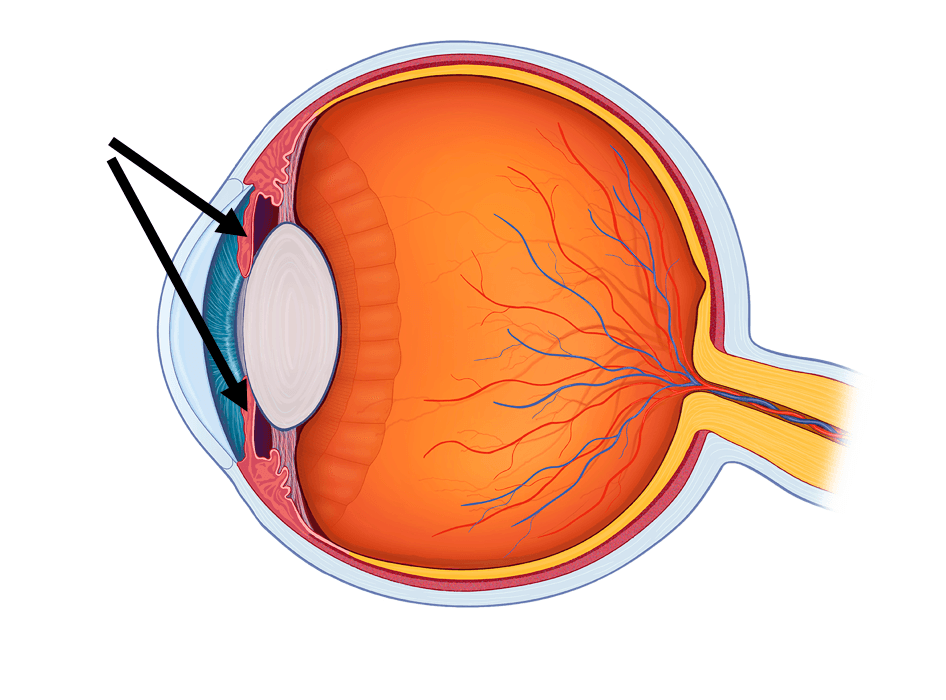
This part of the eye gives it its color. It can open and close to change the size of the pupil.
Cornea
Lens
Iris
Retina
What is myopia
Long sightedness - things which are close up to appear blurred.
Short sightedness - distant objects will appear blurred.
What is hyperopia
Long sightedness - things which are close up to appear blurred.
Short sightedness - distant objects will appear blurred.

