
NEW
Font size
 Worksheets
P2 Earth and Beyond
Total questions: 28
Worksheet time: 17mins
The imaginary lines drawn through the North and South poles of the Earth is called…
axis
orbits
space
Arctic
The closest star to the Earth is…
star
the Moon
the Sun
asteroids

A collection of large group of stars are called
universe
galaxies
Andromeda
Milky Way
Mercury, Venus, Earth, Mars, Jupiter, Saturn, Uranus, Neptune
Mars, Venus, Earth, Mercury, Jupiter, Saturn, Uranus, Neptune
Neptune, Uranus, Saturn, Jupiter, Mars, Earth, Venus, Mercury
Mercury, Venus, Earth, Mars, Neptune, Saturn, Jupiter, Uranus
A pattern of stars, named after mythological or religious figure, an object, or an animal is called
galaxy
star
constellation
planet
Why does the moon appear to shine?
It is like a star and gives off light
It refracts light from the Sun
It reflects light from the Sun
It absorbs light from the Sun
Which of the following statements is correct?
The moon changes in shape
The Earth spins about its axis
The Sun orbits around the Earth
The Earth revolves around the Moon
How long does it take for the earth to make one complete rotation?
24 hours
30 days
28 days
365 days
Which of the following is caused by the spinning/rotation of the earth on its axis?
a year
the cycle of day and night
a leap year every 4 years
season changes
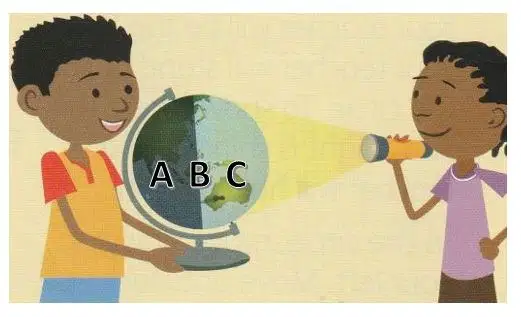
Which part of the Earth has daylight?
A
B
C
all answers are correct
A planet is a very large object that orbits a star in space. An example of planet is .....
Sun
Moon
Comets
Saturn
Astronomers can observe distant stars and galaxies with much more detail using .....
telescopes
microscopes
stethoscopes
endoscopes
It is a collection of the sun and all the other objects that orbit around it.
Earth
Planets
Solar System
Constellations

What is the largest planet?
Saturn
Uranus
Jupiter
Neptune

What is the name of our galaxy?
Milky Shake
Milky Path
Milky Way
Milk Shake
Is the Sun is a Planet?
Yes
No

What is the meaning of orbit?
A center line that an object spins around.
The path Earth takes around the Sun.
The Moon's shape as we see it from Earth.
An object in space made of hot, glowing gases.
How long does it take for the Earth to revolves around the Sun ?
24 hours
365 days
People who explore space are called .....
scientists
professors
astronauts

The changing of the shape of the moon each night is called ________________
Moon Series
Moon Phases
Moon Changes
Moon Seasons

The Earth rotates ...
clockwise
anticlockwise
It is ____ when our part of the Earth faces the sun.
day
night
It is _____ when our part of the Earth faces away from the sun.
day
night
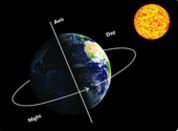
When are shadows the longest?
Morning and evening
Noon
Night

Where will the tree's shadow be?
A
B
C

