Worksheets
Quiz 1: Kinematic Motion
Total questions: 20
Worksheet time: 38mins
Match each term with its formal physics definition
Position
The location of an object relative to its starting location
Velocity
The rate of change of position
Acceleration
The rate of change of velocity
Distance
How far an object has traveled along its path
Displacement
The change in an object's position
At the top of a projectile's path, its vertical velocity is:
Positive
Zero
Negative
A cat starts running across the room. She starts from rest, and reaches her top speed of 12 m/s in 0.4 seconds. What is the cat's acceleration? [include units; write seconds squared as s2]
(a)
Usain Bolt's world record is 100m in 9.69 seconds, set at the Beijing Olympics. What was his average velocity while running this race? [Round to two decimal places, include units]
(a)
A car pulls onto the highway. It accelerates at 2 m/s2, merges over a distance of 100 m, and ends with a velocity of 28 m/s. What was its initial velocity? (Round to two decimal places and use correct units.)
(a)
On the d vs t graph below, circle areas of positive acceleration in green, zero acceleration in yellow, and negative acceleration in red

A projectile is launched with an initial velocity of 10 m/s at an angle of 40 degrees above the horizontal. What is its initial y-velocity? (Round to two decimal places, include units)
(a)
A projectile is launched with an initial vertical velocity (y-component) of 6 m/s. How long will it take to hit the ground? (Use g=9.81 m/s2, round your answer to 2 decimals, and include units)
(a)
A projectile is launched with an initial horizontal velocity of 4 m/s. It hits the ground 3 seconds later. What is its range?
(a)
A projectile is launched with an initial velocity of 12 m/s at an angle of 60 degrees above the horizontal. How far away does it land?
(Hint: resolve your vector into its components, find the time in the air, then find the range).
Round your answer to two decimals, and include units!
(a)
*A car accelerates uniformly from rest at 3.2 m/s2. When the car has traveled a distance of 40. m, its speed will be
8.0 m/s
12.5 m/s
16 m/s
128 m/s
*How long will it take a running horse to travel 260 m and attain a speed of 12 m/s from rest?
1200 seconds
1.2 hours
43 minutes
43 seconds
*An object with an initial velocity of 3.50 m/s moves east along a straight and level path. The object then undergoes a constant acceleration of 1.80 m/s2 east for a period of 5.00 s. How far does the object move while it is accelerating?
6.30 m
17.5 m
27.2 m
40.0 m

*A dog basks in the sun when he sees a squirrel and bolts after it. If the dog accelerates at +1.6 m/s/s, how far does he run in 3 seconds?
4.8 meters
45 meters
1.6 meters
7.2 meters
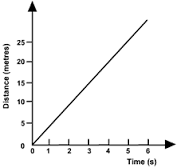
What is this graph showing?
The object is moving away from starting point at a constant speed
The object is moving back towards the starting point at a constant speed
The object is increasing its velocity
The object is decreasing its velocity
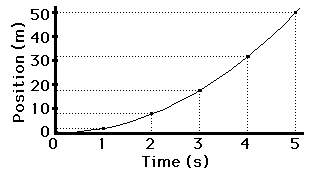
The picture of the position vs. time graph shows an object that is...
speeding up
moving at a constant speed
not moving
slowing down.

Which best describes this motion in the graph?
stopped, walking, running home
running, walking, stopped, walking home
walking, stopped, walking, running home
walking, running, running, stopped

Which segment shows the faster speed?
A to B
C to D
B to C
E to F