
 Worksheets
5th Science - Unit 01 - 5.5a
Total questions: 173
Worksheet time: 4hrs 34mins

Student measured 100ml of water and poured it inside a beaker. The teacher then asked the students to place 50 ml of water in the freezer and 50 ml of water in a hotplate for 20 minutes. What did the students most likely observe after 20 minutes
The water in the freezer became a solid while the water on the hotplate evaporated
The water in the freezer stayed a liquid, while the water on the hotplate was boiling
The water in the freezer "disappeared: while the water in the hotplate stayed a liquid
Both the water in the freezer and the hotplate keep the same state of matter

The picture below shows a balanced scale using a box and a mystery object. Students are investigating using this balance what are they trying to measure
Volume
Size of the box
Density
Mass

A child took a container of ice cream out of a freezer and placed it on a counter for an hour. Which statement equation shows what happened to the ice cream?
Liquid- Heat = Solid
Solid + Heat = Liquid
Liquid + Heat = Gas
Solid - Heat = Gas

The diagram above shows one container with oil and water and another with oil and a cork. Which diagram below shows what most likely would happen if oil, water, and the cork were all put in the same container?


Which of the following is a good conductor of electricity?
glass rod
cotton string
plastic tubing
copper penny

A student reads the label on the salad dressing above. Why would the students shake the salad dressing well before using it?
Vinegar and oil have different densities
Vinegar and oil easily form a solution
Vinegar and oil both contain water
Vinegar and oil are both liquids

5 Jars with 92* C water are set up with thermometers. 4 jars are wrapped equally with different material. One jar is kept unwrapped as a control. After 10 minutes the temperature is checked and noted in the above chart. Which property of the material is most likely being tested?
state of matter
Thermal energy insulation
Thermal energy production
ability to conduct electricity

What is the difference in grams between the total mass of the liquid substances and the total mass of the solid substances in the above chart?
298
130
168
428

A student classifies the above objects shown based on their physical properties. Which property cannot be used to classify these objects into more than one group?
Magnatism
Mass
Electrical Conductivity
Solubility in water

A teacher dropped a bolt into a container of maple syrup and asked the students to remove it without touching the maple syrup. At first they used a strong magnet but the bolt would not move. They finally poured the maple syrup into another container to get the bolt out. Which of these best describes some of the bolt's properties?
The bolt is magnetic and has the same density as the syrup
The bolt is nonmagnetic and more dense than the maple syrup
The bolt is nonmagnetic and less dense than the syrup
The bolt is magnetic and less dense than the maple syrup
Which physical property is used to identify the ability to dissolve?
Conductivity
Magnetism
Solubility
Density

1 solid, 1 liquid, 2 gases
2 solids, 1 liquid, 1 gas
1 solid, 2 liquids, 1 gas
2 solids, 2 liquids, 0 gases
Which method could be used to classify objects by the property of density?
Mix blue and red food coloring with water
Dissolve sugar and salt in water
Place solid objects in water
None of the above

2,003 grams
320 grams
302 grams
23 grams
A student conducts an investigation to learn how materials conduct energy. The student places a wooden spoon and a metal spoon in identical, separate containers of hot water. Then, the student takes the temperature of the water in each container to make sure both are the same temperature. What is the variable in the student’s investigation? 5.2(A)
Temperature of the water
Type of container
Length of time the student leaves the spoons in the water
Type of spoon
The mass of a rock is measured with a balance. The rock is then broken into many smaller pieces and the total mass of all the pieces is measured again. Which of the following sentences about the mass is TRUE?
The mass of the rock will be greater than the total mass of the smaller pieces.
The mass of the rock will be less than the total mass of the smaller pieces.
The mass of the rock will be same as the total mass of the smaller pieces.
The mass of the rock will not be the same as the total mass of the smaller pieces.
The mass of a rock is measured with a balance. The rock is then broken into many smaller pieces and the total mass of all the pieces is measured again. Which of the following sentences about the mass is TRUE?
The mass of the rock will be greater than the total mass of the smaller pieces.
The mass of the rock will be less than the total mass of the smaller pieces.
The mass of the rock will be same as the total mass of the smaller pieces.
The mass of the rock will not be the same as the total mass of the smaller pieces.
A glass marble and a piece of cork of the same shape and size are dropped in water. Which of the following explains correctly why the glass marble sinks while the cork piece floats on water?
The glass marble is denser than water while the cork is less dense than water.
The glass marble is less dense than water while the cork is denser than water.
The glass marble and the cork are both denser than water.
The glass marble and the cork are both less dense than water.
All of the following objects are attracted to magnets EXCEPT _________.
Iron nail
Plastic button
Steel scissors
Iron screw
The same quantity of sugar and sand are added to a glass of water and stirred. After some time the sugar particles cannot be seen while sand particles settle down. Based on the observations, which of the following statements is TRUE?
Sugar is soluble in water while sand is not.
Sand is soluble in water while sugar is not.
Both sugar and sand are soluble in water.
Both sugar and sand are not soluble in water.
Which of these objects is an insulator?
Copper Wire
Oven Mitt
Paper Clip
Soda Can

Which of the following best represents the three states of matter?
Picture A
Picture B
Picture C
Picture D

Identify which item below best completes the table.
Glass Window
Gold Ring
Paper Bag
Styrofoam Cup
A magnet would be attracted to which item?
Plastic bottle sprayer
Refrigerator
Wooden table
Aluminum bat
A student completes an investigation, where sand and water are mixed together. The student needs to separate the sand from the water. Which of the following procedures should the student follow?
Pour the mixture through a funnel to separate the sand from the water.
Pour the mixture through a paper filter to separate the sand, and allow the water to flow through to another container.
Pour the mixture into a glass, and use your hand to separate the sand from the water.
Pour the mixture into a bowl, and dip all the water out with a spoon.
A student mixes together iron filings, sand, salt, gravel, and water. Which ingredients will keep all their physical properties after being mixed?
Iron filings, sand, and gravel
Iron filings, sand, and salt
Sand, gravel, and salt
Sand, salt, and water
Which of these is NOT a mixture?
Hamburger
Kool-Aid
Fruit Salad
Taco
What would be the best way to separate the trail mix?
Put the trail mix in a container and pour water on it.
Drag a magnet over the trail mix to take apart the items.
Place the trail mix in a pan and place it in the Sun.
Use a utensil to physically separate the trail mix.
All of the following science tools can be used to separate a mixture, except _________.
a camera
a stove
a filter paper
tweezers
The diagram above shows one container with oil and water and another with oil and a cork. Which diagram below shows what most likely would happen if oil, water, and the cork were all put in the same container?
Which of the following is a good conductor of electricity?
glass rod
cotton string
plastic tubing
copper penny
A teacher mixes a white powder into a beaker of water. The powder cannot be seen in the water. The teacher then heats up the water until it evaporates and the powder can be seen again. Which of the property of the powder is the teacher demonstrating?
solubility
Density
Conductivity
Mass
5 Jars with 92* C water are set up with thermometers. 4 jars are wrapped equally with different material. One jar is kept unwrapped as a control. After 10 minutes the temperature is checked and noted in the above chart. Which property of the material is most likely being tested?
state of matter
Thermal energy insulation
Thermal energy production
ability to conduct electricity
A student reads the label on the salad dressing above. Why would the students shake the salad dressing well before using it?
Vinegar and oil have different densities
Vinegar and oil easily form a solution
Vinegar and oil both contain water
Vinegar and oil are both liquids
What is the difference in grams between the total mass of the liquid substances and the total mass of the solid substances in the above chart?
298
130
168
428
A teacher wears protective gloves to lift a metal pan filled with boiling water from a hot plate. Why are the protective gloves necessary?
The metal pan creates thermal energy.
the metal pan insulates thermal energy.
The metal pan conducts thermal energy.
The metal pan reduces thermal energy.
Objects that blow into a swimming pool or that are dropped into the pool by swimmers need to be removed. The objects include foam cups, keys, and coins. Which of the following explains a useful method for removing some of the objects?
The keys and coins are less dense than water, so they can easily picked off the bottom of the pool by divers.
The foam cups have the same density as water, so they can be crumbled up for removal by the pool filter
The foam cups are less dense than water, so they can be removed from the surface with a pool cleaning net.
The keys and coins have the same density as water, so they can be washed away when the pool is drained.

A cook uses the ingredients listed above. Which table below shows the physical properties of these ingredients when placed in hot water?


A teacher gives a student 4 clear sealed containers. Each container holds a different substance. The students record their observations about each substance. Based on these observations, which container most likely holds only gas?
Container 1
Container 2
Container 3
Container 4

Some students investigate the properties of matter of four objects using a hand lens, a magnet, and a beaker containing water. Their observations are recorded on the table. Which statement identifies a property that could be used to classify these objects into two different groups?
Density can be used to separate objects that sink in water from objects that don't.
Magnetism can be used to separate objects that are attracted to magnets from objects that are not.
Solubility can be used to separate objects that dissolve in water from objects that do not.
Physical state can be used to separate objects that are solid from objects that are not.
A student classifies the above objects shown based on their physical properties. Which property cannot be used to classify these objects into more than one group?
Magnatism
Mass
Electrical Conductivity
Solubility in water

A science class tested 3 properties of different materials. The results are shown in the table above. Based on the table, which material would be best to use to insulate electrical wire?
wood
plastic
copper
steel
Two wires carrying electricity can create a spark if they come too close together. This spark can start a fire. Wires carrying electricity are usually covered with plastic to keep them from starting a fire. Why does the plastic keep the electricity from starting the fire?
Plastic is a good insulator
Plastic can melt when heated
Plastic is softer that wire
Plastic conducts electricity

A student has puts 4 objects in a bucket filled with water. The objects are listed above. Which two objects are most likely less dense than water?
Wood block and metal paper clip
plastic ball and glass marble
metal paper clip and glass marble
wood block and plastic ball

A student compared the mass of 4 blocks of the same size but different material. He used a balance to compare the masses of two blocks at a time. He repeated this process 3 times with different pair of blocks and recorded observations. Which list shows the blocks in order from least to greatest?
Blocks in N, M, L, P
Blocks in P, M, L, N
Blocks in N, L, M, P
Blocks in P, L, M, N.

The table lists some properties of 4 different samples of matter. Which two samples could be glass and saltwater?
Sample 1 and 2
Sample 3 and 4
Sample 1 and 3
Sample 2 and 3
Which of these is NOT soluble in water?
oil
salt
honey
sugar

A student is asked to design a sleeve for a cup that will insulate thermal energy and not feel hot to the touch when the cup is filled with liquid. The students has 4 materials to choose from. Which of these materials is least useful as an insulator?
cardboard
aluminum
rubber
plastic
A teacher dropped a bolt into a container of maple syrup and asked the students to remove it without touching the maple syrup. At first they used a strong magnet but the bolt would not move. They finally poured the maple syrup into another container to get the bolt out. Which of these best describes some of the bolt's properties?
The bolt is magnetic and has the same density as the syrup
The bolt is nonmagnetic and more dense than the maple syrup
The bolt is nonmagnetic and less dense than the syrup
The bolt is magnetic and less dense than the maple syrup
Which of the following is the correct definition of mass?
A force that acts on all objects at all times
The measure of how much matter is in an object
The weight of an object on a scale
The amount of space an object takes up
Which substance below is soluble when mixed with water?
Sugar
Sand
Oil
Iron filings
Which of the objects listed below is attracted to a magnet?
Silver spoon
Gold earring
Lead fishing sinker
Cast iron pot
What unit of measurement is used for mass in science class?
Meters (m)
Grams (g)
Kelvins (K)
Liters (L)

The picture below is a model of which physical state?
Solid
Liquid
Gas
Plasma
Which list below contains all solid materials?
Crayon, paper, grape juice and pencil
Stapler, water, chair and paper
Chair, crayon, stapler and paper
Pencil, paper, grape juice and water
Which of the objects shown below will float when placed in a bucket of water?
Paperclip
Penny
Pencil
Marble

A student drops a metal bolt into a container of maple syrup and it sinks to the bottom. Why does the metal bolt sink?
The metal bolt is more dense than maple syrup.
The metal bolt is less dense than water.
The metal bolt is more dense than water.
The metal bolt is less dense than maple syrup.
Which of the materials below is the best conductor of thermal and electric energy?
Rubber
Cardboard
Plastic
Aluminum
If something is soluble in water, then it will –
dissolve, but only if the water is heated to the boiling point
not dissolve at all when placed in water
not mix with the water and sit on top
completely dissolve when mixed with water
Which of these is the best conductor of electricity? (5.5A)
Glass rod
Cotton string
Plastic tubing
Copper penny
A teacher mixes a white powder into a beaker of water. The powder cannot be seen in the water. The teacher then heats the mixture until the water evaporates and the powder can be seen again. Which property of the powder is the teacher demonstrating? (5.5A)
Solubility
Relative density
Conductivity
Mass

A teacher sets up an experiment using five jars. The teacher keeps one jar unwrapped, and the other four jars are wrapped with equal thicknesses of four different materials. Which property of the materials wrapping the jars are the students most likely investigating? (5.5A)
State of matter
Thermal energy insulation
Thermal energy production
Ability to conduct electricity

A student reads the label on the bottle of salad dressing shown here. Why would the student shake the salad dressing well before using it? (5.5A)
Vinegar and oil have different densities.
Vinegar and oil easily form a solution.
Vinegar and oil both contain water.
Vinegar and oil are both liquids.
Objects that blow into a swimming pool or that are dropped into the pool by swimmers need to be removed. These objects include foam cups, keys, and coins. Which of the following explains a useful method for removing some of these objects? (5.5A)
The keys and coins are less dense than water, so they can be easily picked up off the bottom of the pool by divers.
The foam cups have the same density as water, so they can crumbled up for removal by the pool filter.
The foam cups are less dense than water, so they can be removed from the surface with a pool cleaning net.
The keys and coins have the same density as water, so they can washed away when the pool is drained.

A cook uses the ingredients listed to prepare a meal. Which table correctly show the physical properties of these ingredients when placed in hot water? (5.5A)


A teacher gives a student four clear sealed containers. Each container holds a different substance. The student records some observations about the substance in each container. Based on these observations, which container most likely holds only gas? (5.5A)
Container 1
Container 2
Container 3
Container 4

Some students investigate the properties of four objects using a hand lens, a magnet, and a beaker containing water. Their observations are recorded in the table. Which statement identifies a property that could be used to classify these objects into two different groups? (5.5A)
Density can be used to separate objects that sink in water from objects that do not.
Magnetism can be used to separate objects that are attracted by a magnet from objects that are not.
Solubility can be used to separate objects that dissolve in water from objects that do not.
Physical state can be used to separate objects that are solids from objects that are not.

A student classifies the objects shown based on their physical properties. Which property cannot be used to classify these objects into more than one group? (5.5A)
Magnetism
Mass
Electrical conductivity
Solubility in water

A science class tested three properties of different materials. The results are shown in the table. Based on the table, which material would be best to use to insulate electrical wires? (5.5A)
Wood
Plastic
Copper
Steel
Two wires carrying electricity can create a spark if they come too close together. This spark can start a fire. Wires carrying electricity are usually covered with plastic to keep them from starting a fire. Why does the plastic keep the electricity from starting a fire? (5.5A)
Plastic is a good insulator.
Plastic can melt when heated.
Plastic is softer than wire.
Plastic conducts electricity.

A student puts four objects in a bucket filled with water. Which two objects are most likely less dense than the water? (5.5A)
Wood block and metal paper clip
Plastic ball and glass marble
Metal paper clip and glass marble
Wood block and plastic ball

A student was asked to compare the masses of four blocks that were all the same size but made of different materials. The student used a balance to compare the masses of two blocks at a time. The student repeated this process three more times with different pairs of blocks and recorded observations. Which list shows the blocks in order from least to greatest mass? (5.5A)
Blocks N, M, L, P
Blocks P, M, L, N
Blocks N, L, M, P
Blocks P, L, M, N

The table lists some properties of four different samples of matter. Which two samples could be glass and saltwater? (5.5A)
Samples 1 and 2
Samples 3 and 4
Samples 1 and 3
Samples 2 and 3
Which of these is not soluble in water?
Oil
Salt
Honey
Sugar

A student is asked to design a sleeve for a cup that will insulate thermal energy and not feel hot to the touch when the cup is filled with hot liquid. The student has four materials to choose from. Which of these materials is least useful as an insulator? (5.5A)
Cardboard
Aluminum
Rubber
Plastic

For an investigation a teacher dropped a bolt into a container of maple syrup and asked students to remove it without touching the syrup. The students first tried to use a strong magnet to remove the bolt, but it remained on the bottom of the container. They finally poured the syrup into another container to get the bolt out. Which of these best describes some of the bolt's physical properties? (5.5A)
The bolt is magnetic and has the same density as the maple syrup.
The bolt is nonmagnetic and more dense than the maple syrup.
The bolt is nonmagnetic and less dense than the maple syrup.
The bolt is magnetic and less dense than the maple syrup.

The table lists some physical properties of two objects. Based on their properties, which of the objects is most likely a metal? (5.5A)
Object 1, because it is a solid that is less dense than water
Object 2, because all metals float in water
Object 2, because metals conduct thermal energy and electricity
Object 1, because it can be used to provide insulation for thermal energy.

Students are investigating properties of objects. They observe four objects and record observations for each object in the table. Based on the students' observations, which of these tables properly identifies the objects? (5.5A)


A student measured out 10 mL of four clear liquids and added one drop of a different-colored dye to each liquid. One of the liquids was water. The student then carefully poured each liquid into a graduated cylinder and let the mixture settle for 30 minutes. The student observed that the liquids had separated into layers, as shown in the diagram. Which of these procedures would help the student identify the layer of water? (5.5A)
Stir the liquids, let them settle, and then identify the bottom layer as water
Drop a piece of ice into the graduated cylinder, let the ice settle, and then identify the layer just above the ice as water
Add water to the graduated cylinder, let the mixture settle, and then identify the layer that increases in volume as water
Carefully pour each layer into separate plastic containers, place the containers in a freezer, and then identify the liquid that takes the longest to freeze as water.
When an ice cube melts, what change in phase occurs?
a liquid becomes a gas
a solid becomes a liquid
a solid becomes a gas
a gas becomes a liquid
This state of matter does not have a definite shape or size
gas
solid
liquid
milk
The amount of space something takes up
density
mass
volume
matter
Liquid matter takes the shape of ___________.
a gas
a pet
it's container
water

This does not allow energy to flow.
insulator
conductor

Electrical wires are usually covered in plastic to help prevent electrical fires. Why does the plastic cover prevent electrical fires?
Plastic conducts electricity.
Plastic produces electricity.
Plastic insulates electricity.
Plastic destroys electricity.

The picture below is a model of which physical state?
Solid
Liquid
Gas
Plasma

The properties of a mystery object are listed below:
The mystery object is most likely –
oil
lemon juice
maple syrup
sugar cube

The left side of the scale has a total mass of 275 grams. The right side has a total mass of 250 grams. What is the easiest way to balance the scale?
Move the 25 g weight from the left side to the right side.
Remove the 25 g weight from the left side.
Remove the 50 g weight from the left side.
There is no way to balance the scale.
A teacher has 8 identical wooden cubes at the front of the classroom. One cube has a mass of 6 grams. What is the total mass of all 8 cubes?
6 grams
40 grams
48 grams
64 grams
In science class, the teacher uses tongs to safely remove a beaker from a hot water bath. This is because –
the glass beaker conducts electrical energy
the glass beaker insulates electrical energy
the glass beaker conducts thermal energy
the glass beaker insulates thermal energy
Which of the following is the correct definition of magnetism?
An invisible force that causes two items to become sticky
An invisible force that pulls certain substances towards a magnet
An invisible force that exists between all metals
An invisible force that causes the north pole of one magnet to pull towards the north pole of another magnet
Which of the following is soluble in water?
Sand
Oil
Pepper
Honey
Which of the objects shown below will sink when placed in a bucket of water?
Cork
Paper Boat
Keys
Plastic Cup


Cindy poured a packet of lemon powder into a pitcher of cold water. Cindy stirred the contents together. Which property of the powder was she demonstrating?
density
conductivity
solubility
mass
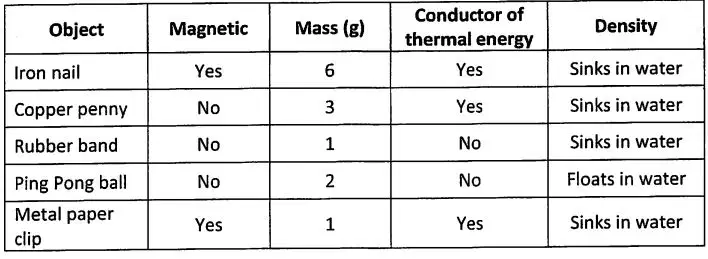
The physical characteristics of five items are shown in the table. Which property would divide the objects into four groups?
magnetism
mass
conductivity
density
Sammy wants to make a wave model. He knows cooking oil is less dense than water. He also knows blued food coloring will dissolve in water but not in the oil. Which diagram shows this information correctly?


Materials are available for a science experiment. Students are to build a circuit that will turn on a light bulb. Which group of available materials can be used to build a working circuit?
pencil, lightbulb, battery
rubber band, battery, copper wire
straw, eraser, lightbulb
copper wire, battery, lightbulb
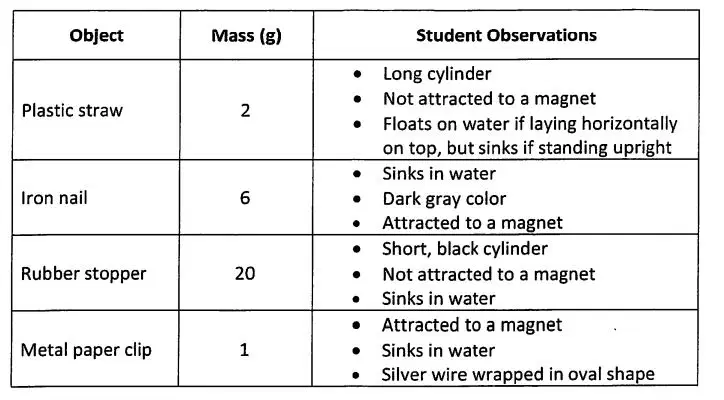
Students were asked to make observations about several objects using a triple beam balance, a magnet and a container of water. The observations were recorded on the table shown.
Which statement is true if students wish to sort the objects into exactly two groups?
Magnetism can be used because not all the objects were attracted to a magnet.
Mass can be used since all measurements are less than 25 grams.
Density can be used because all the objects sink in water.
Shape, color, and state of matter can be used because all of the objects are solids and have a different appearance.
Which table shows the correct physical properties for all items in the list?


vinegar
iron filings
The diagram above shows one container with oil and water and another with oil and a cork. Which diagram below shows what most likely would happen if oil, water, and the cork were all put in the same container?
Objects that blow into a swimming pool or that are dropped into the pool by swimmers need to be removed. The objects include foam cups, keys, and coins. Which of the following explains a useful method for removing some of the objects?
The keys and coins are less dense than water, so they can easily picked off the bottom of the pool by divers.
The foam cups have the same density as water, so they can be crumbled up for removal by the pool filter
The foam cups are less dense than water, so they can be removed from the surface with a pool cleaning net.
The keys and coins have the same density as water, so they can be washed away when the pool is drained.
A student has puts 4 objects in a bucket filled with water. The objects are listed above. Which two objects are most likely less dense than water?
Wood block and metal paper clip
plastic ball and glass marble
metal paper clip and glass marble
wood block and plastic ball
A teacher dropped a bolt into a container of maple syrup and asked the students to remove it without touching the maple syrup. At first they used a strong magnet but the bolt would not move. They finally poured the maple syrup into another container to get the bolt out. Which of these best describes some of the bolt's properties?
The bolt is magnetic and has the same density as the syrup
The bolt is nonmagnetic and more dense than the maple syrup
The bolt is nonmagnetic and less dense than the syrup
The bolt is magnetic and less dense than the maple syrup


A student measures the mass of several substances and records the results in the table below. What is the difference in grams between the total mass of the liquid substances and the total mass of the solid substances used in the investigation?
(a)


Which of these materials would be good insulators of electricity?
Select Two correct answers.
Gold
Glass
Silver
Wood
Iron
A material that has definite volume but no definite shape is classified as a
Solid
liquid
gas
not here
Which physical property is measured rather than tested?
Floating in water
Solubility
Magnetism
Mass
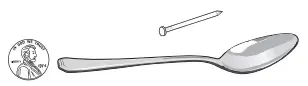
The objects have all of the following properties in common EXCEPT-
they all conduct electricity
they all sink in water
they are all magnetic
they are all solids
Students drop objects into a tank of water. Which objects are less dense than water? Select Two correct answers.


Which substance is NOT soluble in water?
Powdered drink mix
Sugar
Salt
Sand
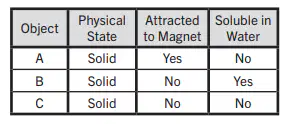
During a science investigation, a student determined how objects could be classified. Based on the properties, which of the following materials has the same physical properties as Object B?
Iron Nail
Salt
Sand
Penny
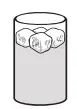
What evidence in the picture proves ice has less density than water?
The water has more buoyancy than the ice cubes.
The ice cubes are floating in the water.
The ice cubes are resting at the bottom of the glass.
The ice cubes are melting and becoming a liquid.
After performing a lab investigation about solubility, what is an appropriate choice for conserving resources?
Throw dirty beakers in the trash
Wash and store beakers for future use
Save any unused food products to eat
Leave all lab materials for other group members to put away
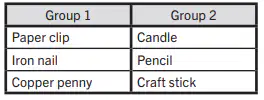
The table shows how a student sorted objects by properties.
Which physical property do the objects in Group 1 have in common?
Correctly place the liquids in order by density.
Correctly label the liquids and solid by density.
Correctly label the most dense and least dense materials.