
 Worksheets
Summer School Science
Total questions: 24
Worksheet time: 15mins
Mutations can be both harmful and helpful. Indicate which of these can be caused by a genetic mutation.
chicken pox
cystic fibrosis
AIDS
influenza
A cross between a male horse and female donkey results in the reproduction of a mule, which does not resemble either of the parents. What is the reason for this?
The genetic code of the mule is different from the parents due to asexual reproduction.
The genetic code of the mule is similar to the parents due to sexual reproduction.
The genetic code of the mule is different from the parents due to sexual reproduction.
The genetic code of the mule is similar to the parents due to asexual reproduction.
Plant and animal cells make exact copies through the process of
segmentation.
oxidation.
interactive replacement.
mitosis.
Changes in a DNA sequence that affect genetic information are known as
hybridizations.
intercalations.
mutations.
expressions.

(a) is the basic unit of heredity; many of them contain the code for a specific proteins. Each (b) contains many (c) . Drag and drop to fill in the blanks.
The sequence of ________________ in a DNA molecule determines the protein that will be produced.
sugars
lipids
nucleotides
proteins
Changes in the DNA sequence, or mutations, help drive
evolutionary change.
deamination events.
environmental interaction.
amino acid coding.
All of the statements EXCEPT one are true about mutations. Which statement is false?
Mutations can be positive and produce organisms with improved traits.
Mutations can be fatal to the organism that has a mutation, if the mutation is in a critical gene.
Mutations can be silent, and not affect the organism that has them, if the mutation is in a non-critical area.
Mutations must be present in parents and then passed to offspring.
Disorders, such as sickle cell anemia, are the result of mutations of the
chromosomes.
heart
brain.
nucleolus.
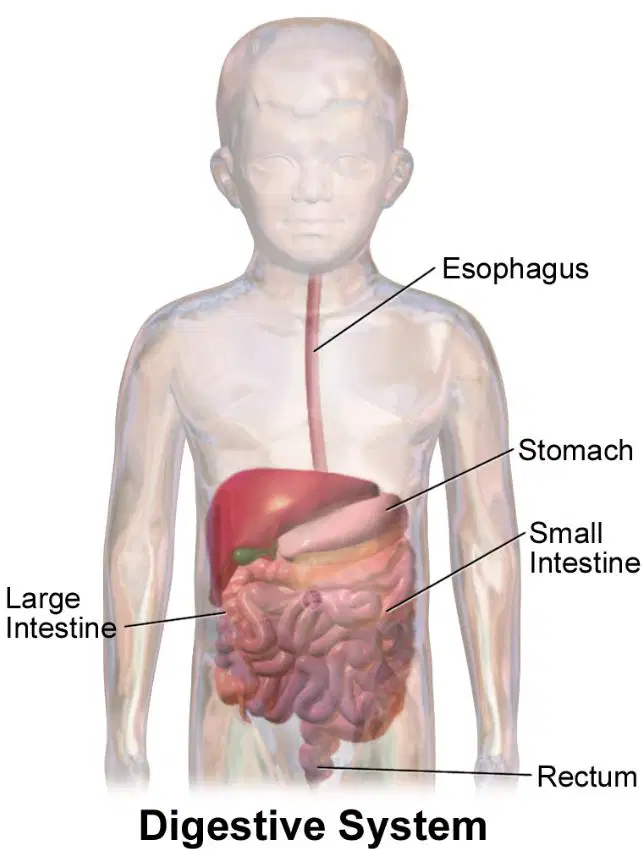
Digestive enzymes in your stomach and intestines help digest the food you eat. If you are lactose intolerant and cannot digest milk products, it is the result of a mutated message in your
lysosomes.
chromosomes.
X or Y chromosomes.
nucleolus.

A _______ is a segment of a chromosome that codes for a specific protein.
amino acid
nucleotide
gene
codon
A woman who has sickle cell anemia passes this disease on to her offspring. This means that the mutation for sickle cell anemia MUST occur in the woman’s
gametes.
somatic cells.
blood cells.
reproductive organs.
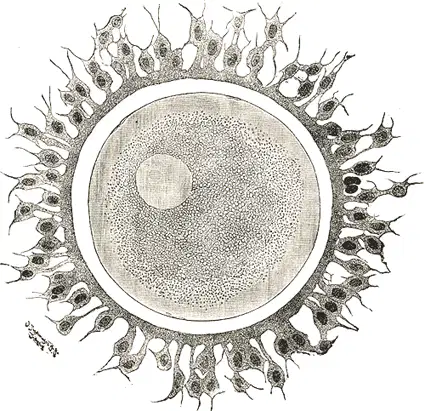
The illustration shown is an ovum, a female sex cell. A mutation in this cell may be passed to the woman’s offspring during
mitosis.
DNA replication.
birth.
sexual reproduction.
How are genetic mutations passed from parent to offspring?
Sex cells divide to create new cells.
Genetic mutations occur during DNA replication.
Mutated gametes (sex cells) fuse to create offspring.
Genetic mutations only occur during meiosis, never mitosis.

Look at the illustration. What type of reproduction is illustrated.
(a)
African elephants are being killed for their ivory tusks. As a result, the elephant populations are becoming reduced in size, Recently, elephants on an African reserve are being born tuskless, and lack the tusks even as adults. Which statements are supported by the description here? Select ALL that apply.
The elephants are being selectively bred to have fewer tusks so that they require less land on the reserve.
The elephants needed to be tuskless, so they lost their tusks in order to survive.
Those elephants without tusks may be more likely to survive and reproduce.
The lack of tusks is an advantage to the organism when poaching is common.
A DNA mutation caused the elephants to be born tuskless.
A ___________ chain is a sequence of amino acids that is the foundation for the basic structure of a protein.
polysaccharide
polynomial
polypeptide
polyunsaturated
Transcription translation errors often result in physical, or ___________, changes in an organism.
genotypic
chemical
phenotypic
carbohydrate
Which situation would probably NOT result in the formation of new species?
Isolation of a population of lizards on an island, which later becomes too distant from the mainland for other lizards to swim to the island.
The introduction of a predatory fish that only eats the largest native bass in a Georgia lake.
A mutation that causes a purple color form to appear in peacock males, which the peahen females seem to either strongly like or dislike.
A period of stable weather conditions that lasts for hundreds of years, allowing a species of grass to do well.
A segment of DNA that codes for the ability to make one type of protein molecule is known as a(n)____________________.
intron
codon
axon
gene
The instructions for making proteins come originally from
ribosomes.
RNA.
amino acids.
DNA.
Cystic fibrosis is an inherited disease. It is associated with a specific gene located on chromosome #7. Imagine that Barbara's mother has the gene for cystic fibrosis. Is there any chance that Barbara could have inherited the gene for the disease? Explain.
Yes. Barbara has definitely inherited the disease. If her mother has the chromosome for cystic fibrosis, then Barbara has inherited gene from her mother.
Yes. There is a chance. Copies of parental chromosomes are randomly passed to offspring through sex cells during sexual reproduction.
No. Although a gene is part of a chromosome, all chromosomes are not inherited by offspring.
No. Although egg and sperm contain chromosomes, they do not contain the chromosomes that cause disease.
In order for a population to survive, sexual reproduction must produce
more males than females.
more offspring that can survive and reproduce.
more females than males.
a large number of self-fertilized individuals.
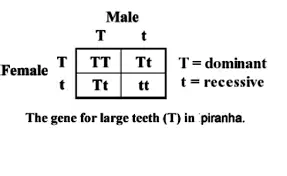
In the chart, the recessive trait is
small teeth.
sex-linked.
large teeth.
no teeth.

