
 Worksheets
Science - Term 4 - Revision
Total questions: 47
Worksheet time: 24mins
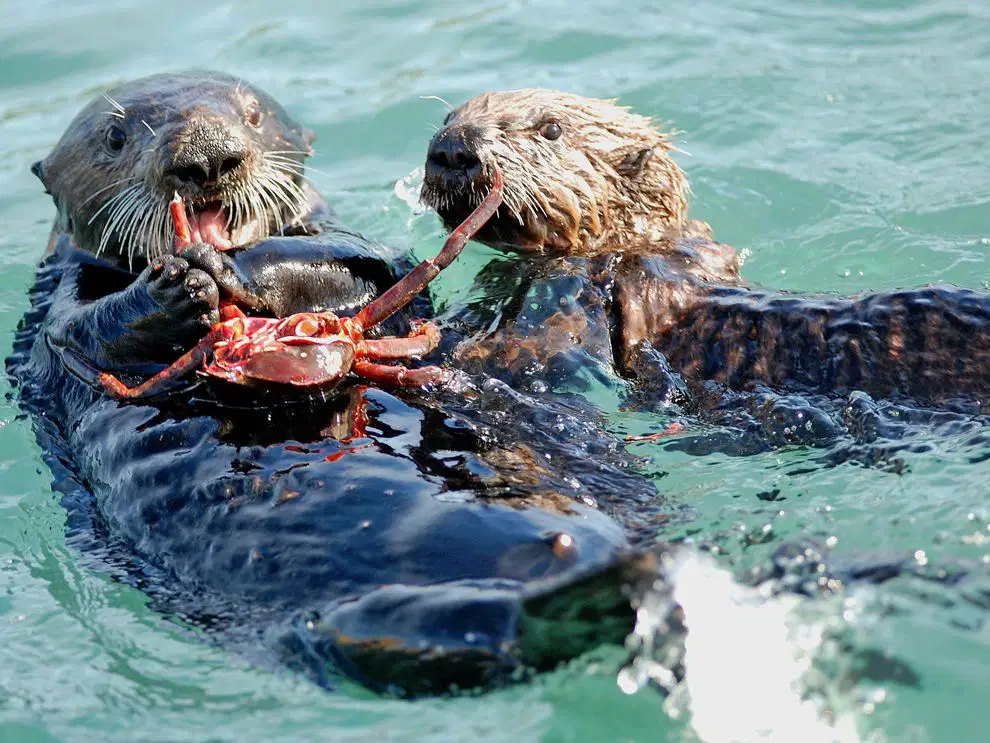
Use the photo of the Otter to answer the question
The abiotic factors in the Otter's ecosystem include
air and water
air, water, sunlight
kelp and crabs
water and kelp

A tree makes its own food using matter from the air and soil. A tree is a
decomposer
producer
consumer
producer and consumer
....................... is all the living and non living components in a particular area
ecosystem
interact
community
When two things ......................., they affect one another
fight
interact
hide
.......................... factors are the non-living parts of an ecosystem.
Abiotic
Biotic
.......................... factors are the living parts of an ecosystem.
Abiotic
Biotic
The components of the ecosystem do not interact


Abiotic Factors include air, water, rocks, soil, sunlight, and temperature
All the organisms living together in an ecosystem make up a community
Ecosystems can be any size. They can be as small as a drop of water or large as an entire forest.
An example of an interaction between biotic and abiotic factors in an ecosystem
The grasshopper eats the grass
The fish use water to swim
Organisms need ...................... to grow, reproduce, and repair damaged body parts
matter
energy
..................... is an organism that makes its own food using non-food matter and energy from the sun.
Producers
Decomposers
Consumers
..................... are organisms that breakdown or decompose other organism's bodies after they die.
Producers
Decomposers
Consumers
..................... are organisms that can not produce their own food and must eat other organisms.
Producers
Decomposers
Consumers
..................... are tiny animals that eats even smaller producers.
Zooplankton
Phytoplankton
......................... and ......................... are organisms that are too small to see
Microbes
Bacteria
Earthworms
Flies
..................... are microscopic organisms.
Zooplankton
Phytoplankton
..................... shows how matter and energy flow from one organism to another.
Food chain
Food web
To get a better picture of the feeding relationships in an ecosystem, use ........................
Food chain
Food web
Decomposers combine the wastes that animals produce.
Plants are producers.
Many decomposers are microbes
The large decomposers include bacteria and fungi
The too-small decomposers include earthworms and flies.
Some consumers eat only producers, some eat only other consumers, and some eat both.
A food chain is a good tool for describing the transfer or movement of matter and energy in an ecosystem.
A food web is a set of interconnected food chains.
Consumers always represent the 1st link in a food chain.
Ocean food chains usually begin with phytoplankton.
Zooplankton is the consumers in the ocean food chains.
Humans fill the role in some food chains.
The producers in the ocean food chain are phytoplankton.
The final link in a food chain can be an animal that is rarely in danger of being eaten.
All ecosystems consist of abiotic and biotic components that do not interact.
Changes to ecosystems differ in how they affect ecosystems.
..................... refers to a series of changes in a community.
Succession
Stable
Competition
A ..................... ecosystem can meet the needs of multiple species or kinds of organisms.
Succession
Stable
Competition
..................... occurs when organisms in an ecosystem need the same resources.
Succession
Stable
Competition
..................... succession is when plants and animals start living on new land.
Primary
Secondary
..................... succession is when plants and animals return to disturbed or damaged land.
Primary
Secondary
Stable means steady or changing.
In any ecosystem, organisms compete.
Competition is a problem unless something causes it to become unbalanced.
Eats-only producers are ............ and ..............
Green Sea Turtle
Mackerel
Zooplankton
Herring
Blue Whale
Eats-only consumers are ............, ............, ............, ............, ............, and ..............
Green Sea Turtle
Mackerel and Tiger shark
Seal and Squid
Herring
Blue Whale
Eats both ......................................
Green Sea Turtle
Mackerel and Tiger shark
Seal and Squid
Herring
Blue Whale

