
 Worksheets
SOCIAL STUDIES FINAL REVIEW
Total questions: 71
Worksheet time: 36mins
Which development led to the other three?
(1) United States troops fought a series of battles with Native American Indians.
(2) The buffalo population was greatly decreased.
(3) Gold was found in California
(4) Native American s were forced to move to reservations.
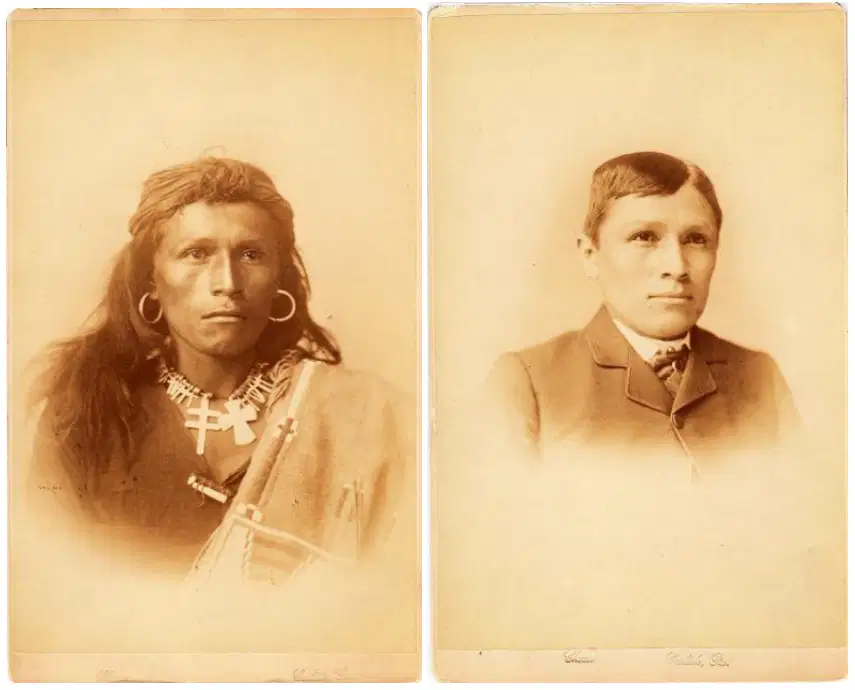
What would be the best use of the photo?
Source: Carlisle Indian School 1883
Learn the causes of the Indian Wars
Study the Impact of Westward Expansion
Outline the history of railroads
Impact of the Homestead Act
“Give me your tired, your poor,
Your huddled masses yearning to breathe free,
The wretched refuse of your teeming shore.
Send these, the homeless, tempest-tost, to me,
I lift my lamp beside the golden door!”
— Emma Lazarus
The main message of this poem was to
(1) encourage a back-to-Africa movement among freed slaves
(2) call for the imprisonment of illegal immigrants
(3) welcome new immigrants to the United States
(4) support the quota system placed on immigrants
Most immigrants settled in large cities because
(1) jobs were available in factories for unskilled workers
(2) farmland was too expensive
(3) There was more housing available
(4) They came from large cities in their home country
A nativist would most likely support
(1) passage of the Chinese Exclusion Act
(2) immigrants taking jobs in factories
(3)ending medical exams at Ellis Island
(4)immigrants settling in urban neighborhoods.
I am a polish man. I want be american citizen . . . But my friends are polish people—I must live with them—I work in the shoes-shop with polish people—I stay all the time with them—at home—in the shop—anywhere. I want live with american people, but I do not know anybody of american. I go 4 times to teacher, and must pay $2 weekly. I wanted take board [to live] in english house, but I could not, for I earn only $5 or 6 in a week, and when I pay teacher $2, I have only $4—$3— and now english board house is too dear [expensive] for me. Better job to get is hard for me, because I do not speak well english and I cannot understand what they say to me. The teacher teach me—but when I come home—I must speak polish and in the shop also. In this way I can live in your country many years—like my friends—and never speak—write well english—and never be good american citizen. . . .
The difficulties faced by this person describe
assimilation
racism
industrialization
urbanization
Blending in to a new nation, culture is know as
(1) integration
(2) assimilation
(3) Unification
Reasons that immigrants chose to come to the US were called
(1) Push Factors
(2) Pull Factors
In the late 1800s, rapid urbanization was mainly the result of the
(1) shortage of land for new farms
(2) federally funded city redevelopment projects
(3) impact of industrialization
(4) migration of formerly enslaved persons to the West
A major goal of the Sherman Antitrust Act was to
(1) prevent the formation of business monopolies
(2) limit imports from foreign nations
(3) set fair prices for manufactured goods
(4) protect consumers from dangerous products
An increase in the number of factories in the mid-1800s led to
(1) an increased dependence on products made in homes
(2) an increase in urbanization
(3) a decrease in levels of water and air pollution
(4) a reduction in immigration from Europe
Businesses formed trusts, pools, and monopolies mainly to
(1) increase profits by eliminating competition.
(2) offer a wide range of goods to consumers.
(3) provide jobs for minorities.
(4) protect the interests of workers.
Why did factory owners use child labor?
(1) Children could be paid less than adults.
(2) Children were more efficient workers.
(3) Children could read and write better than their parents.
(4) Families needed their children to have jobs.
Passage of the Pure Food and Drug Act and the Meat Inspection Act showed the government/s commitment to
(1) the environment
(2) free-enterprise
(3) business competition
(4) consumer protection
Muckrakers were writers and critics of the early 1900s who wanted to
(1) expose corruption and abuses in industry
(2) put an end to immigration
(3) prevent integration in cities
(4) shut down all factories and industries
Progressive Era writers such as Upton Sinclair and Ida Tarbell were called muckrakers because they
(1) exposed corruption in business and government
(2) based their writings on unsupported opinions
(3) were members of political machines
(4) supported changes in farming methods
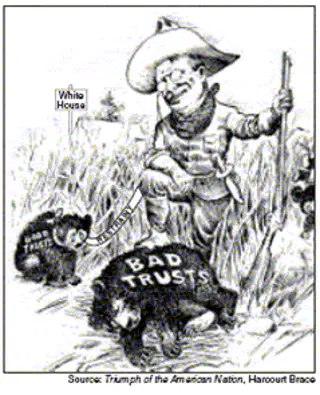
What view of Roosevelt’s in pictured above?
(1) All trusts and monopolies should be eliminated.
(2) National Parks should be created.
(3) The stock market should be controlled.
(4) Big business power should be limited.
Progressive Era reforms such as the initiative, referendum, and recall attempted to
(1) control big business.
(2) reestablish the system of checks and balances.
(3) increase the voting power of citizens.
(4) end the spoils system.
What was a direct result of Upton Sinclair’s novel, The Jungle?
(1) ratification of the woman’s suffrage amendment.
(2) passage of the Meat Inspection Act.
(3) creation of the National Forest Service.
(4) approval of the graduated income tax.
The primary goal of muckrakers was to
(1) change immigration patterns in the United States
(2) provide a greater variety of economic opportunities
(3) expose corruption in business and government
(4) fight racial discrimination and segregation
The Monroe Doctrine, the Roosevelt Corollary,
and the Good Neighbor policy all shaped United
States relations with
(1) Latin America
(2) the Middle East
(3) Asia
(4) Africa
“. . . You furnish the pictures; I’ll furnish the war.”
— William Randolph Hearst
(to war correspondent Frederic Remington)
Which cause of the Spanish-American War is most clearly shown by this statement?
(1) imperialism
(2) militarism
(3) political ambition
(4) yellow journalism
The goal of the Open Door policy of the United States was to
(1) establish military control of Latin America
(2) protect United States trading rights in China
(3) encourage Japanese immigration to the United States
(4) allow for free trade with the Philippines
Reactions to US Overseas Expansion:
A. Destruction of the Warship Maine was the Work of an Enemy
B. Hawaiian Queen Liliuokalani Gives Up Power to the Planters
C. "Seward's Folly" adds deserts of snow, frozen rivers, and ... vast timberland to nation.
D. Hundreds of westerners dead in Chinese "Boxer" Rebellion
US Expansion was achieved through both violent and non-violent ways.
The US supported independence movements around the world
Fulfillment of our Manifest destiny required only military action
In the late 1800s, Western nations carved out spheres of influence in China in order to
(1) support Chinese business interests
(2) gain special trading privileges
(3) protect their diplomats from foreign attacks
(4) limit Chinese immigration to their countries
In 1899–1900, what was the goal of the United
States when it began its Open Door policy
toward China?
(1) defending its new Asian territories
(2) protecting China from a Japanese invasion
(3) assuring equal trading rights for itself
(4) stopping importation of inexpensive goods from China
A major reason the United States wanted to build
the Panama Canal was to
(1) improve United States relations with Latin America
(2) increase trade with England
(3) protect United States citizens living in South America
(4) shorten the sea route between the Atlantic and Pacific coasts
Newspaper Reactions to US Overseas Expansion Effects
A. Destruction of the Warship Maine was the work of an enemy!
B. Hawaiian Queen Gives Up Throne to Planters
C. Hundred's of Westerners dead in Chinese Boxer Rebellion
D. Seward'd Folly adds snow, frozen rivers and timberland to nation
(1) US supported independence movements around the globe.
(2) US expansion was achieved through both violent and non-violent methods
(3)US sought to maintain a policy of isolationism
Imperialism was a cause of World War I mainly because it
(1) encouraged nations to establish trade relations
(2) created conflicts between nations over colonies
(3) supported military dictators throughout Europe
(4) discouraged participation in the League of Nations
In 1914, fighting increased rapidly from a local conflict in Europe to a world war because
(1) several nations had colonies in the region
(2) southeastern Europe was a major oil producing area
(3) powerful nations had opposing alliances
(4) the League of Nations failed in its efforts to achieve a cease-fire
Senate opposition to United States membership in the League of Nations was based mainly on the
(1) fear that the United States would be forced to pay most of the costs of League operations
(2) belief that League decisions would involve the United States in foreign conflicts
(3) demand by President Woodrow Wilson that the nation not join the League
(4) assumption that the League would ask the United States to reduce the size of its army
The United States was drawn into World War I
mainly because of
(1) exaggerated stories by yellow journalists
(2) the unrestricted use of submarine warfare
(3) a direct attack on an American military base
(4) commitments made to the United Nations
President Woodrow Wilson wanted to form the
League of Nations to
(1) prevent future wars
(2) create a world trade organization
(3) develop military plans to win World War I
(4) convince other nations to support the US in World War I
What was the immediate cause of the outbreak of World War I (1914)?
(1) formation of secret alliances
(2) competition over Asian and African colonies
(3) accumulation of arms and weapons
(4) assassination of Archduke Ferdinand of Austria
Much of the economic growth of the 1920s was created by
(1) rapid expansion of canal systems
(2) increased government aid to farmers
(3) sales of new consumer goods
(4) government spending on defense
"I wear bobbed hair, ...... (And, oh, what a comfort it is!). I powder my nose. I wear fringed skirts and bright-colored sweaters, and I adore to dance. I spend a large amount of time in automobiles. I attend hops, and proms, and ball-games, and crew races, and other affairs at men’s colleges."
Which of the following trends most likely made the author write this?
Unfair representation of women in films.
Lifestyle of the Women's Christian Temperance Union.
Rise of flapper fads and fashions
Illegal employment of women in bootlegging,
What was one main reason for the rise of
organized crime during the 1920s?
(1) More people were living in rural areas.
(2) The manufacture/sale of alcoholic beverages was illegal.
(3) Federal laws limited the power of the police.
(4) The automobile improved access to suburban areas.
The Great Depression was caused in part by
(1) increasing government support of big business
(2) the overuse of credit and installment buying
(3) high wages and low unemployment
(4) the scarcity of farm products
What was one effect of the Harlem Renaissance?
(1) Prohibition ended for African Americans.
(2) The formation of multiracial corporations was encouraged.
(3) African-American cultural pride flourished in the cities.
(4) Many African-American veterans of World War I were unemployed.
A big cause of the stock market crash of ‘29 was
(1) buying stocks on margin
(2) using stock certificates as currency
(3) restricting bank loans
(4) outlawing installment buying
Which New Deal agency was set up to provide unemployment insurance and pensions for retired workers, and still plays a major role in American life today?
(1) Federal Deposit Insurance Corporation (FDIC)
(2) National Recovery Administration (NRA)
(3) Social Security Administration (SSA)
(4) Works Progress Administration (WPA)
Some people opposed the New Deal because they thought that
(1) it was a danger to the free-enterprise system
(2) Congress had too much power over the president
(3) women should not be granted voting rights
(4) the Supreme Court should develop governmental policies
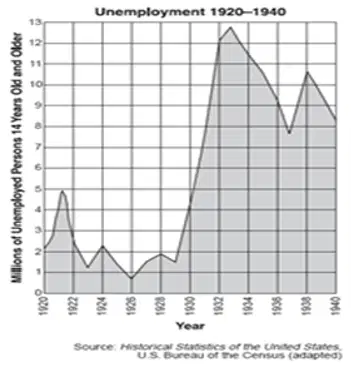
During the Great Depression, unemployment
reached its highest level between
(1) 1928 and 1930
(2) 1932 and 1934
(3) 1930 and 1932
(4) 1934 and 1936
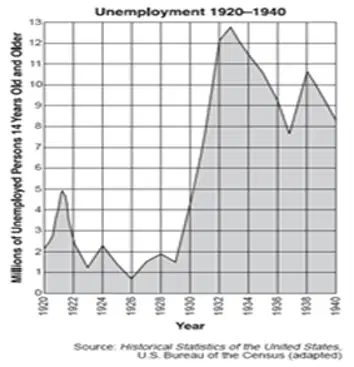
What event was factor related to the rapid change in unemployment after 1929?
World War I
Stock Market Crash
US refusal to join the League of Nations
Passage of the 18th Amendment
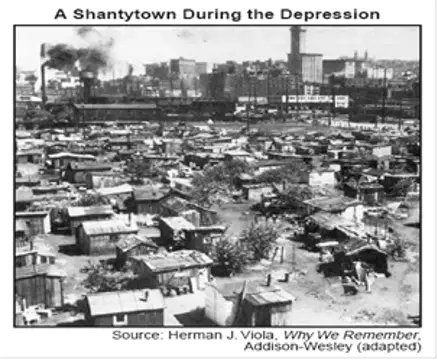
As a way of criticizing the federal government during the early 1930s, areas such as those shown in this photograph were often referred to as
(1) tenements
(2) ghettos
(3) Levittowns
(4) Hoovervilles
The systematic murder by the Nazis of Jews and others who were considered undesirable is known as the
(1) Blitzkrieg
(2) Holocaust
(3) Mass Starvation
(4) Nuremberg trials
President Franklin D. Roosevelt’s 1940 Lend-Lease program was created to
(1) expand New Deal programs to help sharecroppers
(2) provide war materials to the Allies
(3) relocate Japanese Americans
(4) establish the United Nations
President Harry Truman made the decision to drop the atomic bomb on Hiroshima because he
(1) believed America should win the war in Asia first
(2) did not want the Soviet Union to obtain atomic technology
(3) wanted to shift focus away from economic problems
(4) wanted to end the war quickly and save American lives
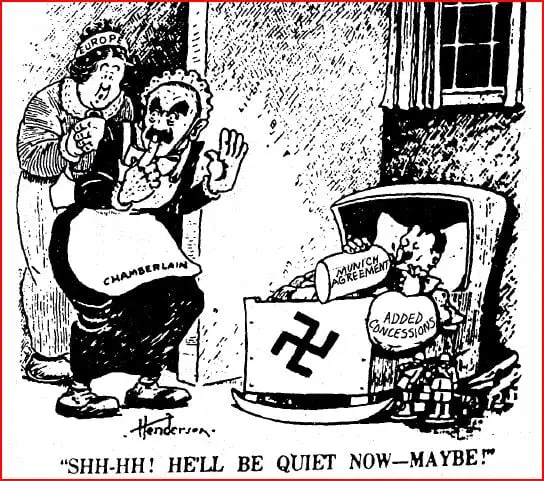
What foreign policy principle is shown in this cartoon?
(1) Aggression
(2) Appeasement
(3)Apprehension
(4) Intervention
"The people of Europe who are defending themselves do not ask us to do their fighting. They ask us for the implements of war, the planes, the tanks, the guns.... which will enable them to fight for their liberty and for our security. Emphatically, we must get these weapons to them, get them to them in sufficient volume and quickly enough so that we and our children will be saved the agony and suffering of war which others have had to endure."
Which below best represents what Roosevelt wants the US to become?
A model for peace in Europe
An Arsenal of Democracy for freedom
Lead negotiator at peace talks
Key supplier of arms to the Nazis
Which of the following ended the policy of appeasement in the late 30's?
(1) Japanese invasion of China
(2) Japanese bombing of Pearl Harbor
(3)German invasion of Poland
Paper drives, rationing of food and gasoline, and victory gardens were all elements of
(1) growth of industry in the late 1800s
(2) support for World War II at home
(3) post–Civil War economic growth
(4) New Deal relief programs
What role did FDR want the US to take on in the early years of WWII?
(1) Model of peace for the world
(2) Arsenal of Democracy
(3) Lead negotiator at the Munich Conference
(4)Supplier of arms to the Axis Powers
During both World War I and World War II, women supported the war effort by
(1) joining the infantry
(2) going to work in factories
(3) gaining the vote
(4) returning to college
“Yesterday, December 7, 1941 — a date which will live in infamy — . . .”
— President Franklin D. Roosevelt
President Roosevelt used these words to describe the
(1) start of World War II in Europe
(2) surprise attack on Pearl Harbor
(3) D-Day invasion at Normandy
(4) dropping of the atomic bomb on Hiroshima
Which group later received an apology and money from the federal government as a result of their internment during World War II?
(1) German Americans
(2) Japanese Americans
(3) Mexican Americans
(4) Italian Americans
“Rosie the Riveter” was a wartime symbol of the
growing role of women in
(1) education
(2) factories
(3) the home
(4) the armed forces
What was a reason President Roosevelt gave for relocating Japanese Americans to internment camps?
To work in factories to make war supplies
To oversee the growth of victory gardens
To provide them with military training
To ease American fears of another attack
Which Supreme Court case declared the “separate but equal” doctrine unconstitutional?
(1) Plessy v. Ferguson
(2) Brown v. Board of Education
(3) Miranda v. Arizona
(4) Roe v. Wade
“We will meet your physical force with soul force. Do to us what you will and we will still love you. . . . Bomb our homes and threaten our homes and threaten our children, and, as difficult as it is, we will still love you. . . .”
Which person’s views are most similar to those expressed in the quotation?
(1) President John F. Kennedy
(2) Malcolm X
(3) Martin Luther King, Jr.
(4) Sen. Joseph McCarthy
The Marshall Plan, the North Atlantic Treaty Organization (NATO), and the Truman Doctrine are examples of United States
(1) economic policies during the Great Depression
(2) involvement in Europe after World War II
(3) civil rights efforts during the 1960s
(4) efforts to put a person on the Moon
"From Stettin in the Baltic to Trieste in the Adriatic an "iron curtain" has descended across the continent. Behind that line lie all the capitals of the ancient states of Central and Eastern Europe. Warsaw, Berlin, Prague, Vienna, Budapest, Belgrade, Bucharest and Sofia; all these famous cities and the populations around them lie in what I must call the Soviet sphere, and all are subject, in one form or another, not only to Soviet influence but to a very high and in some cases increasing measure of control from Moscow."
What issue is Winston Churchill discussing?
Expanding role of the British Empire in the world
Tension between non-communist and communist countries
Build up of the military leading up to WWI
Rising concerns over Nazi Germany
The Berlin airlift, the Korean War, and the Cuban missile crisis are all associated with the
(1) Progressive Era
(2) New Deal
(3) Great Society
(4) Cold War
During the Cold War, Senator Joseph McCarthy affected Americans at home by
(1) recruitins Americans to spy on the USSR
(2) increasing fears of communists in the US
(3) trying to make the United States more isolated
(4) working to establish better economic ties between the United States and Southeast Asia
The Truman Doctrine and the Marshall Plan were associated with efforts by the United States to
(1) end the testing of nuclear weapons
(2) contain the spread of communism
(3) strengthen its isolationist policy
(4) punish war criminals
In the struggle for African-American civil rights, Rosa Parks is most closely associated with the
(1) March on Washington, D.C.
(2) voter registration drives in Mississippi
(3) bus boycott in Montgomery, Alabama
(4) sit-in demonstrations in North Carolina
Which method was used by Martin Luther King, Jr., to protest social injustice?
(1) formation of Greenpeace
(2) civil disobedience
(3) armed rebellion
(4) support for a new political party
What was the purpose of President Nixon's policy of Detente?
To bring peace to Vietnam
To assure adequate oil supply from the middle east
To ease tensions between the US and communist nations
To maintain favorable trade with Latin America
A similarity between the Korean War and the
Vietnam War is that each was
(1) a reaction to attacks on American territory
(2) an effort during the Cold War to contain the spread of communism
(3) continually supported by the American public
(4) fought by individual nations under United Nations command
“Yesterday, December 7, 1941 — a date which will live in infamy — . . .”
— President Franklin D. Roosevelt
President Roosevelt used these words to describe the
(1) start of World War II in Europe
(2) surprise attack on Pearl Harbor
(3) D-Day invasion at Normandy
(4) dropping of the atomic bomb on Hiroshima
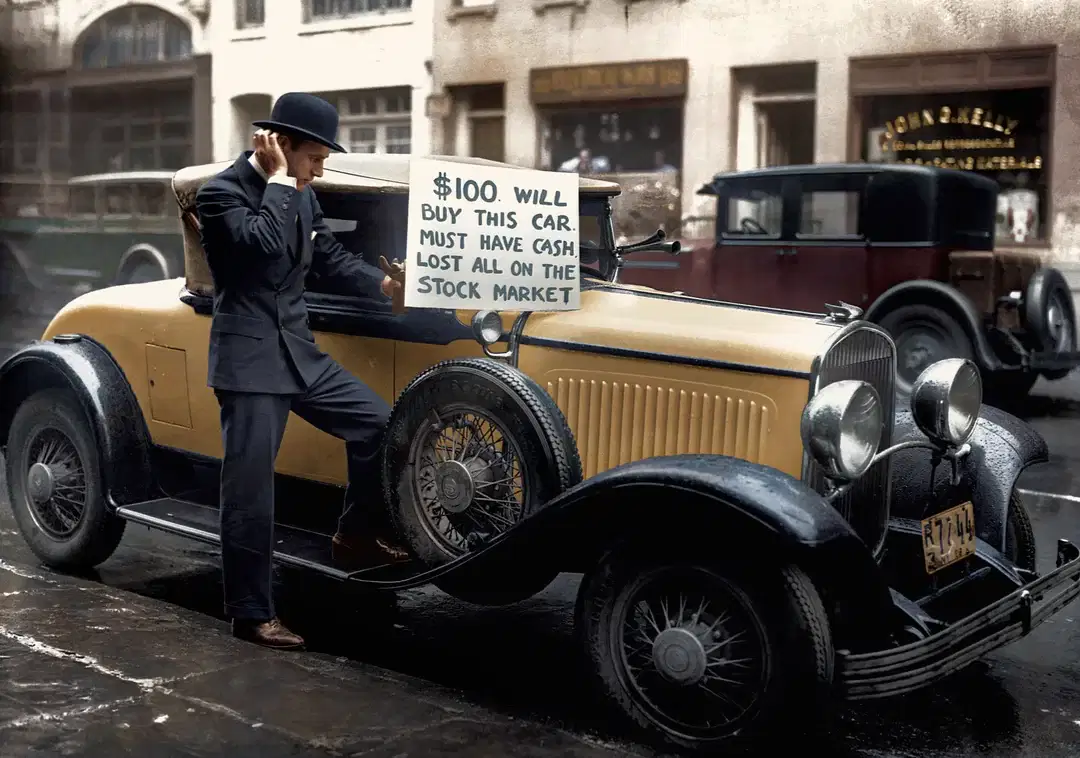
Which action most likely caused the event shown in the photo?
Return of soldiers from WWI
Government's removal of the Bonus Army from Washington DC
Overuse of credit and On-Margin buying during the 20's
Prohibition of alcohol

