
 Worksheets
ECO 2
Total questions: 60
Worksheet time: 30mins
Total revenue equals
price x quantity
price/quantity
(price x quantity) - total cost
output - input
If Kelly sells 300 glasses of lemnonade at $ 0.50 each, her total revenue are
150
299.50
300
600
Zoo sells 200 glasses of lemnonade at $ 0.50 each. Her total costs are $25. Her profits are
25
75
100
175
Those things that must be forgone to accquire a good are called
implicit costs
opportunity costs
explicit costs
accounting costs
A firm's opportunity costs of production are equals to its
explicit costs only
implicit costs only
explicit costs + implicit costs
explicit costs + implicit costs + total revenue
Dianne has decided to start her own photography studio. To purchase
the necessary equipment, Dianne withdrew $10,000 from her savings
account, which was earning 3% interest, and borrowed an additional
$5,000 from the bank at an interest rate of 8%. What is Dianne's annual
opportunity cost of the financial capital that has been invested in the
business?
giai: explicit cost = 5000 x 8% = $400
implicit cost = 10000 x 3% = $300
=> Oppotunity cost = 300 + 400 = $700
300
400
700
1,650
implicit costs
do not require an outlay of money by the firm
do not enter into the economist's measure of a firm's profit
are also know as variable costs
are not part of an economist's measurement of opportunity cost
The amount of money that a wheat farmer could have earned if he had planted barley instead of wheat is
an explicit cost
an accounting cost
an implicit cost
forgone accounting profit
Katherine gives piano lessons for $15 per hour. She also grows flowers, which she arranges andsells at the local farmer's market. One day she spends 5 hours planting $50 worth of seeds in her garden. Once the seeds have grown into flowers, she can sell them for $150 at the farmer's market.
Which of the following statement is correct regarding Katherine's profit from selling flowers
a. $100, and her economic profits are $25.
b.$100, and her economic profits are $75.
.$25, and her economic profits are $100.
d.$75, and her economic profits are $125.
An production function is a relationship between input and
quantity of output
revenue
costs
profit
The marginal product of labor can be defined as
change in total cost/change in labor
change in output/change in labor
change in labor/change in output
change in labor/change in total cost
Suppose a certain firm is able to produce 165 units of output per day when 15 workers are hired. The firm is able to produce 176 units of output per day when 16 workers are hired, holding other inputs fixed. The marginal product of the 16th worker is
units of output
11 units of output
16 units of output
176 units of output
When the marginal product of an input declines as the quantity of the input increases, the production function exhibits:
a) increasing marginal product.
diminishing marginal product.
diminishing total product.
B & c
Some costs do not vary with the quantity of output produced. Those costs are called:
a. Marginal costs,
b. Average costs,
c. Fixed costs,
d. Explicit costs.
If a firm produces nothing, which of the following costs will be zero?
Variable cost
Total cost
Average cost
Opportunity cost
average total cost equals
change in total cost divided by quantity produced
change in total cost divided by change in quantity produced
(fixed costs + variable costs) divided by quantity produced
(fixed costs + variable costs) divided by change in quantity produced
Larry's Lunchcart is a small street vendor business. If Larry makes 15 pretzels in his first hour of business and incurs a total cost of $16.50, his average total cost per pretzel is
1.10
6.50
15.00
16.50
tom's tent company has total fixed costs are $300,000 per year. the firm's average variable cost is $80 for 10,000 tents. at that level of output, the firm's ATC equals
80
90
100
110
technology has average costs of 1 and average total cost of 3 when it produces 500 units of output. The firm's total fixed costs equal
2
4
1,000
2,000
a firm produces 300 units of output at a total cost of $1 000. if fixed costs are $100
average total cost is $4
average variable cost is $3.
average fixed cost is $10.
average total cost is $5.
Marginal costs is equal to
TC/Q
DATC/Q
DTC/DQ
DQ/DTC
A firm has a fixed cost of $500 in its first year of operation. When the firm produces 100 units of output, its total costs are $3500. When it produces 101 units of output, its total costs are $3750. What is the marginal cost of producing the 101st unit of output?
250
275
340.91
350
A firm has a fixed cost of $700 in its first year of operation. When the firm produces 99 units of output, its total costs are $4,000. The marginal cost of producing the 100th unit of output is $200.
42
900
4200
4.900
When marginal cost is less than the average total cost
average total cost is rising.
average variable cost must be falling.
average total cost is falling.
marginal cost must be falling.
Diminishing marginal product suggests that the marginal
a. cost of an extra worker is unchanged.
b. cost of an extra worker is less than the previous worker's marginal cost
c. product of an extra worker is less than the previous worker's marginal product.
d. product of an extra worker is greater than the previous worker's marginal product.
When a firm has little ability to influence market prices it is said to be in what kind of a market?
a competitive market
startegic market
thin market
power market
In a competitive market, the actions of any single buyer or seller will:
Have a negligible impact on the market price,
have a little effect on market equilibrium quantity but will affect market equilibrium price
affect marginal revenue and average revenue but not price
adversely affect the profitablity of more than are firm the market
Which of the following is not a characteristic of a perfectly competitive market?
firm are price takers
firm can freely enter the market
many firms have market power
good affeed for sale are largely the smae
Free entry means that
the goverment pay any entry cost for individual firms
no legal barriers prevent a firm from entering an industry.
a firm marginal cost is zero
a firm has no fixed cost in a short run
In a competitive market, no single producer can influence the market price because
Many other sellers are offering a product that is essentially identical,
Consumers have more influence over the market price than producers do,
Government intervention prevents firms from influencing price,
Producers agree not to change the price.
for a competitive firm
total revenue equals average revenue
total revenue equals marginal revenue
total cost equals marginal revenue
average revenue equal to marginal revenue
Suppose that a firm operating in perfectly competitive market sells 100 units of output. Its total revenues from the sale are $500. Which of the following statements is correct?
(i)
Marginal revenue equals $5.
(ii)
Average revenue equals $5.
(iii)
Price equals $5.
I
III
I, II
(i), (ii), and (iii)
If ABC Company sells its product in a competitive market, the
the price of that product depends on the quantity of the product that ABC Company produces and sells.
ABC Company's total revenue is proportional to its quantity of output.
ABC Company's total cost is proportional to its quantity of output.
ABC Company's total revenue is equal to its average revenue.
when a competitive firm doubles the quantity of output it sells its
total revenue doubles
average revenue doubles
marginal revenue doubles
profits must increase
A monopoly
can set the price it charges for its output and earn unlimited profits
takes the market price as given and earns small but positive profits
can set the price it charges for its output but faces a downward-sloping demand
can set the price it charges for its output but faces a horizontal demand curve so it can earn unlimited profits
Which of the foloowings is not a characteristic of a monopoly
barries to entry
one seller
one buyer
a product without close substitues
A firm that is the sole seller of a product without close substitutes is
perfectly competitive
monopolistically competitive
an oligopolist
a monopolist
Patent and copyright laws are major are major sources
natural monopolies
government-created monopolies
resource monopolies
antitrust regulation
A monopolist maximizes profits by
producing an output level where marginal revenue equals marginal cost
charging a price equal to marginal revenua and marginal cost
charging a price where marginal cost equals average total cost
Both a and b are correct
A monopoly's marginal cost will
be less than its average fixed cost
be less than price per unit of its product
exceed its marginal revenue
equal its average total cost
For a monopolist, marginal revenue is
equal to price, as it is for a perfectly competitive firm
less than price, as it is for a perfectly competitive firm
equal to price, whereas marginal revenue is less than pric for a perfectly competitive
less than price, whereas marginal revenue is less than pric for a perfectly competitive
If a profit-maximizing monopolist faces a downward - sloping market demand curve, its
average revenue is less than the price of the product
average revenue is less than marginal revenue
marginal revenue is less than the price of the product
marginal revenue is grater than the price of the product
The economic inefficiency of a monopolist can be measured by the
number of consumers who are unable to purchase the product because of its high price
excees profit generated by monopoly firms
poor quantity of service offered by monopoly firms
deadweight loss
Price discrimination is the business practice of
bundling related products to increase total sales
selling the same good at different prices to different customers
pricing above marginal cost
hiring marketing experts to increase consumers' brand loyalty
A monopolist's profits with price discrimination will be
lower than if the firm charged a single, profit-maximizing price
the same as if the firm charged a single, profit-maximizing price
higher than if the firm charged a single price because the costs of selling the good will be lower
higher than if the firm charged just one price because the firm will be capture more consumer surplus
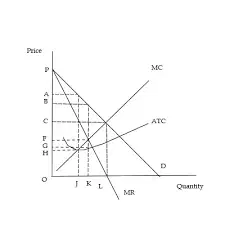
What price will the monopolist charge?
A
B
C
D
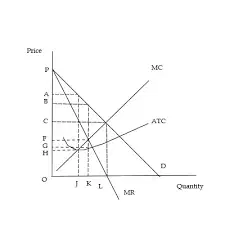
What area measures the monopolist's profit ?
(B-F)*K
(A-H)*J
(B-G)*K
0.5[(B-F)*(L-K)]

The demand curve for a monopoly firm is depicted by curve
A
B
C
D

The marginal revenue curve for a monopoly firm is depicted by curve
A
B
C
D
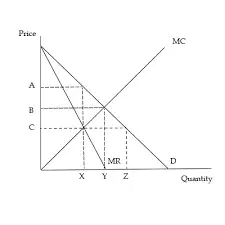
what is the socially efficient price and quantity
Price = A; Quantity = X
Price = B; Quantity= Y
Price = B; Quantity= X
Price= C; Quantity= X
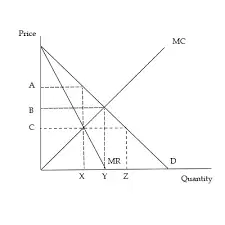
What is the area of deadweight loss?
The rectangle (A-C)*X
The triangle 1/2[(A-C)*(Y-X)]
The triangle 1/2[(A-B)*(Y-X)]
The rectangle (F-D)*A plus the triangle 1/2[(A-B)*(Y-X)]

What is the monopoly price and quantity?
Price= A; quantity=X
Price=B; Quantity= Y
Price= B; quantity= X
Price= C;
quantity = X
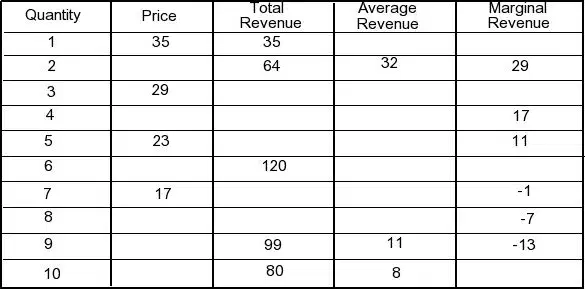
If the monopolist sells 8 units of its product, how much total reveue will it receive from the sale?
14
40
112
164

If the monopoly firm wants to maximize its profit, it should operate at a level of output equal to
Q1
Q2
Q3
Q4

The average total cost curve for a monopoly firm is depicted by curve
A
B
C
D
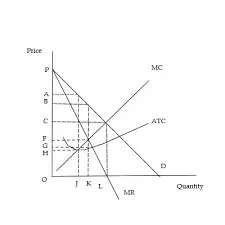
How much output will the monopolist produce?
O
J
K
L
For a profit-maximizing monoppolist
P> MR=MC
P= MR=MC
P>MR>MC
MR<MC<P
the market demand curve for a monopolist is typically
unit price elastic
downward sloping
horizontal
vertical
For a monopoly firm, which of the following qualities is always true?
Price= marginal revenue
Price= average revenue
Price= total revenue
Marginal revenue = total cost
A firm's opportunity costs of production are equals to its
explicit costs only
explicit costs + implicit costs
implicit costs only
explicit costs + implicit costs + total revenue