
 Worksheets
Juggernaut
Total questions: 200
Worksheet time: 2hrs 48mins
Which one of these is not an environmental issue?
Gaining unauthorised access to a computer network
Sending old tech to landfill
Safe disposal of toxic and carcinogenic components
Leaving electronic devices on standby
Charlie uses social media regularly. What step would you recommend to be more secure online?
Use the same password for all online accounts
Only post non-private data/pictures
Always use a mobile phone for security
Share other people’s pictures as much as possible
What does the Data Protection Act give an individual the right to do?
A right to request the data an organisation holds about them without paying a fee
A right to request the data an organisation holds on them for a fee
A right to request the data an organisation holds about anyone without paying a fee
A right to request the data an organisation holds about anyone for a fee
Who is responsible for making sure the requirements of the Data Protection Act are upheld in an organisation?
The Individual
The Data Controller
The Stakeholder
The Computer Network
Why are data centres an environmental issue?
They are really large
They consume a lot of power
They are quite difficult to build
They employ too many people
Which legislation governs the act of hacking?
The Freedom of Information Act
The Data Protection Act
The Creative Commons License
The Computer Misuse Act
Which of the following describes internet censorship?
Access to foreign websites
Monitoring gambling online
Monitoring what people access on the internet
Controlling what people can access on the internet
Which of these statements is not an ETHICAL issue of replacing humans with
robots in the workplace?
Leaving lots of people without jobs
Taking away repetitive or hazardous jobs frees people up to do more interesting and creative things
The software required to make robots useful is complex
Which of these best describes an Ethical issue?
Issues which affected a particular group of people
What is right and wrong in the eyes of the law
What is deemed right or wrong by society
Issues with impact the natural world
Which of these statements is true?
There are no environmental issues with computing
Only the greenhouse effect is linked to computers
The advance in technology should not worry about the environment
There are environmental benefits and drawbacks to developing technology
A company produces an App using only the ASCII character set. What issue may they not have considered?
Cultural
Legal
Environmental
Leaving an off-topic message in an online community to upset someone is what?
Trolling
Ransomware
Digital Divide
Blagging
Which category would the introduction of 'Driver-less' cars fall into?
Ethical
Legal
Cultural
All of the above
Schools are not allowed to share your personal information, this is under the:
Data Protection Act.
Copyright Infringement Act
Computer Misuse Act.
They are allowed to share information
Which type of concern is ensuring public safety classed as?
Legal
Ethical
Environmental
Which type of legislation ensures that organisations in the UK comply with the law regarding privacy?
Data protection legislation
Data production legislation
Data regulation legislation
Which type of concern is illegally copying and distributing films, television programmes and music classed as?
Ethical
Legal
Environmental
Why are smartphones an environmental concern?
Phone batteries need to be recharged
People replace phones every few years and do not recycle them
Phones use wireless technology
The idea that money, language, education, or infrastructure creates a gap between those who have access to information technologies and those who do not.
Digital Divide
Equality of Access
Globalization
Cultural Diversity
People who lack access to the internet have the same opportunities as those who do.
An ethical issue is...
whether something causes damage to land, sea, air and living things
whether something is right or wrong in society or the workplace
whether something causes a problem in a particular group or society
People have different access to technology due to where they live or how much money they have. What is this cultural issue known as?
Digital Divide
Wealth Divide
Geographical Difference
Affordability Divide
Which one of these is not an environmental issue?
Gaining unauthorized Access to a computer network
Sending old tech to landfill
Safe disposal of toxic and carcinogenic components
Leaving electronic devices on standby
Why are data centres an environmental issue?
They are really large
They consume a lot of power
They take up a lot of green space
They employ too many people

The gap between people whose lives are empowered by technology and those who excluded
Digital inclusion
Digital divide
Digital literacy
Digital equality
What is an algorithm?
Patterns and trends used to solve a problem
A set of step-by-step instructions to resolve a problem
A programming language
Which of these is NOT an algorithm?
Following recipe instructions
Working out how an engine works
Tying your shoelaces
Making a cup of coffee
What does an algorithm need to be (choose more than 1)
Clear instructions
Exact
Easy to understand
Complex
When can an algorithm be used?
Only with computers
For programming
To design a solution to any problem
What is decomposition?
Searches the computer's memory for data
Repeats a program
Getting small part of a problem and adding them together
Breaking down a complex problem
What is abstraction?
Removal of certain details, keeping relevant the information
Stores data in a program for retrieval
Freedom from representing art
Detects errors while program is running
What should be considered when designing an algorithm?
If there is more than one way to solve the problem
If the correct hardware is being used
If the correct software is being used

You are at the yellow arrow, pointing in the direction indicated. How would you move to fill in the 2 black squares?
Straight, Turn right, Straight x 1, Fill Square, Straight x 2, Turn left, Straight x 1, Fill Square
Straight x 2, Turn right, Straight x 1, Fill Square, Straight x 2, Turn left, Straight x 1, Fill Square
Straight x 2, Turn right, Straight x 1, Fill Square, Straight x 2, Turn right, Straight x 1, Fill Square
Straight x 2, Turn right, Straight x 1, Fill Square, Straight x 2, Turn left, Straight x 2, Fill Square
What is a flowchart?
A diagram that represents a set of instructions
A high-level language that has specific syntax
A way of describing a set of instructions that doesn’t use specific syntax
How can an algorithm be represented?
As a flowchart only
As pseudocode only
As a flowchart or pseudocode
What are algorithms used for?
To plan out the solution to a problem
As a platform to program a solution
To test a solution to a problem
4 5 9 6 2 7
4 5 6 2 7 9
4 5 2 6 7 9
4 8 6 2 5 7
4 8 6 2 5 7
4 6 8 2 5 7
4 8 3 9 2 6
2 8 3 9 4 6
2 3 8 9 4 6
1 4 2 9 3 8 5
What does the list look like after one pass of the bubble sort algorithm.
1 4 2 9 3 8 5
What does the list look like after one pass of the insertion sort algorithm.


Select the best description to explain what a binary search algorithm is.
Put the elements in order, check each item in turn.
Put the elements in order, compare with the middle value, split the list in order and repeat.
Elements do not need to be in order, check each item in turn.
Elements do not need to be in order, compare to the middle value, split the list in order and repeat
12 6 8 1 3
How many comparisons would it take to find number 1?
3 5 9 10 23
How many comparisons would it take to find number 9?
1 5 10 13 48 68 100 101
How many comparisons would it take to find number 101?
Define the term abstraction within computational thinking
Adding numbers together
Taking a real world problem and designing a computer program that exactly replicates every part of that problem in the computer
Representing real world problems in a computer program, using symbols and removing unnecessary element
Performing multiple calculations on a list of variables
Define the term decomposition within computational thinking
The breaking down of a program until it no longer exists
The creation of music that can be played on a computer
The breaking down of a problem into smaller problems
The breaking down of waste to make compost
Identify which statement describes algorithmic thinking
Thinking like a computer
Writing binary numbers
Identifying the steps involved in solving a problem
Identifying what problems need to be solved
Which of the following is not a component of computational thinking?
Abstraction
Typing
Decomposition
Algorithmic thinking
Pattern recognition/Generalising
Which of these are true about algorithms?
The steps/instructions can be ambiguous
The lowest level of the algorithm can be expressed any way as long as the instruction/step is clear and can be treated as a simple computational process.
Algorithms rely heavily on syntax
Algorithms are about expressing thinking steps not syntax
Python like code cannot be used to write an algorithm


Which algorithm does this image represent?
Bubble sort
Merge sort
Linear search
Binary Search

What algorithm does this image represent?
Bubble sort
Merge sort
Linear search
Binary search

What would the list [9, 6, 12, 7, 3, 16, 10] look like after one iteration of the Bubble sort algorithm (smallest to biggest)?
[6, 9, 7, 3, 12, 10, 16]
[3, 9, 6, 12, 7, 16, 10]
[3, 6, 7, 9, 10, 12, 16]
[9, 6, 12, 3, 7, 16, 10]
1 4 2 9 3 8 5
What does the list look like after one pass of the bubble sort algorithm.
1 5 10 13 48 68 100 101
How many comparisons would it take to find number 101?
4 8 6 2 5 7
4 8 6 2 5 7
4 6 8 2 5 7
4 5 9 6 2 7
4 5 6 2 7 9
4 5 2 6 7 9

What type of design notation is shown here?
Flowchart
Structure diagram
Pseudocode
Wireframe diagram
Choose the most accurate statement that is true for using flowcharts as a design notation.
Good for representing the sequence of steps in an algorithm
Good for representing the top-down decomposition of a problem
Good for representing the abstraction of a problem
Good for representing the visual interface of a computer program
State the final bill that will be calculated for this input data:
bill items = 4
(1 coffee, 2 teas, 1 biscuit)
random number = 2
(a)
State the final bill that will be calculated for this input data:
bill items = 3
(1 coffee, 2 biscuits)
random number = 1
(a)
State the final bill that will be calculated for this input data:
bill items = 5
(2 coffees, 2 teas, 1 biscuit)
random number = 10
(a)
Choose the set of inputs that would result in a final bill of £ 5.10
Num items: 4
(1c, 1t, 2b)
Random num: 2
Num items: 3
(1c, 1t, 1b)
Random num: 10
Num items: 2
(2b)
Random num: 1
Num items: 3
(3t)
Random num: 10
Choose the set of inputs that would result in a final bill of £ 0
Num items: 5
(2c, 2t, 1b)
Random num: 1
Num items: 1
(1c)
Random num: 2
Num items: 1
(1b)
Random num: 10
Num items: 10
(3c, 4t, 3b)
Random num: 6
Choose the sets of inputs that would result in a final bill of £ 7.55
Num items: 3
(2c, 1b)
Random num: 7
Num items: 6
(4c, 2b)
Random num: 6
Num items: 4
(2t, 2b)
Random num: 8
Num items: 5
(5b)
Random num: 3

This flowchart is made to...
Calculate the area and perimeter of a square
Output figures of different sizes
Calculate the area and perimeter of a circle
Find out how long it takes to get to the moon

In this flowchart, r ...
is the radius of a circle
stands for random number
represents a running total
is a miscellaneous variable
Which one is the odd one out?


Looking at the flowchart above, which flowchart below behaves the same when given the input of 4?


Select all flowcharts below that output five numbers when given the input of 5?


This flowchart has a major flaw. It is
Not using diamonds for decisions
Asking too many questions
Being illegible for horses
Helping people who think they are horses realise they are not


What will be displayed as output?

What will happen if the user gets their details wrong?
Checks how many times they have tried
They get another try

What will happen if the user's book return is late?
Sends them an SMS (text)
Does not send them an SMS (text)

What happens if the alarm is not ringing?
You press the snooze button
Whether you are ready to get up is checked
It will loop back to check if the alarm is ringing
You get out of bed

What happens if the alarm is ringing?
You press the snooze button
Whether you are ready to get up is checked
It will loop back to check if the alarm is ringing
You get out of bed

The flowchart needs to be modified to add a symbol for 'Set alarm day'. Which type of symbol should be used?
Start/Stop
Process
Decision
Input/Output
The flowchart needs to be modified to add a symbol for 'Get ready'. Which type of symbol should be used?
Start/Stop
Process
Decision
Input/Output

Look at the flowchart.
Which of these are decisions? Select TWO.
Look for lost item
Did you find it?
Do you need it?
Enter item to find

Look at the flowchart.
What happens if 'Did you find it?' is 'Yes'?
Enter item to find
Look for lost item
Stop looking
Do you need it?
SELECT *
_______ CUSTOMER;

Which logic gate is this truth table for?
AND
OR
NOR
XOR

Truth table for OR gate?


Truth table for AND gate?


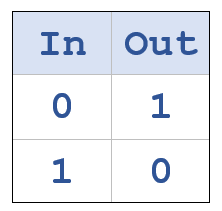
This is the truth table for which logic gate?
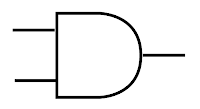
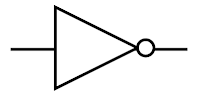
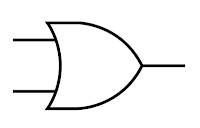
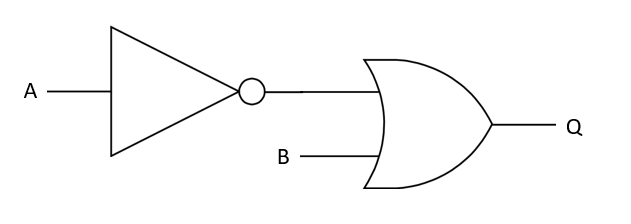
What is the boolean expression for this logic circuit?
Q = NOT (A OR B)
Q = NOT A AND B
NOT A OR B = Q
Q = (NOT A) OR B

Choose all the recognised control structures in a computer program ...
Sequence
Selection
Iteration
Duplication

Example of ... ?
Selection
Repetition
Sequence
Iteration

Example of ...?
Conditional loop
Unconditional loop
Selection
Sequence
Odd one out ...?


Example of ...?
Sequence
Selection
Repetition
Recursion

Example of ...?
Nested loop
Nested selection
Recursion
Sequence

Example of ...?
Nested selection
Nested loop
Repetition
Iteration

A special type of loop that never ends?
Infinite loop
Recursive loop
Nested loop
Unconditional loop

What is the expression for this circuit?
C = NOT(A AND B)
C = NOT (A OR B)
C = NOT A OR B
C = (NOT A) AND (NOT B)
C = A AND (NOT B)

What is the expression for this circuit?
Z = X AND Y
Z = X OR Y
Z = NOT XY
X AND Y = Z
X OR Y = Z

What is the expression for this diagram?
X = (A OR B) OR (C OR D)
X = (A AND B) AND (C AND D)
X = (A AND B) OR (C AND D)
X = (A OR B) AND (C OR D)
X = (A AND B) OR C

Which Logic Gate does this truth table belong too?
NOT
AND
OR

Which Logic Gate does this truth table belong too?
NOT
AND
OR

Which Logic Gate does this truth table belong too?
NOT
AND
OR

A=1
B=0
What is the value of Z?
1
0
Which of the following is NOT a property of a High Level Language?
Enables programs to be developed quickly
Commands resemble "natural" language
Commands are translated into machine code before they can be run
Enable the programmer to directly control system hardware
What does IDE stand for?
Intelligent Development Environment
Integrated Design Environment
Intelligent Development Environment
Integrated Development Environment
Which of the following statements about COMPILERS is TRUE?
Each line of the program needs to be translated each time it is run
Enables programs to be easily re-edited
Outputs the finished code into a complete machine code program
Each time an error is encountered, it stops the program and reports it
Which of the following is not an example of a Translator?
Compiler
Editor
Assembler
Interpreter
There are two types of languages used within computer systems:
High Level & Low Level Languages
Choose the correct options below:
High Level
Low Level
Mid Level
Level 42
A high level programming language uses code written in a way that is similar to a natural human language, such as English.
A high-level language must be translated into a low-level language (binary) before it can be run, as high-level languages cannot be executed directly by the CPU.
I have read this carefully
I need to read back over this
Therefore, examples of High Level languages include Python, Java, Ruby, Visual Basic, Perl etc...
These need to be translated so that the computer understands them
The computer already understands them
Low level programming languages do not resemble natural languages, such as English. They are made up entirely of bit patterns (binary) that can be executed directly by the CPU.
They are very difficult for humans to read
They are easy for humans to read
They look like this: 0011001001100110
Python is an example of a Low level language
Low level languages are useful when speed of execution is critical or when writing software which interfaces directly with the hardware, e.g. device drivers.
I have read this carefully
I have not read this
An example of a high level programming language is...
Python
Assembly code
Machine code
An example of a low level programming language is...
Python
Assembly code
Machine code
Machine code is...
The lowest level of code
Only made of 1s and 0s
Easy for humans to read
Translated before it can be run.
A high level programming language is...
very efficient on the processor
easy for humans to read
interpreted or compiled
multiple instructions per statement
assembled
A low level programming language is...
very efficient on the processor
easy for humans to read
interpreted or compiled
multiple instructions per statement
assembled
High-level languages are faster to write than in assembly or machine language but they are harder to read and understand.
True
False
Machine code is...
The lowest level of code
Only made of 1s and 0s
Easy for humans to read
Translated before it can be run.
What is the purpose of Anti-Virus software?
To keep the computer safe from malicious software
To keep people safe from other people
To keep the computer safe from defragmantation
To keep data safe
What does defragmentation software do?
Moves files to collect all free space together
Deletes unwanted files from the hard disk
Move unwanted files from the hard disk
Compresses files therefore creating more room
Why is utility software needed? (Select all that are true)
To analyse computer performance
to configure a computer
to optimize a computer
to maintain a computer
Utility programs are usually…..?
Part of the Operating System
Brought on a disk from a store
Only needed if you are connected to the Internet
Very expensive to buy
To scramble data so that it is unreadable is a form of….?
Compression
Encryption
Back-Up
Defragmentation
Encryption does not prevent someone from intercepting a message it only prevents them from being able to understand it, true or false?
True
False
Encrypted messages are called which?
Plaintext
Ciphertext
Key Text
Original Text
Unencrypted messages are called which?
Plaintext
Ciphertext
Key text
Orignal Text
Which of the following is an advantage of file compression? Click all that apply
Files can be sent quicker
Files can be uploaded and downloaded quicker
Files take up less storage space
Utility software performs specific ______ to help your computer run ______
Jobs, Efficiently
Code, Efficiently
Jobs, Processing
Code, Smoothly
If your encrypted data was intercepted, it would be unreadable unless the thief had the decryption _____
Key
Answer
Code
What is the purpose of Utility Software? Click all that apply
To keep the computer organised
To ensure it has up to date software
To ensure the system runs efficiently
To translate machine code into high level code
What type of Software is needed to control the computer’s hardware?
Programming Software
Systems Software
Application Software
Bespoke Software
What is the purpose of an Incremental Backup?
Changes the files of everyone on the system
Allows a user to see what is going on in the computer
Backs up only the files that have been changed by users
Backs up all the files that by all users
What are the benefits of an Incremental Backup?
It is quicker than a full back up
It will incur less traffic on the system
It will copy all the files in one go for every user
It is slower than full backups
"Making a duplicate of all the users work" is a description of what?
Defragmentation
Drivers
Task Manager
Backup
In a school, user access levels are used to...
Allow students to open files from shared drives, but not to edit or delete them
Prevent students from installing games on their computers
Stop teachers from deleting software
Prevent students from accessing games on the internet
Which of these are the two biggest software vulnerabilities?
Unpatched software
Not updating your antivirus
Having a weak password
Installing programs off the internet
Falling for phishing scams
Which of the following are features of a firewall?
Block unsafe websites
Prevent unwanted devices from connecting to your trusted network
Filtering packets from known unsafe IP addresses
Blocking phishing emails
Encrypting all the data you send to the internet

