
 Worksheets
Spacecraft Design Fundamentals 29.06
Total questions: 20
Worksheet time: 8mins
At which point of an elliptical orbit is a spacecraft at its lowest velocity?
Periapsis
First point of Aries
On the semi-minor axis
Apoapsis
Which orbital element describes the orbital shape:
Eccentricity
True anomaly
Semi-Major Axis
RAAN
How does the groundtracks of a perfect GEO and LEO polar orbit look like respectively?
Straight, sinusoidal
Sinusoidal, Co-Sinusoidal
Point, Sinusoidal
Closed eight, Co-sinusoidal
In which orbit GNSS satellites like GPS or Galileo are positioned?
GEO
LEO
MEO
All of them
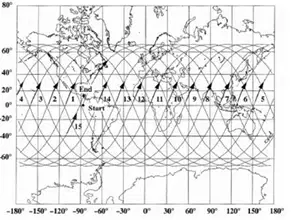
What is the inclination of the satellite with the following groundtrack? Can this groundtrack most likely cover more than 90% landmass of Greenland?
55°, Yes!
65°, No!
60°, Yes!
Polar orbit, Yes!
___(1)___ maneuver a requires continuous thrust in order to increase the altitude of a spacecraft? And ___(2)___ maneuver typically is the most efficient orbital transfer?
(1) Hohmann Transfer
(2) Bi- elliptical Transfer
(1) Spiraling
(2) Hohmann Transfer
(1) Gravity Assist
(2) Bi- elliptical Transfer
(1) Bi- elliptical Transfer
(2) Hohmann Transfer
For which Mission Gravity Assist Maneuvers were performed?
Galileo
MOVE-II
Voyager 1 and 2
FSSCAT
What is the purpose of the Hohmann maneuver in space travel?
To change the inclination of an orbit.
To change the RAAN of the orbit.
To perform a rendezvous with another spacecraft.
To transfer between two different circular orbits.
During a Hohmann maneuver, at which points of the orbit are velocity changes typically performed?
At the periapsis and apoapsis.
At the ascending node and descending node.
Both at the periapsis
At the points of closest approach and farthest distance from the target.
What is the purpose of magnetorquers in ADCS?
Measuring magnetic fields in space
Generating electrical power
Communicating with other spacecraft
Applying torque to control the spacecraft's attitude
Which actuator can be a good choice to be used for attitude control for cubesats?
Reaction wheels
Thrusters
Ion engines
Pneumatic actuators
What CANNOT you use to modify the attitude of your satellite?
Reaction Wheels
CMG
Magnetometers
Thrusters
Which one of the following sensors has the best accuracy?
Star sensor
Sun sensor
Earth sensor
Reaction Wheel
What is the reasonable RPM limit for a Reaction Wheel?
50000 rpm
50 rpm
5000 rpm
500 rpm
Considering an optical payload, for a given wavelength and altitude; if you increase the aperture radius of the optic, the Ground Sampling Distance (GSD), will:
Increase linearly
Decrease linearly
Increase quadratically
Decrease quadratically
The Depth of Discharge:
Depends on the battery materials
Decrease during the lifetime
It is essential when sizing a battery
All of the answers are correct
A reasonable value for the Conversion efficiency of a solar panel is:
0.3
0.8
0.01
1.3
If the satellite is operating, what is an acceptable temperature for the electronics?
The same of the external space
293 Kelvin
– 50 Celsius
343 Kelvin
Which is the most relevant heat transfer mechanism in space?
Conduction
Free Convection
Forced Convection
Radiation
What is NOT directly affecting the calculation of the free space losses?
The distance between the transmitter and receiver
The frequency
The antenna selection
The speed of light

