
 Worksheets
AEF 2025 US Chapter 16 Review
Total questions: 100
Worksheet time: 1hrs 27mins

This amendment gained support based on the belief that people should have the right to vote if they are old enough to —
drive motorized vehicles
serve as members of juries
pay federal income taxes
be drafted into the military

Which of the following is the best title for this list?
Protests Against the Vietnam War
Opposition to the Arms Race
Support for Gender Equality
Demands to Stop Dumping Chemical Waste
As part of the Nixon administration’s policy of Vietnamization, the U.S. military —
trained South Vietnamese forces to take over combat responsibilities from U.S. troops
shared military technology with North Vietnam
shared military technology with North Vietnam
installed a puppet government in South Vietnam

What happened as a direct result of these recommendations?
North Vietnamese leaders appealed for a ceasefire.
U.S military involvement in Vietnam escalated.
South Vietnamese leaders rejected military assistance.
Soviet ground troops were deployed to Vietnam.

What was the overall goal of U.S. military intervention in Vietnam from 1964–1973?
Eliminating trade barriers between the United States and Southeast Asia.
Isolating the Soviet Union by improving Chinese relations with the United States.
Promoting economic growth in the Pacific region.
Preventing communism from spreading throughout Southeast Asia.

As part of the Nixon administration’s policy of Vietnamization, the U.S. military —
Trained South Vietnamese forces to take over combat responsibilities from U.S. troops.
Shared military technology with North Vietnam.
Imposed martial law in North Vietnam.
Installed a puppet government in South Vietnam.

The program being promoted by this poster was created to —
Assist soldiers when they returned to civilian life.
Ensure proper schooling for army officers.
Provide incentives to enlist in the military.
Encourage recruits to view the military as a career.

Why was the United States concerned about Agreement 2?
Officials believed the election would lead to a civil war and revolution.
Congress members feared foreign policy decisions would lead to criticism at home.
The administration opposed the creation of regional alliances.
Leaders feared communist officials would win the election and take over the country.

Why did the government implement a draft during the Vietnam War?
To monitor ethnic groups for espionage activities.
To fund the war by authorizing the sale of government bonds.
To regulate freedom of expression at antiwar demonstrations.
To provide the military with additional manpower.
American policy of resisting further expansion of communism around the world
Containment
Iron Curtain
Marshall Plan
Truman Doctrine
Idea that people who are desperate might fall to Communism, so U.S. would provide financial aid to war-torn nations of Europe to help rebuild.
Containment
Iron Curtain
Marshall Plan
Truman Doctrine
Phrase coined by Churchill that explained that Europe had been divided into western Europe and communist eastern Europe
Containment
Iron Curtain
Marshall Plan
Truman Doctrine
Mutual Defense Alliance - Western countries pledge to defend each other from attacks
United Nations
NATO
Warsaw Pact
Berlin Airlift
A military alliance between the Soviet Union and its satellite nations and a response by Stalin to the US creation of NATO
United Nations
NATO
Warsaw Pact
Berlin Airlift
The 1962 confrontation between US and the Soviet Union over Soviet missiles in Cuba. The U.S. responded by blockading Cuba until the Soviets agreed to remove the missiles.
Korean War
Vietnam War
Cuban Missile Crisis
Bay of Pigs Invasion
The conflict between Communist North Korea and Non-Communist South Korea. The United Nations (led by the United States) helped South Korea in an effort to contain communism.
Korean War
Vietnam War
Cuban Missile Crisis
Bay of Pigs Invasion
Period in the United States where the fear of communism led to widespread accusations with no evidence
Baby Boom
McCarthyism
Space Race
Arms Race
Increase in birthrate after WWII. Led to an increased demand for housing and the growth of the suburbs.
Baby Boom
McCarthyism
Space Race
Arms Race
Competition between the Soviet Union and the United States, to achieve firsts in spaceflight capability. Began with the Soviet launch of Sputnik
Baby Boom
McCarthyism
Space Race
Arms Race
Which of the following was a direct result of the 1957 launch of Sputnik 1?
The US began a period of technology sharing with the USSR
The US government founded an accelerated space program with NASA.
The USSR was unable to collect images of the US from space
The Soviet government collapsed because of economic competition
What was the overall goal of US military intervention in Vietnam from 1964-1973?
Eliminating trade barriers between the US and Southeast Asia
Isolating the USSR by improving Chinese relations with the US
Promoting economic growth in the Pacific region
Preventing communism from spreading throughout Southeast Asia

Kennedy ordered a naval blockade of Cuba to prevent shipment of Soviet missiles.
Cuban Missile Crisis
Causes for the Spanish-American War
Causes of WWI
Causes of Vietnam

As more troops were sent to Vietnam and the media reported setbacks (credibility gap), people protested by mass demonstrations, violence at some rallies
Antiwar movement
Prowar movement
Civil Rights movement
Chicano Mural movement

What type of music led to a massive cultural and generational divide?
Jazz
Rock and Roll
Heavy Metal
Bluegrass
What percentage of American homes had a television by 1960?
10%
40%
75%
90%


Love
What event started the Cuban Missile Crisis?
USSR established nuclear missiles on Cuba
US threatened to invade the USSR
USSR threatened to invade the US
None of the above
The US agreed to remove missiles from Turkey if the US removed missiles from Cuba, ending which event?
Cuban Missile Crisis
Bolshevik Revolution
Bay of Pigs
Space Race
After JFK was killed in 1963, his vice president _________ was sworn into office:
Lyndon B Johnson
Harry S Truman
Abraham Lincoln
Richard Nixon
The successful launching of Sputnik by the USSR signaled the need for
Educational initiatives in math & science to compete with Soviet aggression
Soviet aggression in Afghanistan and China
Soviet Union colonizing Jupiter
Cold War with France
Which Containment Events List is in the correct chronological order?
1. Truman Doctrine
2. Marshall Plan
3. NATO Established
4. Cuban Missile Crisis
1. NATO Established
2. Truman Doctrine
3. Cuban Missile Crisis
4. Marshall Plan
1. Cuban Missile Crisis
2. NATO Established
3. Marshall Plan
4. Truman Doctrine
1. Marshall Plan
2. Truman Doctrine
3. NATO Established
4. Cuban Missile Crisis
After the Second World War, where was Korea spilt?
Along 36th Parallel
Along 38th Parallel
Along 28th Parallel
Along 18th Parallel


Which action occurred for the first time in the early 1950s during the Korean War?
United States troops fought a land war in Asia
The United States used military force against an aggressor nation.
The United Nations used military force against an aggressor nation.
United States and Soviet troops fought on the same side.
What idea is President Eisenhower referring to in this quotation?
Control of Korea was turned over to the United Nations.
The US & UN forces did keep South Korea from falling to Communism.
North Korea became an ally of the United States.
South Korea became a Communist nation.
What was the primary reason for U.S. involvement in East Asia during the early 1950s?
North Korean attempts to unify the peninsula challenged the U.S. policy of containment.
Communities in Korea needed humanitarian aid due to a famine.
International groups needed help investigating North Korean officials charged with corruption.
Democratic reformers sought help from the U.S. military to overthrow dictatorial regimes in Korea.

Which action best explains the differences shown in these photographs?
The United States gave economic assistance through the Marshall Plan
The United States and the Soviet Union created an alliance after World War II.
U.S. leaders created the United Nations.
The Soviet Union established the "Iron Curtain" after World War II.
Which amendment to the U.S. Constitution lowered the voting age to 18?
26th
27th
18th
19th

How did televisions impact our view of the war?
It showed a lack of progress and the horrors of war
People were being shown fake news regarding the war
They were too busy watching their TV's to care about the war
People began to sympathize with communist principles through the nightly news broadcasts
Credibility gap is when you are given information that contradicts with what you have seen to be true.
True
False

Nixon's idea of shifting the burden of actual combat from American troops to South Vietnamese forces.
Vietminization
Vietcong
Internationalism
Linkage
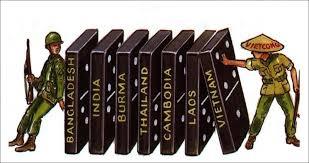

What defined the border between North Vietnam and South Vietnam?
38th Parallel
17th Parallel
Mekong River
It was a straight line exactly halfway between the northern tip and the southern tip of the country
On the U.S. Homefront how was the war in Vietnam treated? (TWO correct answers)
U.S. Soldiers received great support, though many were angry at the government
Many citizens were pro communist and wanted to see Vietnam win
Anti-War protests broke out, low support for soldiers, as many citizens wanted peace not war
Soldiers returning home from Vietnam struggled with living a normal life.
Which of the following presidents was elected in 1968 with the promise of solving the Vietnam War issues?
Gerald Ford
Jimmy Carter
Richard Nixon
Ronald Reagan
1968, massive attack by the Viet Cong on major cities in South Vietnam; caused American public support of war to plummet
Operation Rolling Thunder
Gulf of Tonkin Resolution
Tet Offensive
Kent State University
People begin to distrust the government about information in the Vietnam War
Silent Majority
Credibility Gap
Vietnamization
Escalation
Was an eventual victory for the United States but it also turns people against the war
Tet Offensive
Operation Overlord
Pearl Harbor
Desert Storm
Which amendment was said to have been violated in the case Tinker v. Des Moines?
1st Amendment
19th Amendment
2nd Amendment
26th Amendment
Everyday Americans who don't speak out but who wanted to continue the war
Doves
Viet Cong
Silent Majority
Communists


Mexican American who received congressional Medal of Honor in Vietnam War? *not covered - eliminate obvious answers
Roy Benividez
Pablo Escobar
Fidel Castro
Cesar Chavez
SS.912.A.6.14
Which of the following lists events from the Vietnam War in the correct chronological sequence?
Paris Peace Accords—Gulf of Tonkin Resolution—Tet Offensive—Geneva Accords—Vietnamization
Geneva Accords—Gulf of Tonkin Resolution—Tet Offensive—
Vietnamization—Paris Peace Accords
Vietnamization—Paris Peace Accords—Geneva Accords—Gulf of Tonkin Resolution—Tet Offensive
Tet Offensive—Geneva Accords—Vietnamization—Paris Peace
Accords—Gulf of Tonkin Resolution
SS.912.A.7.10
Which argument was raised by domestic critics of the Vietnam War?
Military service, even on behalf of a just cause, should never be
compulsory.
Most South Vietnamese welcomed establishment of a Communist government.
An all-out military effort by the United States would quickly bring a military victory.
The U.S. government had misrepresented facts about the war to the American public.


Why did John & Mary Beth Tinker and Chris Eckhardt wear black arm bands?
To Protest the war in Vietnam.
They disagreed about taxes.
To protest the 4th amendment.
To support WWII veterans.
What was the Supreme Court's response to siding with the students and parents?
The first amendment is irrelevant to this case.
Parents and students have a stronger say in decisions than schools.
Students have unlimited rights in expression.
Students and teachers don't shed their constitutional rights to freedom of speech or expression.
What was the purpose of duck and cover drills?
To learn how to raise ducks
They were fire drills in schools
These were new dance styles
To learn what to do in case of a nuclear bomb being dropped

by signing a mutual defense treaty with China
by bombing significantly increasing bombing.
by placing a trade embargo on surrounding Asian nations
by sending troops to Taiwan without legislative approva

The event in the headline resulted in -


Why was the United States concerned about Agreement 2?
Officials believed the election would lead to a civil war and revolution.
Congress members feared foreign policy decisions would lead to criticism at home.
The administration opposed the creation of regional alliances.
Leaders feared communist officials would win the election and take over the country.

Which Soviet action led to the threat illustrated on this map?
The placement of nuclear weapons installations in Cuba
Blockading foreign supply ships from entering the Caribbean
The signing of an arms limitations treaty
Closing the border between East and West Berlin
Heavy bombing campaign on N. Vietnam
Operation Rolling Thunder
Woodstock
Richard Nixon
Lt. William Calley
Grateful Dead
Increased S. Vietnamese responsibility of war effort
Gulf of Tonkin Resolution
Vietnamization
Paris Peace Accords
War Powers Resolution
SEATO
President __________ is credited with the plan of Vietnamization
Ford
Reagan
Johnson
Nixon

