
 Worksheets
An Overview of Modernism & Postmodernism
Total questions: 15
Worksheet time: 1hrs 15mins

Name the global event that happened during 1760 - 1820 in Great Britain and 1870 - 1914 in America.
It began in Great Britain with the British textile business, utilising the invention of steam power, the event provided the world with new products, i.e. iron, steel, glass, reinforced concrete, and elevator, enabling the pragmatic possibility of creating tall buildings.
The invention of machines to replace hand production methods. Trains, automobiles, and railroads were built. The pace of daily life was quickened by technological advancement. Scientific and technological innovations energised society. The world was changing and modern civilisation yearned to revitalise the way life, art, architecture, politics and science were viewed and practised.
(a)

The exhibition was designed by the French government to highlight the new style moderne of architecture, interior decoration, furniture, glass, jewelry and other decorative arts in Europe and throughout the world. Many ideas of the international avant-garde in the fields of architecture and applied arts were presented for the first time at the Exhibition, i.e. , Art Deco and Internatinoal Style. The program for the Exhibition made it clear that it was intended to be a celebration of modernism, not of historical styles.
The site chosen for the Exhibition was the center of Paris.
(a)

It is an English aesthetic movement occurring in the last years of the 19th Century, representing the beginning of a new appreciation of decorative arts throughout Europe.
The Movement took its name from the Arts and Crafts Exhibition Society, founded in 1887, it encompassed a very wide range of like-minded societies, workshops and manufacturers.
(a)
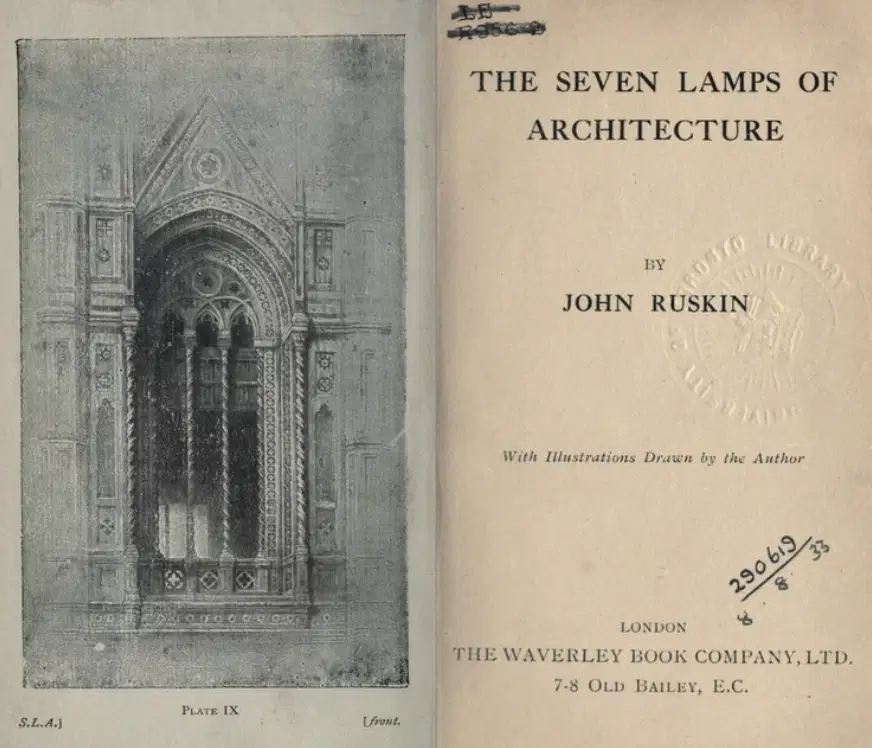
The arts and Crafts movement was inspired by the writing of (a) . The movement became the foundation for the other three movements: Art Nouveau, Art Deco and Bauhaus.
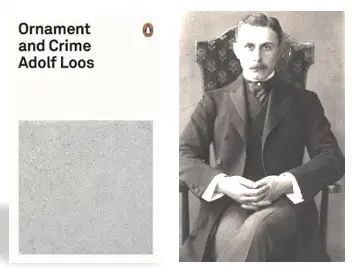
An architect, his influence is primarily limited to major works in what is now Austria and the Czech Republic, but as a writer he had a major impact on the development of 20th century architecture, producing a series of controversial essays that elaborated on his own architectural style by decrying ornament and a range of social ills - Ornament and Crime.
His minimalist attitudes are reflected in the works of Le Corbusier, Mies van der Rohe, and many other modernists and led to a fundamental shift in the way architects perceive ornamentation.
(a)
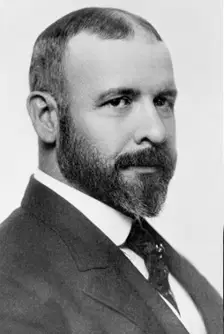
Another important early source of modernism’s ideology is (a) , which was coined by the American architect Louis H. Sullivan – in his essay “The Tall Office Building Artistically Considered”, 1896.
Sullivan argued that a tall building's exterior design (form) should reflect the activities (functions) that take place inside its walls, became the touchstone for many architects. This means that the purpose of a building should be starting point for its design. Wright extended the teachings of his mentor by changing the phrase to “form and function are one.”
Sullivan is one of the great figures in American architecture, known for steel-frame constructions of some of the earliest skyscrapers, characterised what became known as The Chicago School.
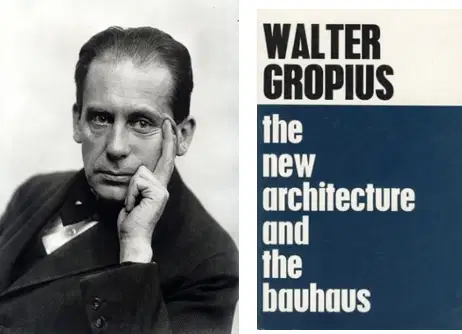
Traditional art schools were conservative and elitist. Technical colleges were dreary and conventional. Walter Adolph Gropius broke down the barrier between fine art and applied arts.
It was much more than an architectural style – it was a new way of thinking, at the end of WWI, its ideas still set the pattern for the way we live today.
The School founder by Gropius, was the most influential German School in art, design and architecture, founded in 1919, that has greatly reflected Gropiu's Modernist ethos - to reimagine the material world to reflect the unity of all the arts.
(a)
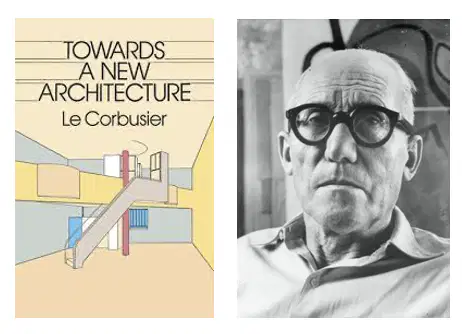
The Architect is widely regarded as the most important architect of the 20th century, proclaimed that ‘a house is a machine for living’ in his book ‘Towards a New Architecture’.
By this definition, a house is an efficient tool to help provide for the necessities of life and no more. Decoration and extra frills are not necessary.
Using this reasoning, the Architect advocated an architectural style of simple shapes, clean lines, open floor plans, large windows, and comfortable furniture. Everything you need to live comfortably and productively and nothing more.
These reflect his manifesto of “Purism” and “five points of architecture”.
(a)
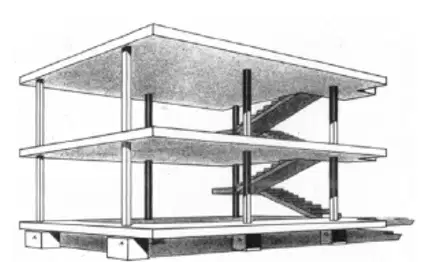
In 1914–15 Le Corbusier developed his first major theoretical work, namely (a) : a reinforced concrete frame, which he posited as a mass production system for free-plan housing.
He advanced a revolutionary vision of the modern house that embraced prefabrication, mass production, technological advancement and new materials.

The Modernist Movement began in the Europe originally arising from wide-scale and far-reaching changes to Western society in the late 19th and early 20th centuries, before World War I.
Followed then by the horror of World War I.
After WWI, the prominent figures of the movement – Le Corbusier, Walter Gropius, and Ludwig Mies van der Rohe - had established their reputations. (However, it was not until after WWII that it gained mass popularity, after modernist planning was implemented as a solution to the previous failure of architecture and design to meet the basic social needs11.)
During the interwar period, students at the Bauhaus school of design were taught purity of form and to design for a better world by Walter Gropius.
Many prominent architects emigrated to the US, bringing their new architectural concepts with them and spread to the United States in the 1920s, as Europe sunk into chaos just before WWII.
In 1932 the first modern architectures exhibit in America was held at the Museum of Modern Art in New York City which brought these new ideas in architecture to the forefront. That same year an influential book entitled (a) was published by architects Henry-Russell Hitchcock and Philip Johnson.

During interwar, as much as 15% of the urban populations were living in poverty, and slum clearance was one of the many social problems of this decade. Modernist planning was a popular idea, and used as a solution to these problems.
A congress led by Le Corbusier, namely (a) (Congres Internationaux d’Architecture Moderne) was formed 1928. It foundation marks the determination of Modernist architects to promote and finesse their theories. For nearly 30 years the great questions of urban living, space, and belonging were discussed by the Congress's members.
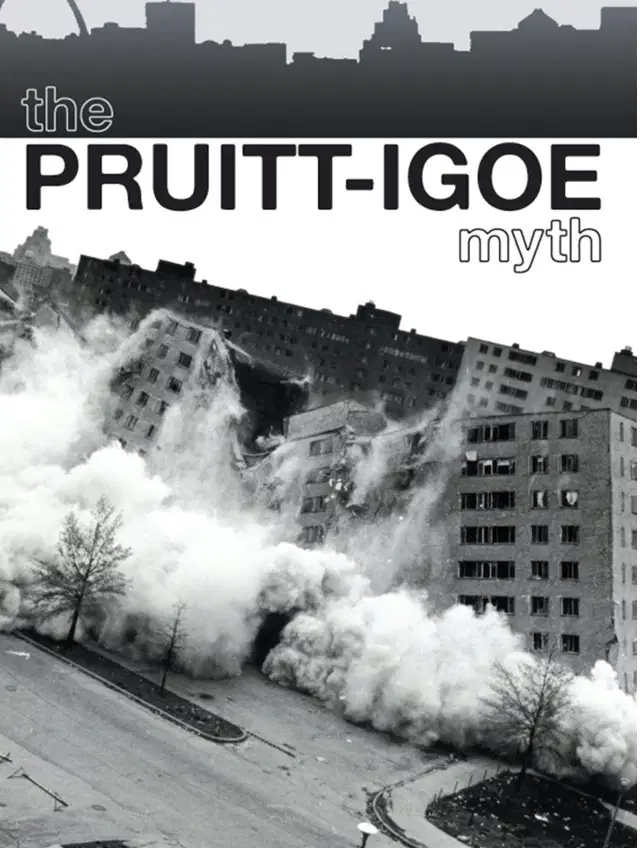
The ambitions of the modernists and their “strong sense of social responsibility in that architecture should raise the living conditions of the masses.” However not all modernist social housing projects were as successful: many were demolished from the 1970s due to large-scale failure.
For 30 years after the WWII, Modernism faced critiques; many architects seek new vocabularies for architectural production. Many modernist architects recognised the need to transcend the limits of functionalism of Modernism.
The ultimate example of the failure of the modernist utopia is the now infamous Pruitt Igoe urban housing development in St. Louis, Missouri, completed in 1955, by Minoru Yamasaki
July 15th 1972 3.32pm - the death of Modernist Architecture
It resulted in a new movement namely (a) with a range of overlapping theories and interests. Modernist architecture eventually being replaced as the dominant style by the new movement in the 1970s and 80s.
Architecture of the movement opposed Modernism and is characterised by broad scepticism, subjectivism, or relativism; a general suspicion of reason; and an acute sensitivity to the role of ideology.
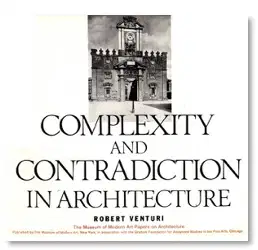
The 1960s were marked by dissatisfaction with the consequences of the Modernist movement, where its failings were exposed in two influential books, The Death and Life of Great American Cities (1961) by Jame Jacob, and Complexity and Contradiction in Architecture (1966) by (a) .

Founded in 1961, the architecture movement was an avant-garde collective of architects that became famous in the 1960s and 1970s for its radical architecture concepts. The architects advocating for the movement are Peter Cook, Dennis Crompton, David Greene, Warren Chalk, Ron Herron, and Michael Webb.
They were inspired by the technocratic ideas of Buckminster Fuller as well as the American Beat movement and Pop art. The architecture explored emerging technologies and consumer culture of the 1960s. At the heart of this was not a money-making scheme but a sense of expanding realms in which to be free, whether psychological or geographical.
(a)

The term first appeared in the 1980s, as an idea developed by French philosopher Jacques Derrida. Derrida developed the idea of fragmenting a building and exploring the asymmetry of geometry (inspired by Russian Constructivism), while maintaining the core functionality of the space (inspired by Modernism). The public first noticed the movement in the 1980s during the Parc de la Villette competition, thanks to the winning entry by Bernard Tschumi, as well as Derrida’s and Eisenman’s design entry.
(a)

