
Font size
 Worksheets
Cloud Computing Quiz-1
Total questions: 30
Worksheet time: 18mins
Which of the following is not a type of cloud server?
a) Public Cloud Servers
b) Private Cloud Servers
c) Merged Cloud Servers
d) Dedicated Cloud Serverd
Which of the following is a type of cloud computing service?
a) Service-as-a-Software (SaaS)
c) Software-as-a-Service (SaaS)
d) Software-as-a-Server (SaaS)
b) Software-and-a-Server (SaaS)
Which of the following is the application of cloud computing?
Adobe
All of the above
Paypal
Google G Suite
Which of the following is the correct statement about cloud types?
a) Cloud Square Model is meant to show is that the traditional notion of a network boundary being the network’s firewall no longer applies in cloud computing
b) A deployment model defines the purpose of the cloud and the nature of how the cloud is located
c) Service model defines the purpose of the cloud and the nature of how the cloud is located
d) All of the mentioned
Choose among the following which is related to services provided by the cloud.
Reliability
Souring
Ownership
AaaS
Cloud computing is believed to have been invented by Joseph Carl Robnett Licklider in the 1960s with his work on ARPANET to connect people and data from anywhere at any time.
Select the correct question for the above explanation (may be more then one)
Who Deployed Cloud Computing?
Who Implemented Cloud Computing?
Who Invented Cloud Computing?
Who coined the term Cloud Computing?
In which year Salesforce.com pioneered the notion of bringing remotely provisioned services into the enterprise
In the late 1990s
In the late 1970s
In the late 1999s
In the late 1980s
Cloud computing is a model for enabling ubiquitous, convenient, on-demand network access to a shared pool of configurable computing resources (e.g., networks, servers, storage, applications, and services) that can be rapidly provisioned and released with minimal management effort or service provider interaction. This cloud model is composed of five essential characteristics, three service models, and four deployment models.
Definition Given by .......
Cloud Federation of USA
National Institute of Science and Technology
National Institute of Standards and Technology
International Cloud Federation
•A layer of software allows physical IT resources to provide multiple images of a single physical machine so that their underlying processing capabilities can be shared by multiple users.
Virtual Server Replication
Virtualization
Service Replication
Hardware Replication
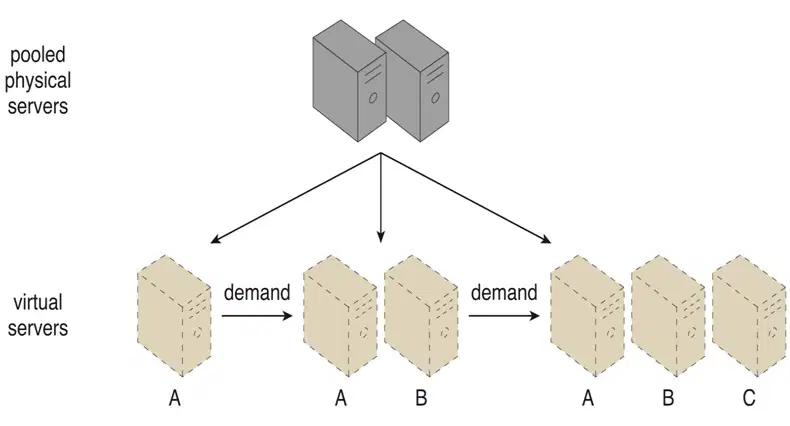
What is significant of this Image
virtualization
Horizontal Scaling
Vertical Scaling
Server Replication
scaling refers to adding more or faster CPUs, memory, or I/O resources to an existing server, or replacing one server with a more powerful server.
Horizontal Scaling
Vertical Scaling
Both Horizontal and Vertical Scaling
Neither Horizontal nor vertical scaling
•Cloud provider is responsible for making cloud services available to cloud consumers, as per agreed (a) guarantees.
Auditor–A third-party (often accredited) that conducts independent assessments of cloud environments assumes the role of the cloud_____________
Cloud Broker
Cloud Maintenance Engineer
cloud auditor
Cloud Service Tester
A system is capable of recovering from certain types of failure without any human intervention. It has a “convergence” or “control” loop that actively looks at the system's actual state and compares it to the state that the operators initially desired.
self-healing
self recovery
self backup
self-auditing
•The delivery model represents a pre-defined “ready-to-use” environment comprised of already deployed and configured IT resources.
•Set of pre-packaged products and tools used to support the entire delivery lifecycle of custom applications.
SaaS
IaaS
HaaS
PaaS
A cloud enables an organization to use cloud computing technology as a means of centralizing access to IT resources by different parts, locations, or departments of the organization and owned by a single organization•
The actual administration of this cloud environment may be carried out by internal or outsourced staff.
Public cloud
Hybrid cloud
community cloud
Private cloud
•Private systems that enterprises build in-house and operate themselves.
•These data centers can be utilized to run private cloud networks, in which resources are virtualized in similar ways to public clouds and can be used from anywhere. However, private clouds can be operated and maintained by third-party services.
On-premises data centers
Off-premises data centers
Third party data centers
Public data centers
A Cloud-based Data Center can be easily accessed through smart phones and other connecting devices with security credentials to allow remote working. The stored data can be retrieved, processed, or recovered with just a few clicks on the laptop. This will enable employees to carry out their work from any corner of the world in any time zone.
Standardization and Modularity
Data recovery
Mobility
All of the above
•Data centers are designed to operate with increasingly higher levels of redundancy to sustain availability.
•Data centers usually have redundant, uninterruptable power supplies, cabling, and environmental control subsystems in anticipation of system failure, along with communication links and clustered hardware for load balancing.
High Backup
High Availability
High Reliability
High Security

What is significance of this image
Virtualization
Hybrid Virtualization
Full Virtualization
Para Virtualization
•Three fundamental elements of Web technology architecture are:
URL, HTTP, HTML/XML
URL, HTTP/XML, HTML
HTTP, HTML, XML
URL, HTML, XML
•An IT resource that actively filters network traffic to and from the isolated network while controlling its interactions with the Internet.
Virtual Network
Logical Network Perimeter
Virtual Firewall
All of these
•The process of isolation of a network environment from the rest of a communications network.
isolate grouping
virtual network boundary
Logical Network
logical network perimeter
•Cloud storage device mechanisms provide common logical units of data storage, such as:
Disc, Block, Datasets, Objects
File, Block, Datasets, Servers
File, Block, Datasets, Objects
Block, Datasets, Directory, Files
In Network Storage Interfaces, Industry standard protocols are used, such as
Small Computer System Integration (SCSI),
server mapping block (SMB),
Common Internet File System (CIFS),
Network File System (NFS)
Small Computer System Interface (SCSI),
server message block (SMB),
Common Internet File System (CIFS),,
Network File System (NFS)
System Computer Small Interface (SCSI),
server message block (SMB),
Common Internet File System (CIFS),,
Network File System (NFS)
Small Computer System Interface (SCSI),
service message block (SMB),
Common Internet File System (CIFS),
Network File Server (NFS)
1. The protocol does not provide the session
2. Not a reliable protocol
3. The speed of communication is fast
4. It is highly scalable
From the above properties identify the correct network storage Interface
CISF
NFS
Both NFS and CISF
NFS or CISF
1. Scaling a relational cloud storage device vertically can be more complex and cost-ineffective than horizontal scaling.
2. Scaling a relational cloud storage device horizontally can be more complex and cost-ineffective than vertically scaling.
3 Databases with complex relationships and containing large volumes of data can be afflicted with higher processing overhead and latency.
4. Databases with complex relationships and containing large volumes of data can be afflicted with lower processing overhead and lower latency.
Identify which two are true with respect to Cloud Storage Device
1 and 2
2 and 4
1 and 3
3 and 4
1. Replication is typically performed when an IT resource’s availability and performance need to be enhanced.
2. •Virtualization technology is used to implement the resource replication mechanism to replicate cloud-based IT resources.
1. Ture
2. False
1. False
2. False
1. Ture
2. Ture
1. False
2. False
In Resource Pooling Architecture:
1. A resource pooling architecture is a grouping of identical IT resources maintained by a system that automatically ensures that they remain synchronized.
2. Physical server pools are composed of networked servers that have been installed with operating systems and other necessary programs and/or applications and are ready for immediate use.
3. Virtual server pools are configured with several available templates chosen by the cloud provider during provisioning.
1 is True
2 is False
3 is False
1 is True
2 is True
3 is False
1 is True
2 is True
3 is True
1 is False
2 is False
3 is False
1). This mechanism is commonly used to interface with backend systems and programs in order to provide resource pool administration features via a front-end portal
2). The resource management system mechanism supplies cloud consumers with the tools and permission management options for administering resource pools.
1) Remote Administration System
2) Remote Management System
1) Remote Administration System
2) Resource Management System
1) Resource Administration System
2) Resource Management System
1) Resource Administration System
2) Remote Management System

