
 Worksheets
Biochem: Enzyme Regulation Part I
Total questions: 70
Worksheet time: 37mins
Enzymes that effect the overall rate of a series of metabolic reactions
regulatory enzymes
proenzyme
coenzyme
allosteric site
Rates of enzyme-catalyzed reactions in the body are controlled by these principles: When more of a particular substance is needed, reaction rates _________; When a substance is not needed anymore, reaction rate _______.
stay the same;increase
Increase;decrease
decrease;increase
decrease; stay the same
The ability to control the rate of the overall metabolic pathway allows the cell to _____.
use up all of its enzymes
keep a set amount of enzymes at all times
adapt to its changing needs
maintain the same amounts of enzymes
Catalyze the rate-limiting or slowest step in a pathway.
coenzyme
Regulatory enzymes
coefficient partition
substrate
Enzyme rate depends on...
enzyme concentration
water availibility
heat
substrate concentration
Regulation of enzyme activity is mediated by two mechanisms:
control of catalytic efficiency through protein modification
tissue need
blood flow
bioavailability
Select all of the following ways enzymes are regulated.
amount of enzyme present
Allosteric control
reversible covalent modification
isozymes
proteolytic activation
Effectors that non-covalently bind to an enzyme that cause conformational change.
allosteric activators and inhibitors
substrate
ions only
water molecules
Allosteric site on an enzyme is
within the active site
separate from the active site
the same at the active site
can be in the active site or outside of the active site
Enzymes that usually have interactive subunits and have quaternary structure.
conformational change
allosteric enzymes
Isozymes
When the enzyme's substrate serves as an effector
inhibition
homotropic effector
heterotropic effector
allosteric enzyme
When allosteric effectors are different from the enzyme substrate.
substrates
inhibition
homotropic effector
heterotropic effector
Homotropic effectors function mostly as
activators
inhibitors
Presence of substrate in one active site enhances the catalytic properties at other substrate binding sites.
inhibition
activation
negative cooperativity
positive cooperativity
What type of effector exhibits positive cooperativity?
homotropic effector
heterotropic effector
This allosteric effector plays an important role in feedback mechanisms where products from downstream reactions feedback and affect enzyme activity.
heterotropic effector
homotropic effector
Which type of effector typically serves as allosteric inhibitors?
homotropic effectors
heterotropic effectors
Allosteric enzymes usually have ____ subunits
5 to 7 subunits
3 subunits
one subunit
2 or more subunits
Which substrate will have the most difficulty binding to the enzyme?
1st substrate
2nd substrate
3rd substrate
4th substrate
when the enzyme subunits are in a conformation with LOW affinity for the substrate
S-> P
T state
R state
E-S complex
When an enzyme has a HIGH affinity confirmation for substrate.
S -> P
T state
R state
ES complex
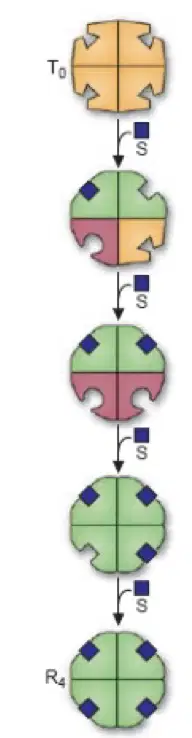
The image best represents...
positive cooperativity
isozymes
negative feedback
enzyme-substrate complex
Where do activators bind on an allosteric enzyme?
either an allosteric site or active site
allosteric site
active site
An allosteric activator does what to an enzyme?
breaks down the enzymes
changes its confirmation and decreases its affinity for substrate
changes its confirmation and increases affinity for substrate
Allosteric activators bind at a site other than the active site.
True
False
Which confirmation would cause allosteric activators to bind more tightly?
R state
T state
Locks enzyme in the T state.
allosteric inhibitor
allosteric activator
coenzyme
substrate
Allosteric inhibitors bind more tightly to
R state
the T state
Which would make it MORE difficult for a substrate to its active site?
allosteric activator
allosteric inhibitor
Which of the following would overcome the effects of an allosteric inhibitor?
increasing substrate concentration
increasing activator concentration
decreasing substrate concentration
increasing inhibitor concentration
Serve as rate limiting enzymes in metabolic pathways.
allosteric enzymes
isozymes
coenzymes
all enzymes
An allosteric effector needs to resemble the substrate or product of an enzyme.
True
False
Serve as allosteric activators of many enzymes involved in metabolic pathways.
ADP and AMP
ATP
water
electrons
ADP and AMP indicate
high energy
low energy
excess ATP
loss of ATP
The effect of an allosteric effector is very fast.
True
False
Which type of enzyme is usually tissue specific?
isozymes
allosteric enzymes
coenzymes
Enzymes that catalyze the same reaction but have different physical properties and AA sequence.
regulatory enzyme
allosteric enzyme
isozyme
coenzyme
Which of the following is an isozyme to glucokinase?
lipase
protease
hexokinase
phosphatase
Found in skeletal muscle
hexokinase
glucokinase
found in the liver
hexokinase
glucokinase
Has low affinity for glucose and found in the liver.
hexokinase
glucokinase
has HIGH affinity for glucose and is found in RBCs, skeletal muscle, and most tissues.
hexokinase
glucokinase
have different kinetics but catalyze the same reaction.
isozymes
allosteric enzymes
coenzyme
Have different subunits depending on what tissue they are found in.
coenzyme
allosteric enzyme
isozyme
Either adding a phosphate or removing a phosphate.
phosphorylation
kinase
allosteric
Carry out phosphorylation (adds a phosphate)
kinase
phosphatase
protease
lipase
Carries out dephosphorylation (removes a phosphate)
kinase
phosphatase
lipase
protease
Transfer a phosphate group to the hydroxyl group of a specific tyrosine residue.
tyrosine phosphatase
threonine kinase
tyrosine kinase
serine kinase
Select all that accurately describes a phosphate group.
Bulky
small
negatively charged
neutral molecules
Phosphorylation is irreversable.
True
False
Transfer a phosphate group from ATP to OH group of this amino acid on a target enzyme.
serine
glycine
threonine
tyrosine
Phosphorylation and dephosphorylation is a slow process, often taking as long as 3 days.
True
False
What do kinases use as a source of phosphate groups?
ATP
AMP
Glucose
Ribosomes
Adding a phosphoryl group will....
make the compound neutral
make the molecule smaller
make the molecule nonpolar
alter electrostatic interactions
Phosphoryl groups can form hydrogen bonds.
True
False
If an enzymatic process is "reversible" what does that mean?
There is an inhibitor
there is an enzyme that can add and remove that molecule
we lack the enzyme to remove the molecule
the product will be immediately broken down
Which AA are commonly phosphorylated?
Tyrosine
serine
threonine
histadine
How is glycogen phosphorylase activated?
phosphorylation of Serine
dephosphorylation of glutamate
breakdown of glucose
lack of ATP
How is glycogen phosphorylase inactivated?
lack of oxygen
increase in AMP
dephosphorylation of serine
phosphorylation of serine
What is the rate limiting enzyme in glycogen degradation?
none of these
lipase
phosphorylase phosphatase
glycogen phosphorylase
Glycogen phosphorylase (rate limiting enzyme in glycogen degradation) can be summarized by: add phosphate to turn on, remove phosphate to turn off.
True
False
Which best describes a zymogen?
a neutral molecule
inactive precursor of enzymes (proenzyme)
overactive enzyme
allosteric enzyme
Proteolytic cleavage requires a lot of ATP.
True
False
After an enzyme undergoes proteolytic cleavage to be activated, it cannot be reversed back into a proenzyme.
True
False
The prefix "pro" and suffix "ogen" means...
inactive zymogen
active enzyme
enzyme that contains serine
nonpolar substrates
Pepsinogen is the...
active form of the enzyme
inactive form of the enzyme
proenzyme
Zymogens are activated by
adding a serine
dephosphorylation
proteolytic cleavage
phosphorylation
Which of the following is the active form?
Proinsulin
pepsin
pepsinogen
Insulin
Which of the following is the inactive enzyme?
chymotrypsinogen
chymotrypsin
How is chymotrypsinogen converted to a-chymotrypsin?
increase AMP
taking a phosphate off of serine
adding a phosphate to serine
by the proteolytic enzyme trypsin

