
 Worksheets
Final Exam 20256
Total questions: 62
Worksheet time: 37mins
1. One widely accepted theory suggests that the ancestors of Native American Indians migrated to the Americas from Asia by crossing the
Appalachian mountain range
Bering Strait land bridge
Atlantic Ocean
Great Plains
2. Many different native cultures developed in North America primarily because
Native American Indians worshiped many gods
Native American Indian groups did not trade with each other
hunting for food was an important
a variety of environmental conditions existed throughout this region
3. The buffalo was the primary source of food, shelter, clothing, and tools for Native American Indians of the
Southeast
Pacific Coast
Eastern woodlands
Great Plains
4. Early European explorers who came to the New World were looking for a northwest passage in order to
prove the world was round
improve trade with Native American Indians
explore the Great Lakes
find a shorter route to Asia
5. What was one result of the Columbian Exchange (the Encounter)?
Native American Indian populations continued to increase.
The African slave trade ended.
Diseases were spread to native populations.
Spain’s empire in the New World declined.
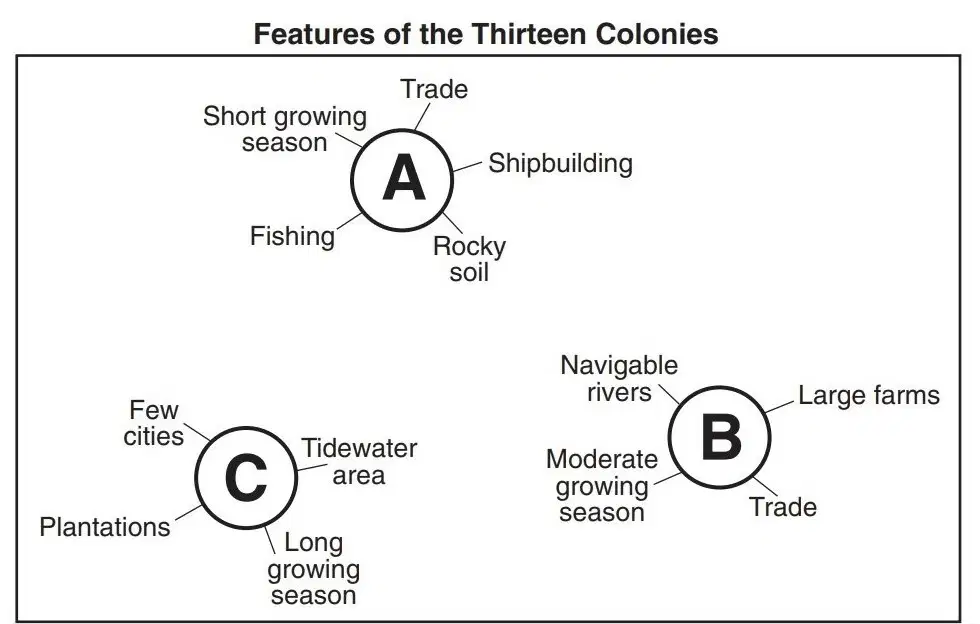
Base your answers to questions 6 through 8 on the diagram below and on your knowledge of social studies.
6. Which part of the thirteen colonies is represented by cluster A?
frontier region
New England colonies
middle colonies
southern colonies
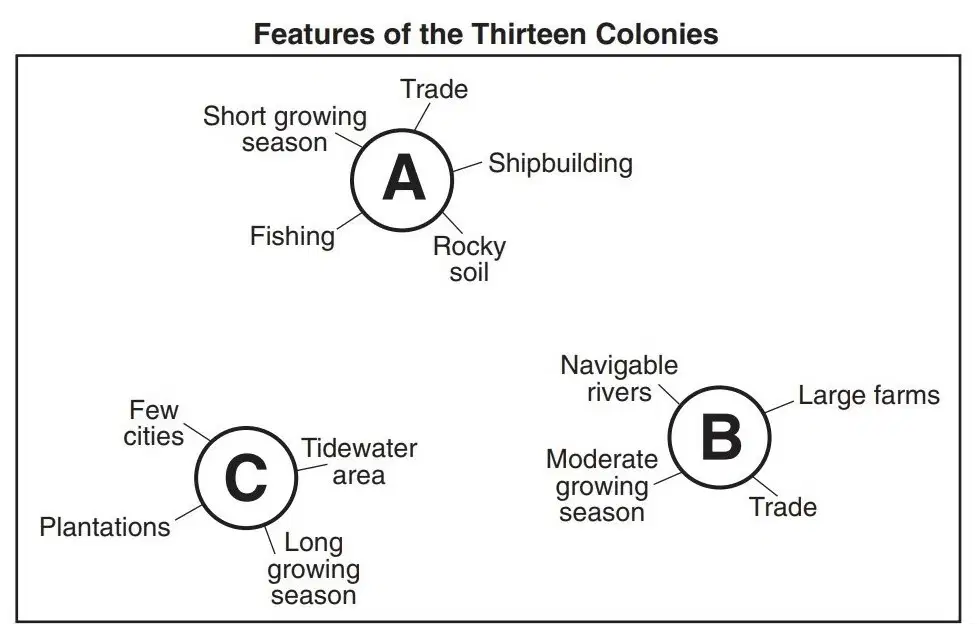
Base your answers to questions 6 through 8 on the diagram below and on your knowledge of social studies.
7. What were the chief exports produced by colonists in cluster C?
whale oil and silver
potatoes and fish
textiles and tea
tobacco and rice
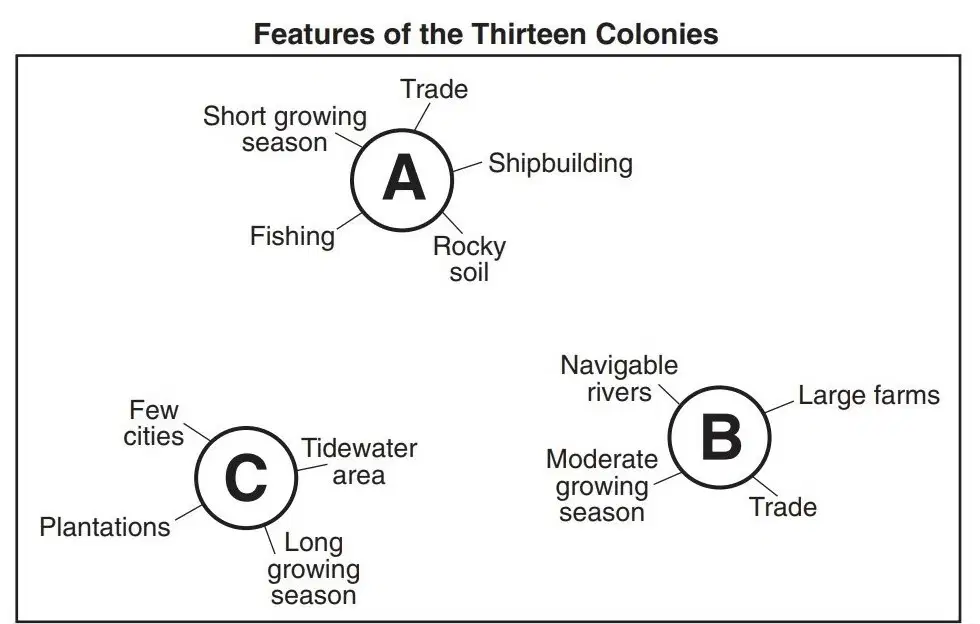
Base your answers to questions 6 through 8 on the diagram below and on your knowledge of social studies.
8. The differences between the three clusters shown in the diagram were mainly due to
geographic conditions
relations with England
political beliefs
religious practices
9. What was the main purpose of the Mayflower Compact?
to establish freedom of religion in the colony
to ensure obedience to the king of England
to provide a new chance for debtors and criminals
to create a government that would benefit the colony
10. • Cruel treatment • Poor sanitary conditions • Starvation and disease • Overcrowding and imprisonment Which group experienced these conditions?
Pilgrims on the Mayflower
passengers on the Underground Railroad
enslaved Africans during the Middle Passage
Native American Indians traveling with French fur traders
11. The need for agricultural workers in the early southern colonies led to the
formation of labor unions
decision to industrialize
improvement in farming
use of enslaved persons from Africa
12. What was a result of the French and Indian War that led directly to the American Revolution?
The British lost most of their colonies in the Americas.
French colonies expanded west of the Appalachians.
Native American Indians were given lands west of the Appalachians.
England decided to make the American colonists help pay war debts.
13. The major reason the British government issued the Proclamation of 1763, which banned colonial settlement west of the Appalachian Mountains, was to
avoid conflicts with Native American Indians
reduce casualties during the French and Indian War
maintain markets for British manufactured goods
promote easy collection of new taxes
14. Many American colonists believed that British tax laws were unfair because
colonists lacked representation in Parliament
the British treasury had a surplus of funds
Native American Indians were exempt from British tax laws
taxes were higher in the colonies than in England
15. The slogan “No taxation without representation” referred to taxes enacted by
colonial legislators
town meetings
the English Parliament
the First Continental Congress
16. In the American colonies, boycotts were an effective way of protesting British policies mainly because the boycotts
ended trade within the colonies
forced Britain to remove most troops
kept out products from other European nations
caused economic hardships for British merchants
17• Statement of grievances committed by Britain • Statement of the natural rights of life, liberty, and the pursuit of happiness • Establishment of the United States of America
Which document is associated with these actions?
Albany Plan of Union
Declaration of Independence
Articles of Confederation
Constitution of the United States
18. What was the primary purpose of the Declaration of Independence?
to persuade England to end slavery in America
to list reasons the colonies should be free from England
to provide a plan for financing the American Revolution
to convince the king to grant colonists more land
•Congress could not levy and collect taxes.
•Congress could not regulate interstate or foreign trade.
•There was no national court system to settle disputes.
•The thirteen separate states lacked national unity.
19. Which document is characterized by these statements?
Articles of Confederation
Federalist Papers
Northwest Ordinance
United States Constitution
20. Delegates to the Constitutional Convention of 1787 wrote a new constitution because
the Revolutionary War was over
the Articles of Confederation were about to expire
they wanted to increase the power of the states
they believed that a stronger central government was necessary
21. At the Constitutional Convention of 1787, conflicts between states with large populations and states with small populations resulted in the creation of
the offices of president and vice president
the three branches of government
a federal court system
a bicameral (two-house) legislature
22. To win support for ratification of the United States Constitution, Federalists agreed to
give up western land claims
restrict the importation of slaves
add a bill of rights to the document
grant voting rights to all adult white males
23. By which process can the United States Constitution be changed?
veto
amendment
resolution
legislative hearing
24. Which document guarantees freedom of speech, the right to bear arms, and protection from unreasonable search and seizure?
Bill of Rights
Albany Plan of Union
Declaration of Sentiments
Federalist Papers
25. One major reason historians consider George Washington a great president is that he
created many important practices still used by the government
made the United States a world power
ended conflicts among the Native American Indians
extended voting rights to most free males throughout the United States
26. A major reason President Thomas Jefferson supported buying the Louisiana Territory was because the purchase
gave the United States ownership of Florida
allowed the United States to gain control of California
gave the United States control of the port of New Orleans
removed the Spanish from North America
27. The Louisiana Purchase was important to the growth of the United States because it
doubled the size of the country
gave the nation control of the Great Lakes
completed America’s westward expansion
brought California into the Union
28. President Thomas Jefferson sent Lewis and Clark into the newly acquired Louisiana Territory primarily to
explore and map the region
search for gold and other valuable mineral deposits
improve relations with Native American Indians
force British and Spanish settlers out of the territory
29. Why did the North and the South have different attitudes toward higher
tariffs?
The North had better roads and canals.
Northern ports were closer to Europe.
The South had far fewer factories.
Prices of goods were always lower in the South.
30. The Trail of Tears resulted from President Andrew Jackson’s effort to
remove Native American Indians from all land east of the Mississippi River
teach Native American Indians the American lifestyle
return tribal lands to Native American Indians
allow native tribes self-rule within state boundaries
31. Which action toward Native American Indians did the United States government take between 1820 and 1840?
paying Native American Indians a fair price for their land
passing a law giving all Native American Indians United States citizenship
encouraging Native American Indians to take jobs in factories
removing Native American Indians from their tribal lands and placing them on reservations
32. President Andrew Jackson defended the spoils system as a benefit to democracy because it
created more political parties
granted the right to vote to more people
increased the power of the states
filled government jobs with common citizens
33. In the 1820s, New York City was connected to the Great Lakes region by the
Pony Express
Louisiana Purchase
New York Central Railroad
Erie Canal
34. Which event was a major cause of the War with Mexico (1846–1848)?
Missouri Compromise
discovery of gold in California
passage of the Northwest Ordinance
annexation of Texas
35. During the late 1840s, thousands of people were attracted to California to
fight in the Mexican War
help build railroads
search for gold
obtain good farmland
36. Mass production is a term that can best be defined as the
number of hours employees are required to work
manufacture of large quantities of a product quickly and cheaply
profit made by a large business or corporation
formation of a business monopoly
37. Eli Whitney and Samuel Slater were important to the early Industrial Revolution in the United States because they
developed new methods of manufacturing
invented new forms of transportation
built machines powered by steam
improved techniques in the production of steel
38. The cotton gin advanced the growth of the textile industry because it
reduced the time needed to plant cotton seeds
improved the process of weaving cotton cloth
made it possible for unskilled slaves to cultivate cotton
provided a faster method of separating seeds from cotton fiber
39. The Industrial Revolution began in the
shipping industry.
textile industry.
mining industry
farming industry.
40. Which of the following was part of the Missouri Compromise?
Slave owners would not be allowed to pursue slaves who escaped to
“free” territory.
The Louisiana Territory north of the southern border of Missouri would
be free of slavery.
All children born to enslaved people in Missouri would be free.
No additional slaves could be brought into Missouri after its admission
to the Union as a slave state.
41. During the first half of the 19th century, the abolition movement worked to
end slavery
promote the civil service system
establish free public schools
limit consumption of alcoholic beverages
42. Which of the following might have been said by someone in the women’s
rights movement?
“Women should have the same educational opportunities as men.”
“Women don’t need to be educated because they don’t vote.”
“Having an education won’t help a woman be a good mother.”
“A woman who wants an education isn’t a good wife.”
43. The Underground Railroad was developed in the 1840s in order to
smuggle illegal goods into the country
help runaway slaves escape to freedom
provide a form of inexpensive transportation
stop illegal aliens from entering the country
44. Which abolitionist leader was a “conductor” on the Underground Railroad?
John Brown
William Lloyd Garrison
Harriet Beecher Stowe
Harriet Tubman
45. Which event led directly to the secession of Southern States from the Union in 1860 and 1861?
election of Abraham Lincoln as president
passage of the Kansas-Nebraska Act
adoption of a new fugitive slave law
decision of the Supreme Court in Dred Scott v. Sanford
46. How did the Civil War begin?
Federal troops attacked Fort Sumter, South Carolina
Confederate troops attacked Fort Sumter, South Carolina
Confederate troops attacked federal forts off the coast of Florida
Union troops attacked Confederate forts off the coast of Florida
47. By issuing the Emancipation Proclamation, President Abraham Lincoln
lost Northern support for the war
broadened Union war goals to include ending slavery
strengthened the principle of states’ rights
brought a quick end to the war
48. What advantage did the South have over the North during the Civil War?
greater manufacturing
more effective navy
better government
more capable military leaders
49. Which of the following was a successful strategy for winning the Civil War?
The Confederacy prolonged fighting until the northern spirit broke
The Union pursued the Confederates back to the South after the Battle of Antietam
The Union took control of the Mississippi River
The Confederacy continued to receive supplies from Europe
50. What was the North’s one official goal at the start of the Civil War?
to protect the northern way of life
to abolish slavery
to drive slave states out of the union
to keep the Union together
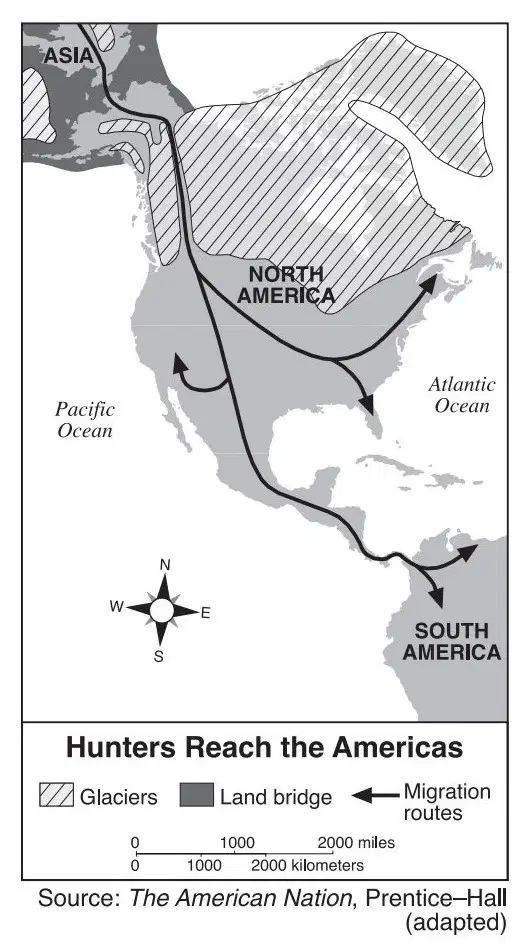
Directions: Write your answers to the questions that follow in the spaces provided in this test booklet. Base your answers to questions 51 through 53 on the map below and on your knowledge of social studies.
51. According to the theory on which this map is based, from which continent did hunters migrate to North America?
(a)
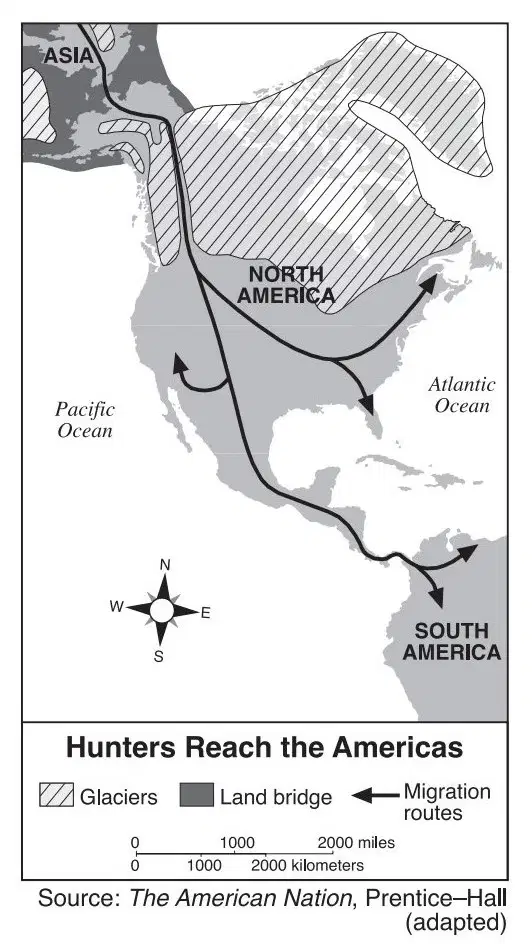
Directions: Write your answers to the questions that follow in the spaces provided in this test booklet. Base your answers to questions 51 through 53 on the map below and on your knowledge of social studies.
52. According to this map, which geographic feature probably allowed the hunters to migrate?
(a)
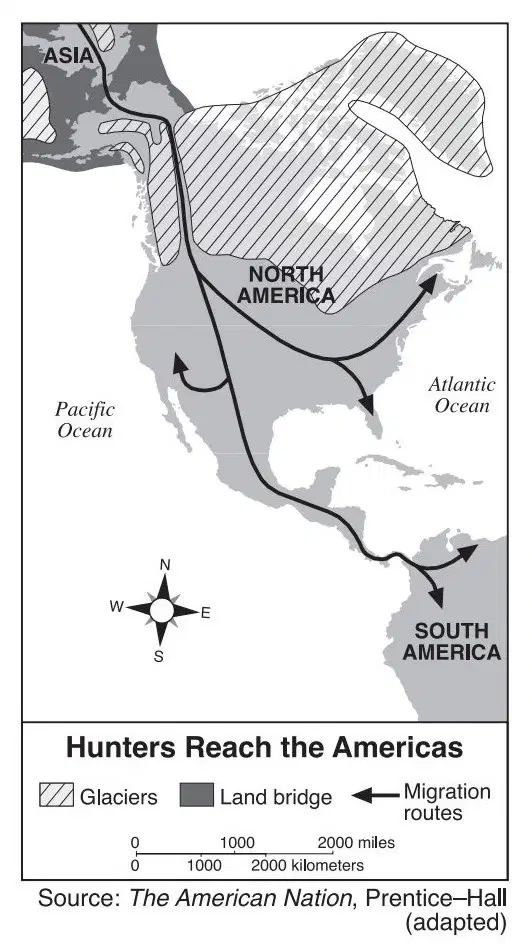
Directions: Write your answers to the questions that follow in the spaces provided in this test booklet. Base your answers to questions 51 through 53 on the map below and on your knowledge of social studies.
53. State one reason hunters migrated further south rather than settling in the northernmost part of North America.
(a)
Base your answers to questions 54 through 56 on the map below and on your knowledge of social studies.
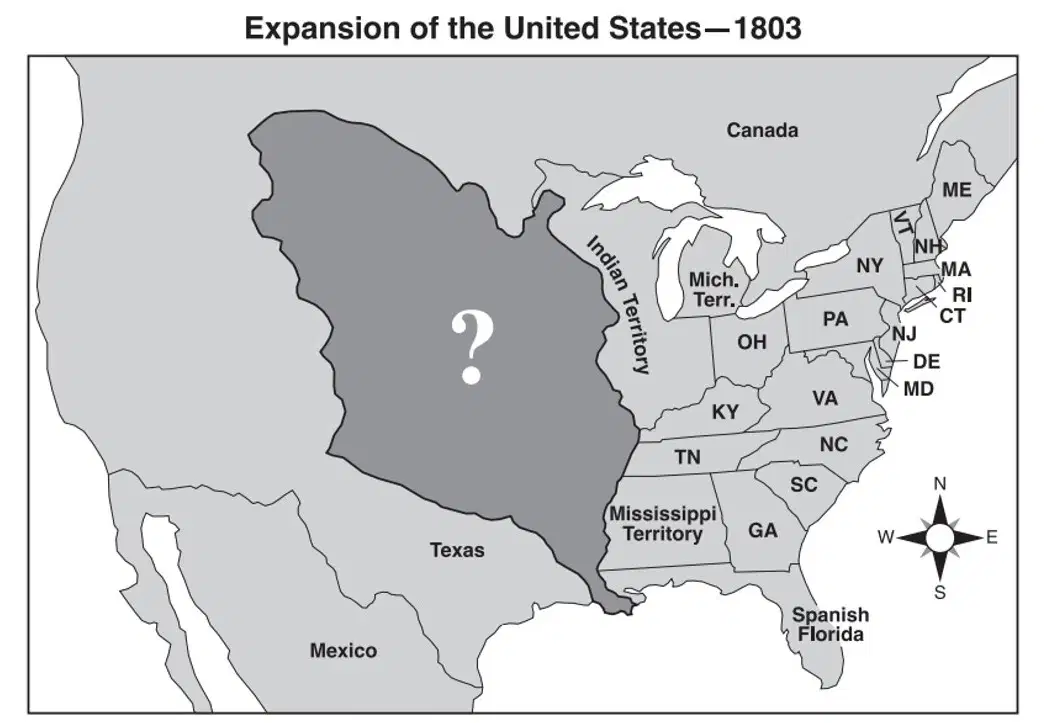
54. Which European nation controlled Florida in 1803?
(a)
Base your answers to questions 54 through 56 on the map below and on your knowledge of social studies.
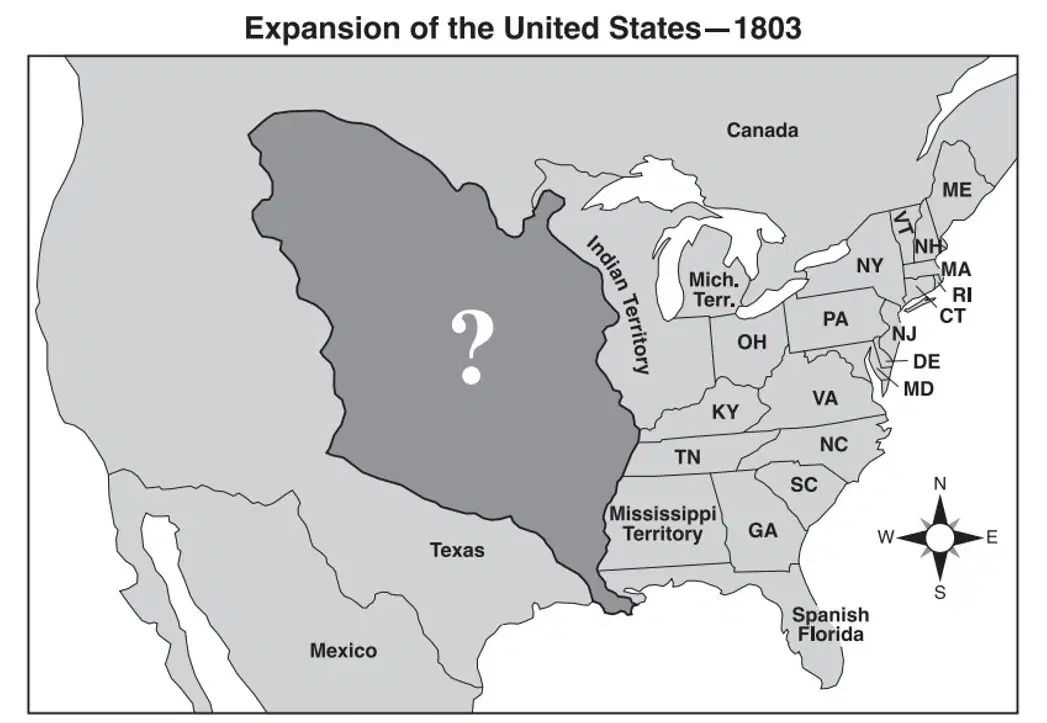
55. How did the United States obtain the area that is shown on the map with a question mark?
(a)
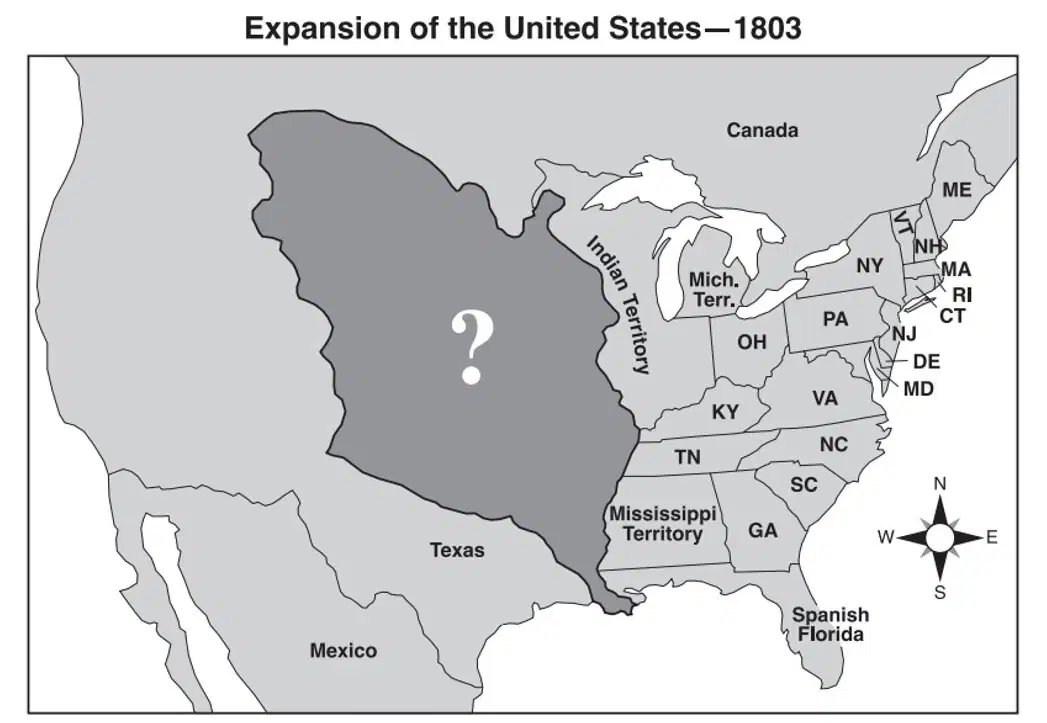
Base your answers to questions 54 through 56 on the map below and on your knowledge of social studies.
56. State two ways the land identified by the question mark benefited the United States.
(a)
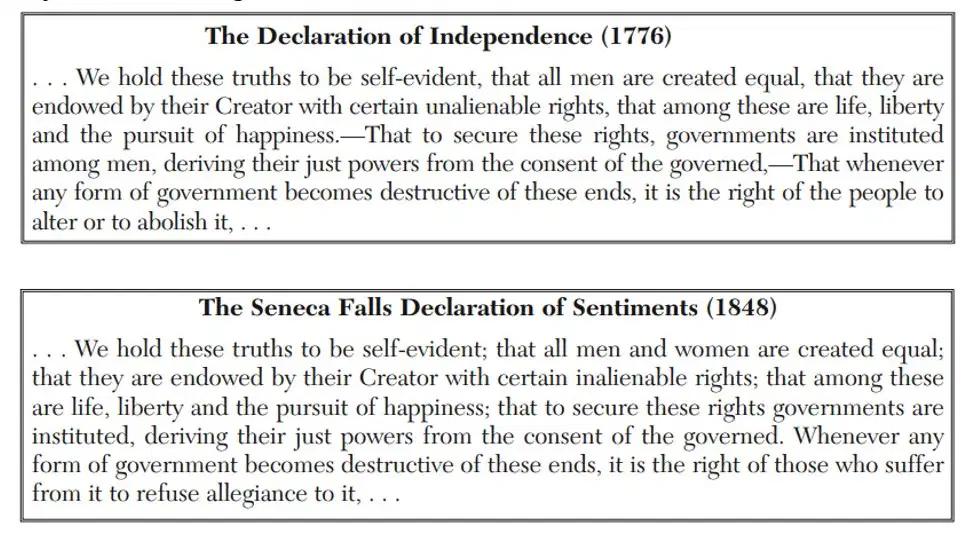
Directions: Write your answers to the questions that follow in the spaces provided in this test booklet. Base your answers to questions 57 through 59 on the passages below and on your knowledge of social studies.
57. When the Declaration of Independence was written in 1776, who was considered to be created equal?
(a)
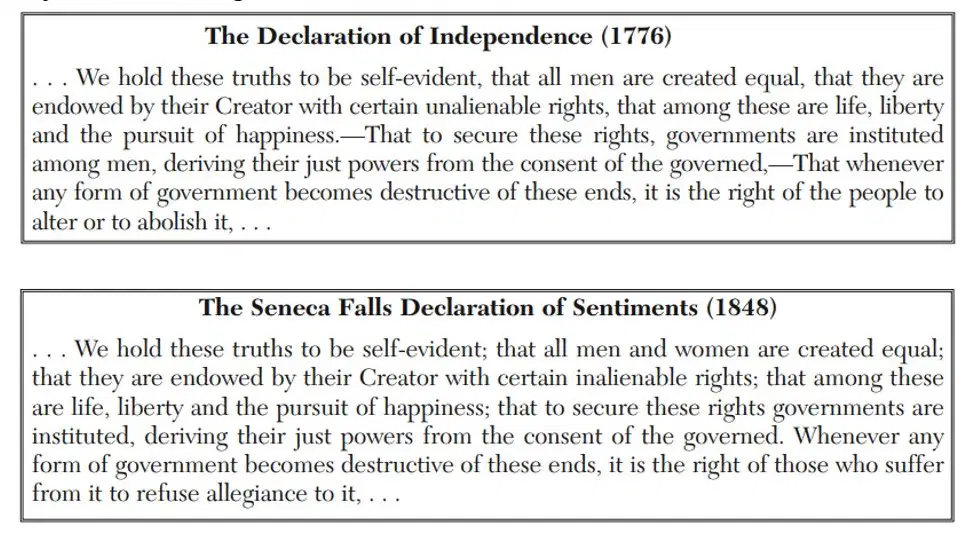
Directions: Write your answers to the questions that follow in the spaces provided in this test booklet. Base your answers to questions 57 through 59 on the passages below and on your knowledge of social studies.
58. State one way the ideas found in the Seneca Falls Declaration of Sentiments are different from the ideas found in the Declaration of Independence.
(a)
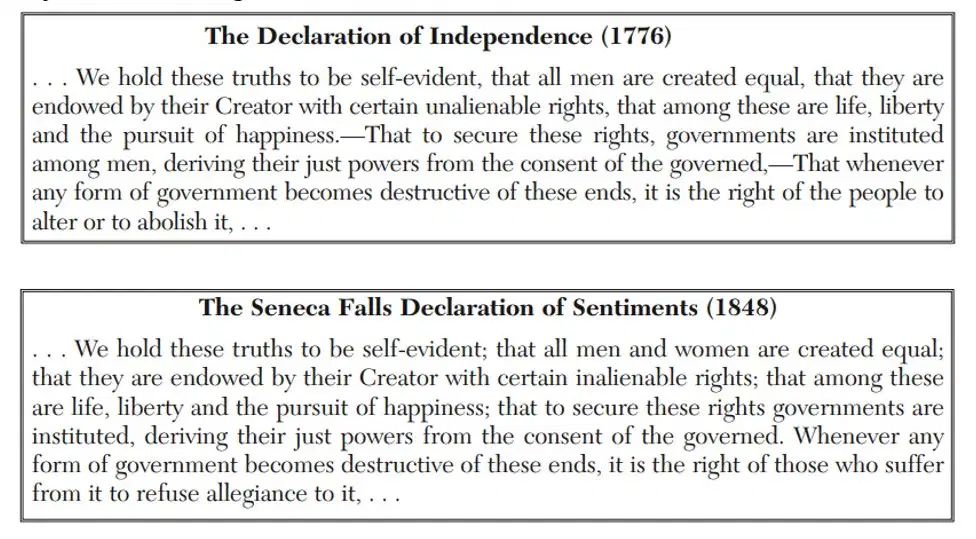
Directions: Write your answers to the questions that follow in the spaces provided in this test booklet. Base your answers to questions 57 through 59 on the passages below and on your knowledge of social studies.
59. Why was the Seneca Falls Declaration of Sentiments based on the ideas found in the Declaration of Independence?
(a)
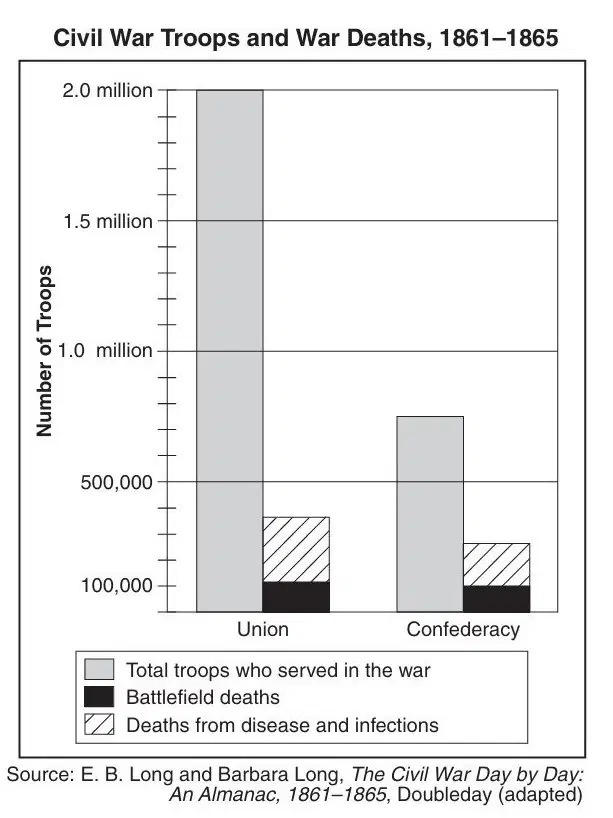
Base your answers to questions 60 through 62 on the graph below and on your knowledge of social studies.
60. Based on the information in this graph, state one advantage the Union had over the Confederacy during the Civil War.
(a)
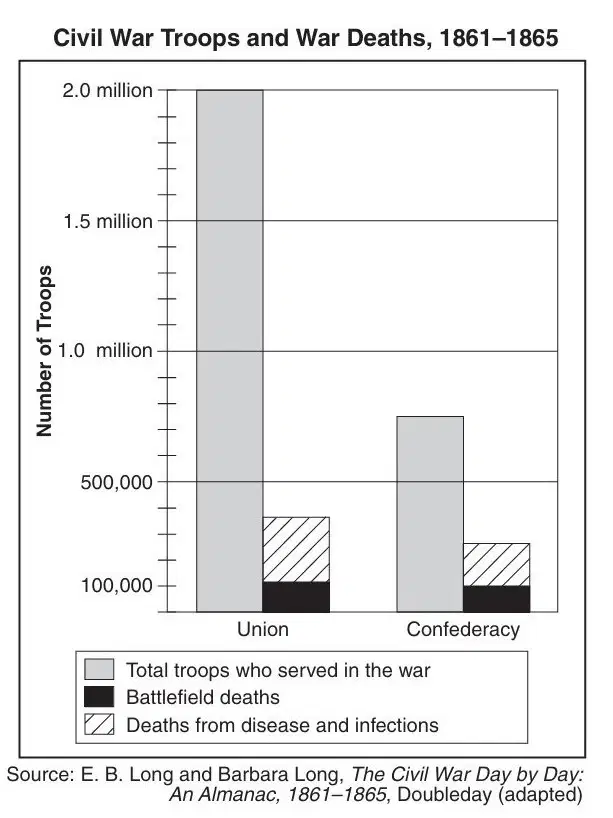
Base your answers to questions 60 through 62 on the graph below and on your knowledge of social studies.
61. Approximately how many Confederate troops died during the Civil War?
(a)
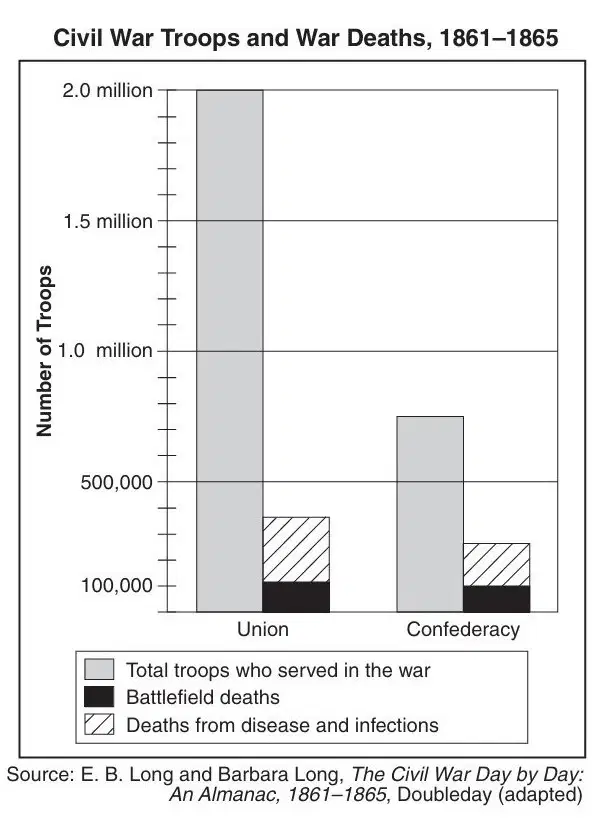
Base your answers to questions 60 through 62 on the graph below and on your knowledge of social studies.
62. State one reason deaths from disease and infections were greater than battlefield deaths during the Civil War.
(a)

