
 Worksheets
Molecules Of Life 1.1 - 1.3
Total questions: 15
Worksheet time: 8mins
Which of the following properties of water are a result of intermolecular forces?
High surface tension and good solvent
High surface tension, good solvent and cohesive
High surface tension and good solvent and high specific heat capacity
High surface tension, good solvent, cohesive and high specific heat capacity
Water is a polar molecule. What does this statement mean?
That water is one of the many hydrophobic molecules
That water molecules are linear, like a pole
That atoms in the molecules have partial charges as a result of unequal sharing of electrons in a covalent bond
That the atoms in water have equal electronegatives
In a group of water molecules, hydrogen bonds form between which of the following?
The oxygen atoms in different water molecules
Two hydrogen atoms in different water molecules
The oxygen atom in one water molecule and a hydrogen atom in another water molecule
The hydrogen atoms in a single water molecule
Sweating has a cooling effect because of water's high __________________
specific heat of capacity
cohesion of water molecules
hydrophobic interaction
latent heat of vaporisation
Which of the following occurs because molecules of water are farther apart in ice than in liquid water?
Ice expands when it melts
Ice floats
Ice vaporises before liquid water does
Ice is denser than liquid water

Which bonds are found in glycogen?
A
B
C
D

Which of the molecules below is α-glucose?
A
B
C
D
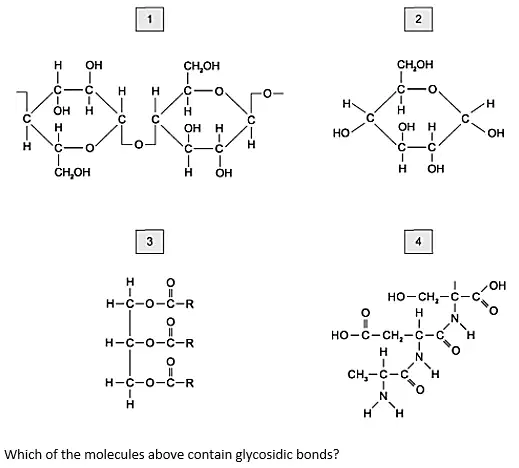
The diagrams below show a number of biological molecules.
I only
I and II only
I, II and IV
I and III only
Which of the following statements is true?
Many condensation reactions in the breakdown of amylose and amylopectin, release stored energy.
The amylose-amylopectin complex is insoluble, so it does not affect the water potential of the cell.
Many hydrolysis reactions in the formation of amylose and amylopectin allow the release of stored energy to fuel cellular processes.
Amylose has a branched structure and amylopectin is coiled to give a compact structure for transport around the plant through the phloem.
Which of the statements below correctly describes a disaccharide?
Sugars formed from two subunits joined together by a peptide bond that forms during a hydrolysis reaction.
Sugars formed from two subunits joined together by a glycosidic bond that forms during a hydrolysis reaction.
Sugars formed from two subunits joined together by a glycosidic bond that forms during a condensation reaction.
Starches formed from two subunits joined together by a peptide bond that forms during a condensation reaction.
In what polysaccharide form do plants store glucose to be available later as an energy source
glycogen
cellulose
fatty acids
starch
Where are the double bonds located in unsaturated lipid molecules?
Within fatty acid chains and within glycerol molecules
Within fatty acid chains only
Between glycerol molecules and fatty acid chains
Within glycerol molecules only

Which molecule in figure below contains ester linkages?
A
B
C
D
Which of the following statements about triglycerides is incorrect?
They play a vital role in energy storage within an organism.
They have a lower ratio of oxygen to carbon compared with carbohydrates.
Only triglycerides with unsaturated fatty acid chains contain double bonds.
They are made up with three glycerol combined with fatty acids.

Two biological molecules are shown below.
A
B
C
D

