
 Worksheets
Unit 5 Lesson 1- Leaders and Issues of the Early Republic
Total questions: 45
Worksheet time: 45mins
Match the following Early Republic presidents in order
1st President
George Washington
2nd President
John Adams
3rd President
Thomas Jefferson
4th President
James Madison
5th President
James Monroe
George Washington
Whiskey Rebellion
John Adams
Alien & Sedition Acts
Thomas Jefferson
Marbury v. Madison
Why did Alexander Hamilton think a national bank would strengthen the central government?
The bank would help provide stability for the U.S. economy
The bank would create a monopoly that would eliminate state banks
The bank would encourage foreign competition for manufactured goods
The bank would have the power to regulate interstate commerce
Which of the following is the best example of an early U.S. struggle to define the domestic authority of the central government?
(a)The Whiskey Rebellion challenged the idea that -
the federal government had the power to pass and enforce tax laws
a national military was needed for dealing with foreign threats
the federal government could raise tariffs to protect industries
a national court system was needed for resolving disputes between states
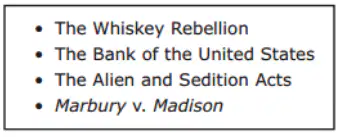
This list provides examples of -
topics discussed during the Second Constitutional Convention
domestic issues faced by the leaders of the new republic
weaknesses of the government under the Articles of Confederation
issues leading to the ratification of the first constitutional amendments
Which problem did George Washington encounter when he became president?
Southern states were threatening to secede from the Union
The United States had large debts from the American Revolution
Great Britain was refusing to trade with the United States
The Articles of Confederation needed to be replaced with a stronger constitution
According to Alexander Hamilton, which action was necessary to ensure the stability of the nation's economy?
The passage of a trade embargo against Great Britain
The abolition of consumption taxes
The creation of a trade alliance with France
The establishment of a national bank
What issue was the Whiskey Rebellion over?
(a)What did Congress pass to set up the number of federal courts and their locations?
(a) (a) members are chosen by the (b) but they must be approved by the (c) .
The present three-level court system was established by the (a) .
Which of the following statements most accurately describes judicial review?
the power to nominate and appoint new judges
the power to reverse the decisions of lower courts
the power to review presidential actions
the power to declare laws unconstitutional
Which Supreme Court case established judicial review?
(a)The government is divided into three branches, each with its own, specified powers.
(a)
The Supreme Court issued its famous Marbury v. Madison ruling in what year?
(a)The outcome of the case led the Supreme Court to declare that the Judiciary Act of 1789 was (a) (meaning it violates the Constitution and is therefore not permitted)
McCulloch v. Maryland was about whether a state could (a) a U.S. bank.
The decision in McCullough v. Maryland defined which clause that shaped Congress’s power?
Necessary & Proper
The clause to collect taxes
The right of states to control interstate commerce
The River Clause
The decision in Gibbons v Ogden (1824) addressed which of the following issues?
The issue of congressional privileges
The regulation of interstate commerce
The right of states to tax a federal property
The Supreme Court’s right to declare Congressional acts unconstitutional
What was the result of the Supreme Court decisions made by Chief Justice John Marshall in the following cases:
- Marbury vs. Madison
- McCullough vs. Maryland
- Gibbons vs. Ogden
the court upheld the rights of the workers.
the court abolished the system of slavery.
the court protected the rights of children.
the court ruled in favor of strengthening the federal government.
How did the appointment of “midnight judges” by president Adams impact future Supreme Court cases?
explained the creation of the chief justice position
allowed presidents to decide important cases
resulted in the ruling of McCulloch v. Maryland
led to the principle of judicial review
What do you call the buying and selling of goods that occurs between different states?
monopolies
Intrastate Commerce
Interstate Commerce
Bartering
What case established the federal government’s control over interstate commerce?
McCulloch vs Maryland
Tinker vs. Des Moines
Marbury vs. Madison
Gibbons vs. Ogden
What was the direct cause of the Whiskey Rebellion
WWI
WWII
The Great Depression
tax on the manufacture and sale of whiskey
During the rebellion, who resigned as Washington's secretary?
John Adams
Thomas Jefferson
James Madison
None of these
Why did back country farmers hate the tax on whiskey?
a. The tax greatly reduced the value of their corn
b. The farmers were uneducated and could not figure out the tax rates
c. The tax sharply reduced their income
d. The tax was higher than the one the wine makers had to pay
How did Pres. Washington's handling of the Whiskey Rebellion prove about the national government?
The national government is too weak to enforce its laws.
A democratic government can't work.
The national government is strong enough to enforce its laws.
conduct or speech inciting people to rebel against the government
alien
sedition
amendment
freedom of expression

