wayground logo

Free Printable Worksheets

Font size

S
M
L
XL
Worksheets

American Democracy- Unit 2: The Critical Period

Total questions: 38

Worksheet time: 2hrs 53mins

Name
Class
Date
1.

What was the main weakness of the Articles of Confederation?

a)

the federal government was too weak

b)

It had no legislative branch

c)

The judicial was too powerful

d)

The executive was too powerful

2.
A weakness of the Articles of Confederation is that it had __________ . 
a)
only an executive branch
b)
only a legislative branch
c)
only a judicial branch
d)
an executive and legislative branch
3.
One major problem with the Articles of Confederation is that Congress could not ______ the citizens to raise money.
a)
tax
b)
ask
c)
demand
d)
force
4.
Who had more power under the Articles of Confederation?
a)
Federal Government
b)
State Governments
c)
Individual people
d)
States with larger populations
5.
Which branch of government existed when the Articles of Confederation was created?
a)
Legislative (congress)
b)
Judicial (Supreme court)
c)
Executive (President)
d)
Legislative, Executive, and Judicial
6.
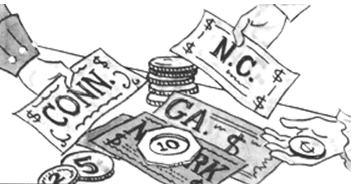
Which of the following weaknesses  in the Articles of Confederation does  this picture represent?
a)
no common currency (money)
b)
no executive branch
c)
no power to tax
d)
one vote for each state
7.
Under the Articles of Confederation, how many votes did each state get?
a)
Zero
b)
One
c)
Two 
d)
Three
8.
Which of the following is an example of a weakness in the Articles of Confederation?
a)
Congress couldn't collect taxes
b)
Weak national government
c)
Provided no common currency/money for all 13 states
d)
All of the  above
9.
Why was this first U.S. government so weak?
a)
King George III  was still in charge of USA
b)
Americans were afraid to give their new government too much power
c)
The American army did not win their independence from Great Britain and King George III
d)
ask; no
10.
The Articles of Confederation created a ________ national government.
a)
weak
b)
strong
c)
both strong and weak
d)
neither  strong nor  weak
11.
Because of the Articles  of  Confederarion the government could NOT regulate(control) ______ among the states.
a)
food quality
b)
laws
c)
travel
d)
commerce (trade)
12.

Why were farmers in Massachusetts so upset in 1786 and 1787?

a)

The US was getting ready to go to war with France and they'd have to be soldiers again

b)

The national government kept raising taxes on farmers to pay off the war debt

c)

They were losing their farms because they could not afford the taxes on them

d)

No one would buy their crops because they were over priced

13.

What did Daniel Shays' and his men do?

a)

Challenged the US military to a battle under the Constitution

b)

Took over courthouses by going in armed and refusing to leave

c)

Paid Native Americans to raid the houses of the wealthy and powerful Bostonians

14.

What did Shays' rebellion reveal about the Articles of Confederation?

a)

That it was too similar to the British system

b)

That it was too weak to succeed

c)

That it was strong and resilient

d)

That it was a successful model of government

15.

What did Shays' Rebellion help Americans realize they needed?

a)

A strong federal government

b)

A stronger militia

c)

A common currency

d)

The ability to sign peace treaties

16.

The most important thing to remember about Shaye's Rebellion is........

a)

That it showed the weaknesses of the Articles of Confederation and the need for revision of the current government.

b)

It showed the weaknesses of the Constitution and how the Articles of Confederation would be more effective.

c)

One man can not rule them all and that the Articles of Confederation would be a more representative government.

17.
What was the Great Compromise?
a)
The Virginia Plan
b)
The New Jersey Plan
c)
A combining of the Virginia Plan and the New Jersey Plan
d)
A destruction of the Virginia & New Jersey plans
18.

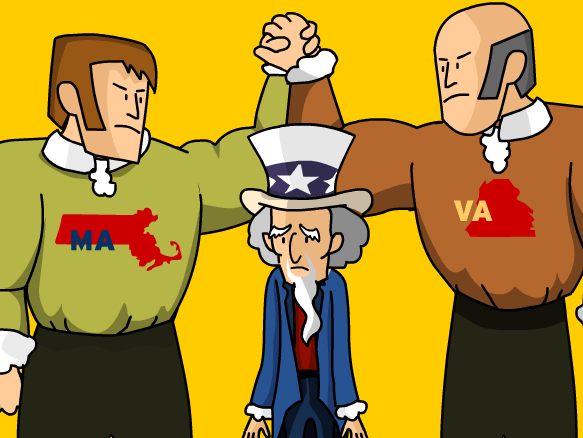
What does the political cartoon represent?

a)

3/5 Compromise: every 5 slaves = 3 people for representation & taxation in Congress

b)

5/3 Compromise: every 3 slaves = 5 people for representation & taxation in Congress

c)

3/5 Compromise: every 3 slaves = 5 people for representation in the slave trade taxes

d)

10/8 Compromise: every 10 slaves = 8 people for representation in the Appalachian Mountains

19.
Determining representation in the House of Representatives & the Senate caused - 
a)
conflict between the north and the south
b)
conflict between the large states & the small states
c)
conflict between the middle colonies, the southern colonies & the New England colonies
d)
conflict between all the delegates
20.

What made people concerned about the weakness of the central (federal) government under the Articles of Confederation and caused the revision?

a)

The Great Compromise

b)

Constitutional Convention

c)

The 3/5 Compromise

d)

Shay's Rebellion

21.
The smaller states wanted - 
a)
equal representation for all states in Congress
b)
representation in Congress based on a state's population
c)
the revision of the Articles of Confederation
d)
the nation's capitol in New Jersey
22.
What was New Jersey's plan?
a)
Representation in Congress and taxation is based on population
b)
All states have equal representation in Congress & taxation
c)
That we only have 2 branches of government: legislative and executive
d)
That we keep the Articles of Confederation the same
23.
What was Virginia's plan?
a)
Representation in Congress and taxation is based on population
b)
All states have equal representation in Congress & taxation
c)
That we only have 2 branches of government: legislative and executive
d)
That we keep the Articles of Confederation the same
24.
Every state has 2 representatives in the - 
a)
The Legislative Branch
b)
House of Representatives
c)
Congress
d)
Senate
25.
Every state has representatives based on population in the - 
a)
The Legislative Branch
b)
House of Representatives
c)
Congress
d)
Senate
26.
What was the original purpose of the Constitutional Convention?
a)
To rewrite the Declaration of Independence
b)
To rewrite the Articles of Confederation
c)
To write the Treaty of Paris
d)
To elect the first president
27.
The three branches of government are ________________
a)
Executive, Legislative, and Judicial
b)
Legislative, Judicial, and National
c)
Executive, Principle, and Judicial
d)
Judicial, National, and Legislative
28.
Which branch of government has two houses?
a)
Executive
b)
Legislative
c)
Judicial
d)
National
29.
Which part of the legislative branch has representation based on population?
a)
Senate
b)
Judicial
c)
House of 
Representatives
d)
House of Congress
30.
Which part of the legislative branch has the same number of representatives for each state?
a)
House of Representatives
b)
Judicial
c)
Executive
d)
Senate
31.
The _______________ was the solution to the disagreement about how many representatives each state would have. 
a)
Great Compromise
b)
Three-fifths Compromise
c)
Great Dispute
d)
Big Agreement
32.
How were slaves counted as part of the population when deciding the number of representatives for a state?
a)
All slaves were counted.
b)
Three-fifths of the number of slaves was added to the population.
c)
Slaves were not counted at all.
d)
Slaves were allowed to vote and be elected to represent each state.
33.
The Great Compromise accomplished which of the following? 
a)
Created a one house legislature
b)
Postponed the conversation about slavery
c)
Added the Bill of Rights 
d)
Created a two house legislature
34.
A major weakness under the Articles of Confederation was-
a)
Congress could not negotiate treaties
b)
Congress could print money
c)
Congress did not have the power to raise money or enforce laws
d)
Congress established the Northwest Ordinance
35.

James Madison, Alexander Hamilton and John Jay were....

a)

Federalists

b)

Anti-Federalists

36.

An Anti Federalist believed...

a)

There should be a weak central government

b)

There should be a powerful central government

37.

A strong central government would be able to...

a)

Create rules and regulations for the entire nation

b)

Give power to the states to create their own rules and regulations

38.

Who would represent the Executive Branch?

a)

The President

b)

Congress

c)

Supreme Court