
 Worksheets
Unit 1 World History Practice Test [SEMESTER 1]
Total questions: 98
Worksheet time: 1hrs 7mins
What was another name for the Neolithic Revolution?
Agricultural Revolution
New World Revolution
Did the Mesopotamians and Egyptians settle in different environments, or were they almost identical to each other.
They settled in substantially different environments, although both civilizations settled near fertile river valleys.
The environments that the Mesopotamian and Egyptian civilizations were the same.
What was the main cause of the development of the first urban centers?
Industrialization.
Improved agricultural technologies, such as irrigation canals.
What was the name of the arch in which Mesopotamia was developed in, and what two rivers made up said arch?
Fertile Crescent; Tigris and Nile Rivers
Fertile Crescent; Tigris and Euphrates Rivers
True/False: Mesopotamia lacked natural boundaries, making it susceptible to frequent invasions and nuking.
True. This is one of the main things that made Mesopotamia different from Egypt.
False. Mesopotamia had natural boundaries such as large bodies of water and vast deserts, protecting it against invasions like ones mentioned in the question.
What river(s) did Egyptian civilizations develop near?
Nile River
Tigris and Huang He (Yellow) Rivers
Indus River
Ganges River
In what month(s) do/does the Nile River regularly each year? What would be deposited when these floods occurred?
July-November; silt that was ideal for agriculture.
January only; silt that was ideal for agriculture.
July-October; silt that was ideal for agriculture.
What was the regularity/consistency of the Nile River's flooding that helped with agriculture referred to by the Egyptian citizens?
Savior of the Nile
Gift of the Nile
Present of the Nile
What natural boundaries, if any, did Egypt have to protect them from repetitive invasions?
Egypt did not have any natural boundaries; they were constantly attacked due to them lacking protection.
Egypt had large bodies of water to the north and east.
Egypt had vast deserts to the north and south.
Egypt had vast deserts in the south and west.
How could one describe the religion of Egyptians and Mesopotamians? Choose all that apply.
Polytheistic
Monotheistic
Atheists
Were the attitudes of Mesopotamians and Egyptians towards their respective Gods similar or different? Choose the explanation that goes with your answer to the first question.
No; both civilizations had a positive attitude towards their respective Gods.
Yes; the civilizations had different attitudes towards their Gods.
Mesopotamia and Egypt were very similar in terms of environment, so they thought of their Gods the same.
The natural world of both civilizations differed significantly, resulting in them having different viewpoints on their Gods.
How did Mesopotamians view their Gods, and why?
Unpredictable; they prompted the fear of those who attempted to win their approval with elaborate rectangular structures known as Ziggurats
Dependable; they could be relied on to provide bounty and prosperity.
How did Egyptians view their Gods, and why?
Dependable; they could be relied on to provide bounty and prosperity.
Unpredictable; they prompted the fear of those who attempted to win their approval with elaborate rectangular structures known as Ziggurats
How did Mesopotamians view the afterlife?
They believed it to be fearful and gloomy.
They believed that good deeds in life were rewarded with a rich afterlife. This optimistic belief is what led to elaborate burial practices such as the construction of tombs and mummification.
How did Egyptians view the afterlife?
They believed it to be fearful and gloomy.
They believed that good deeds in life were rewarded with a rich afterlife. This optimistic belief is what led to elaborate burial practices such as the construction of tombs and mummification.
What was the name of the first phase of Mesopotamia's political history?
Sumer.
Hittite.
True/False: In the first phase of Mesopotamia's political history, each city-state had a walled urban area and a ceremonial and administrative center dominated by a Ziggurat.
True.
False.
What is the division of society by rank or class?
Open-class System.
Social hierarchy.
What group of people unified the region of Mesopotamia?
Babylonians.
Assyrians.
Hittites.
Who was the king of the group that unified Mesopotamia?
Hammurabi.
Julian.
What action did Hammurabi take that resulted in a flowering in mathematics and literature, and why was this action performed? Choose all that apply.
Hammurabi established the world's first written law code based on the "eye for an eye" principle. Punishments would be based on the wrongdoer's social class.
Hammurabi introduced school systems.
Hammurabi wanted to maintain order in Mesopotamia.
Hammurabi wanted to unify the region and the groups that he conquered/controlled.
Who was the leader of the Egyptian kingdom?
Hereditary monarch, referred to as a Pharoah.
the Pope.
What structures that were aided by priests, administrators, and scribes, served as tombs for the leader of Egypt?
Pyramids.
Ziggurats.
Historians divide Egyptian History into three periods. Select the three that historians use for naming them.
Old Kingdom.
New Kingdom.
Newer Kingdom.
Middle Kingdom.
True/False: Both the Mesopotamian and Egyptian empires developed specialization of labor, which in turn resulted in the establishment of social classes.
True.
False.
True/False: The Mesopotamian and Egyptian empires had contrasting social hierarchies.
True.
False.
True/False: The specialization of labor allowed for notable cultural and technological advances to be made.
False.
True.
Did Mesopotamia and Egypt develop complex systems of writing? If so, name the systems that go with each civilization.
No, neither one developed writing systems.
Yes, both developed writing systems.
Egypt used cuneiform, and Mesopotamia used hieroglyphics.
Mesopotamia used cuneiform, and Egypt used hieroglyphics.
Refer to the S.T.A.I.R acronym below.
Specialized workers: merchants, teachers, soldiers, farmers, scribes, government, priests, etc.
Technology: wheel, plow, sailboat, weapons, etc.
Advanced cities: heavily populated urban centers. Ur, Uruk, Lagash, and Umma in Mesopotamia.
Institutions: formal governments with officials & laws, priests with religious & political power, and education.
Record keeping: records of business transactions, historical events, customs, and traditions with the help of cuneiform tablets and hieroglyphics.
What two rivers were near the fertile plain where farming villages in South Asia first became prominent?
Indus and Ganges Rivers.
Indus and Tigris Rivers.
Nile and Euphrates Rivers.
Yangtze and Ganges Rivers.
What was/were the main climate(s) in India? Select all that apply.
Monsoon rains.
Sandstorms.
Tundra.
True/False: India had mountains to the north that partially isolated its people.
True.
False.
Of India's urban centers, which two were the most significant?
Mohenjo-Daro
Sumer
Harappa
What two rivers did farming villages in China appear enarnear?
Huang He (Yellow) River
Tigris River
Yangtze River
Nile River
What was the yellow silt that resulted from the flooding of the Yangtze called, and how did it impact the urban areas of China? Select all that apply.
Loess.
Sediment.
It supported agricultural practices in the region.
It made major shifts in the course of the rivers and massive floods common.
What element was present in the two urban cities of India (Mohenjo-Daro and Harappa), and what did that element indicate? Select all that apply.
Urban planning
Indicated a strong central government
Indicated a strong monarchy
Choose the statements that were true about Ancient India's layout.
Streets were laid out on a grid system.
There was a city-wide sewer and plumbing system.
Each city had a fortified citadel in the center, which likely served as the political and religious center.
Societies were generally peaceful, and the economy heavily relied on agriculture. There was also evidence of trade with the Middle East and Central Asia.
What was the name of the first documented dynasty of China?
Shang Dynasty
Ming Dynasty
Qing Dynasty
True/False: The Shang Dynasty began the tradition of a hereditary monarch with the support of a complex bureaucracy.
True.
False.
Which of the following elements was developed during the Shang Dynasty?
Writing system
Complex urban planning
Irrigation control
Flood control
True/False: The Shang Dynasty period included the emergence of foundational and interconnected Chinese religious principles.
Ex: Yin and Yang supported the idea that the universe was balanced between male and female forces.
True.
False.
What was the name of the first of the two Indian empires?
Mauryan Empire
Gupta Empire
True/False: The Mauryan Empire was ruled by a hereditary monarch.
True. Emperor As(h)oka was the leader of the Mauryan Empire.
False. The citizens of the empire were allowed to vote to decide their leader.
Which of the following traits resides with the Mauryan Empire? Select all that apply.
Central government
Collected high taxes, issued a standard currency
Maintained control of mining, had an extensive spy network
Powerful army with elephant, chariot, and cavalry divisions
What was the primary economic activity in the Mauryan economy?
Agriculture.
Textiles.
Select all of the answers that satisfy the blank.
Emperor As(h)oka ushered the first Indian Empire during a period of ____.
Religious pluralism
Tolerance
War
True/False: A very bloody battle caused Emperor As(h)oka to convert to Buddhism.
False. As(h)oka remained an advocate of violence until his death.
True. He felt guilty for the large amount of fatalities.
What were the buildings constructed by Emperor As(h)oka called, and what were their purpose? Select all that apply.
Stupas.
Ziggurats.
They promoted Buddhist teachings.
They promoted violence.
The Gupta Empire came to power following a period of ____.
Political disunity
Religious tolerance
Poverty
True/False: The founder of the Gupta Empire modeled his rule after that of the Mauryan Empire.
True. They collected taxes, demanded labor, and controlled metal mining and salt production.
False. They had a democracy and mainly focused on nomadic practices.
What religion was resurged during the Gupta Empire, and what element(s) of said religion became more prominent?
Hinduism.
Buddhism.
Caste System.
Patriarchy.
What is the tradition of sati?
Select all of the reasons for why the Gupta Empire was referred to as the Golden Age.
Trade continued to prosper.
Advances in mathematics were made (decimal system, Arabic numerals, pi)
Technological advances.
______ from the ______ were responsible for the fall of the Gupta Empire.
(Type your answer like so: answer 1, answer 2)
(a)
Select the term that satisfies this defintion.
Concept arguing that the ruling dynasty must rule with benevolence and Confucianism as told to them by Heaven.
Mandate of Heaven
4 Noble Truths
Eightfold Path
Select the basic tenants that were established during the Zhou Dynasty.
Filial piety
Adherence to tradition
Patriarchy and duty
Relationships
The Zhou Dynasty maintained ____ until about 800 BCE; by 480 BCE, civil war thrust China into the _____.
(Type your answers like this: answer 1, answer 2)
(a)
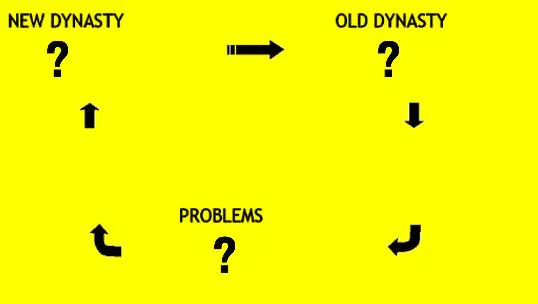
The image attached is the Dynastic Cycle. What should go in place of the question mark below New Dynasty?
- Brings peace
- (Re)builds infrastructure
- Gives land to peasants
- Protects people
- Taxes people too much
- Stops protecting people
- Lets infrastructure decay
- Treats people unfairly
- Corruption
- Floods, earthquakes, etc.
- Peasant revolts
- Invaders attack empire
- Bandits raid countrysite
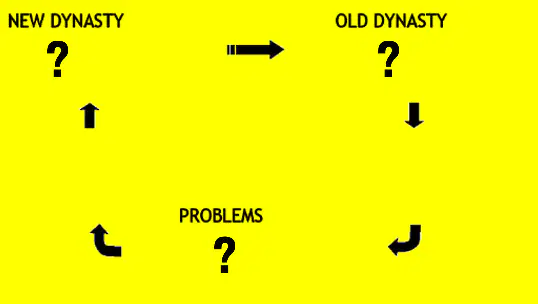
The image attached is the Dynastic Cycle. What should go in place of the question mark below Old Dynasty?
- Brings peace
- (Re)builds infrastructure
- Gives land to peasants
- Protects people
- Taxes people too much
- Stops protecting people
- Lets infrastructure decay
- Treats people unfairly
- Corruption
- Floods, earthquakes, etc.
- Peasant revolts
- Invaders attack empire
- Bandits raid countrysite
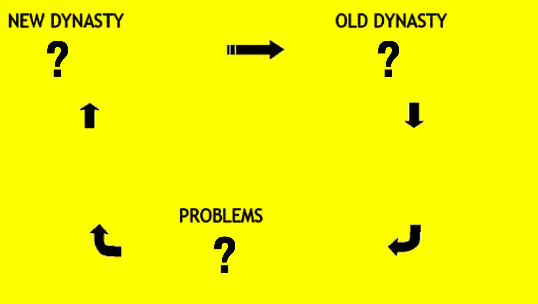
The image attached is the Dynastic Cycle. What should go in place of the question mark below Problems?
- Taxes people too much
- Stops protecting people
- Lets infrastructure decay
- Treats people unfairly
- Brings peace
- (Re)builds infrastructure
- Gives land to peasants
- Protects people
- Corruption
- Floods, earthquakes, etc.
- Peasant revolts
- Invaders attack empire
- Bandits raid countrysite
Who was the leader of the Qin Dynasty, and how did he come to power? Select all that apply.
Shi Huangdi.
Liu Bang.
Came to power after emerging victorious from the Warring States Period.
Was the leader of an invasion of the area.
True/False: The Qin Dynasty unified China politically, economically, and culturally.
False. The Qin Dynasty was very short-lived and made very few advancements that were not important.
True. Despite being short-lived, it receives credit for standardizing things such as weights, laws, writing, etc.
Select the way(s) in which the Qin Dynasty added to China's infrastructure.
Directed the construction of extensive roads and canals.
Began work on the Great Wall of China.
Constructed a grid system.
Established land reform that broke up the power of feudal lords.
Extensive ____ and ____ led to rebellion in the Qin Dynasty after ____'s death.
(Answers should be typed this way: answer 1, answer 2, etc)
(a)
The peasant who emerged as the new emperor of China after the fall of the Qin Dynasty was:
Liu Bang.
Shi Huangdi.
What was the test that citizens in the Han Dynasty had to take?
Civil service examination.
Eightfold Path.
The Han Dynasty profited tremendously from the export of (a) .
(Type your answer as shown: answer 1, answer 2, etc)
The Han Dynasty began to declined due to ____, _____, and nomadic invaders.
(Type answers as shown: answer 1, answer 2, etc)
(a)
Where was Hinduism preserved?
Vedas.
Stupas.
True/False: Hinduism began to formalize with the writing of the Upanishads.
True.
False.
The basic belief that are living things are reincarnated after death with the quality of their next life based on the deeds committed in their previous life is known as (a) .
Hindus are expected to live according to ____. The eventual release from reincarnation as a reward of good conduct is called ____.
(Answer format: answer 1, answer 2, etc)
(a)
The dominance of the Indo-European ____ led to the creation of a social class system better known as the ____ System.
(Answer format: answer 1, answer 2, etc)
(a)
The Hindu population was divided into ____ ____ social classes based on ____ and ____.
five, hereditary, ethnicity, occupation
four, hereditary, ethnicity, wealth
Hinduism fully developed in the (a) Empire.
Hinduism gaining traction resulted in the ideas of the ____ System and ____ becoming common.
(a)
Buddhism was founded by a Hindu prince named ____.
Siddhartha Gautama.
Emperor As(h)oka.
Another term for spiritual enlightment.
Nirvana.
Moksha.
Dharma.
True/False: Like Hinduism, patriarchy and the Caste System were present in Buddhism.
False. Buddhism excluding these elements made more people convert from Hinduism to Buddhism.
True. The founder was Hindu, so he included elements of Hinduism.
Of the concepts/teachings, select the ones that Buddhists must follow to reach Nirvana.
4 Noble Truths.
Eightfold Path.
5 Core Relationships.
Confucius, the creator of Confucianism, had a philosophy recorded in the (a) .
In Confucianism, the eldest male of a family is morally obligated to:
Lead and care for his household.
Become wealthy and appoint his family members to high positions.
Of the 5, select the answers that represent the relationships laid out in the Analects of Confucianism.
Ruler and subject.
Father and son.
Friend and friend.
Older brother and younger brother.
Husband and wide.
True/False: Confucianists must follow the golden rule:
"Never do to others what you would not like them to do to you."
True.
False.
The religion that helped monotheism reach its complete and enduring form among the Hebrews.
Zoroastrianism.
Christianity.
Islam.
True/False: God promised to protect His chosen people in exchange for their exclusive obedience to Him.
True.
False.
The basic tenants and Judaism, including monotheism, were established as the ____.
Ten Commandments.
Fruits of the Spirit.
True/False: While in Persia, synagogues were established, and in about 450 BCE, Judaism as a monotheistic faith was fully developed along with the completion of the Hebrew Bible.
False. These events did happen, just not in Persia. They occurred in Babylonia.
True.
The migration of which group of people allowed for the development of iron technology which was then used to produce agricultural tools?
Bantus.
Hebrews.
Jews.
True/False: The migration of Bantu-speaking people to the south and southeast was quick.
False. It was slow.
True.
What did the Bantu migration bring to the region? Select all that apply.
Agriculture.
Iron technology.
New language (region was previously dominated by hunter/gatherers).
Common cultural heritage (present in West, Central, East, and South Africa).
Societies involved with the Silk Road relied on (a) using horses, camels, and oxen.
True/False: Silk, glassware, cotton cloth, horses, spices, perfumes, and slaves led to the rise of the Silk Road.
True (kinda obvious).
False (don't choose).
Select the empires/dynasties that were linked by the Silk Road.
Chinese dynasties (Han, Sui, Tang)
Indian empires (Mauryan and Gupta)
Persians
Select the examples of answers that represent elements spread via the Silk Road.
Spread of Buddhism from India --> China
Spread of Christianity to the East
Spread of horse technology to China
Introduction of new crops to China, Rome, and Middle East
The vast network of exchange between East Africa, Middle East, South and Southeast Asia, and China during the Classical Age; caused by the predictable nature of the monsoon winds
Indian Ocean Trade.
Pacific Ocean Trade.
The two technologies developed by the Arabs that allowed for more efficient transport of goods were the ____ and ____ sail.
(Answer format: answer 1, answer 2, etc)
(a)
The (a) language of East Africa is a product of Arabs blending with the indigenous Bantu languages.

