
 Worksheets
Science grade 5
Total questions: 50
Worksheet time: 1hrs 9mins

What is the source of light?
building
shadow
sun
no source of light

What is this....?
mirror
periscopes
picture
light

The incoming light makes an ................. with the mirror
light source
beam
angle
nothing

Light reflects off mirror.............
different angle
same angle
will not reflect
no angle

This mirror helps us to see .....
in front of you
behind you
you can nothing
it will absorb the image

A mirror image........
up side down
back to front
same image
no image
At night, we use _________________ light sources such as lamps to provide us with light
man made
natural
shadow
translucent
The astronaut can see the Earth from the moon because the light hits the Earth and is__________ This light reaches he astronaut on the Moon.
reflected
direction
shadow
light sources
This quantity can be measured
light intensity
man made sources
light sources
shadow
Light from this enters our eyes
natural sorces
man made sources
light sources
shadow
Made when light from a source is blocked
natural sorces
man made sources
light sources
shadow
lightning
natural sorces
man made sources
light sources
shadow
Blessy moves towards the light source. The size of the shadow of Blessy’s head will . . .
drecease
get smaller
increase
get bigger
The correct man-made light sources are . .
campfire
moon
sun
light bulb
Class 5 are doing quiz about light and shadows
Shadows need light to form.
Opaque materials do not let light through.
Shadows change position only if the object moves.
Shadows are always longest at night
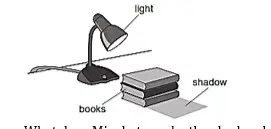
Mia puts some books on a desk. She turns the light on. The books make a shadow on the desk. What does Mia do to make the shadow longer?
remove a book
make the light dimmer
make the light brighter
add a book
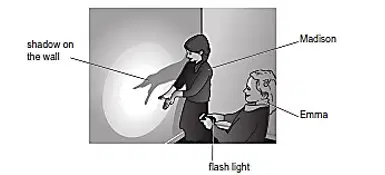
There is a shadow on the wall. What part of Madison makes the shadow?
flashlight
head
wall
hands
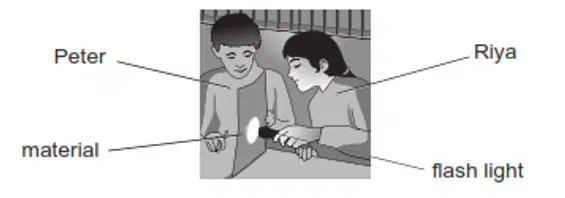
· Peter holds the material.
· Riya points the flashlight at the material.
What will happen when Peter holds a piece of transparent material?
I predict that light . . . through the material.
will be stopped
will be blocked
will pass
will be formed a shadow
The correct natural light sources are . . .
lighting
star
fireworks
light stick
Why can we see our reflection in the mirror?
Because it has smooth surface
Because it’s dull
Because it has rough surface
Because it’s shiny
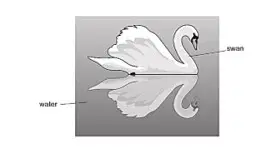
Which word describes why it looks like there are two swans in the picture?
intensity
reflection
shadow
transparent
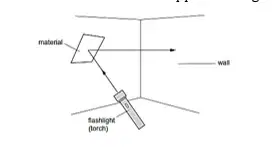
The light from the flashlight is reflected by the material. When this happens the light changes
absorbed
bounced
shape
direction
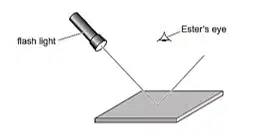
Alfi uses a flashlight to reflect light into Ester’s eye and Ester moves. Her eye is in a new position. What must Alfi do to the flash light so Ester can see the reflected light?
turn off the flash light
change the angle
change the mirror
change the flash light
The The correct sentence about light intensity is . . . .
Light from this enters our eyes.
Changes the size of a shadow
Made when light from a source is blocked
this quantity can be measured
which type of gas we use for breathing.
nitrogen
helium
carbon dioxide
none of these
78% of nitrogen is present in the air.
true
false
the blanket that surrounds the earth is called atmosphere
true
false
(a) is the outermost layer of the atmosphere.
the layer of the atmosphere where meteoroids burn up.
stratosphere
troposphere
exosphere
none of these
the ozone layer lives in which layer.
troposphere
mesosphere
exosphere
thermosphere
stratosphere
the amount of water present in the air is known as ...................
humidity
temperature
clouds

Changes of the material of the picture is . . . .
Melting
Freezing
Evaporation
Condensation

Causes of changes in nature of this picture is . . . .
Deforestation
Tsunami
Volcanic eruption
Flood
__________ move around the nucleus
Protons
Neutrons
Electrons
A(n) ___________ is the smallest unit of an element
Molecules
Atom
Energy

Which colored particle is the electron?
blue
red
yellow
red and yellow


