
 Worksheets
Chemistry Module 1
Total questions: 36
Worksheet time: 27mins
Which of the following is true about subatomic particles?
The mass of a neutron is much lighter than the mass of a proton.
Electrons are negatively charged and are the lightest subatomic particle.
Protons are positively charged and the lightest subatomic particle.
Neutrons have no charge and are the lightest subatomic particle.
The smallest particle of an element that retains the properties of that element is a(n) ____.
electron
atom
proton
neutron
The atomic mass of an element is the ____.
total mass of the isotopes of the element
total number of subatomic particles in its nucleus
weighted average of the masses of the isotopes of the element
average of the mass number and the atomic number for the element
The particles that are found in the nucleus of an atom are ____.
electrons only
neutrons and electrons
protons and electrons
protons and neutrons
An element has an atomic number of 76. The number of protons and electrons in a neutral atom of the element are __.
76 protons and 76 electrons
38 protons and 38 electrons
76 protons and 0 electrons
152 protons and 76 electrons
The atomic number of an element is the total number of which particles in the nucleus?
electrons
neutrons
protons
protons and electrons
All atoms of the same element have the same ____.
mass numbers
number of protons
mass
number of neutrons
The sum of the protons and neutrons in an atom equals the ____.
nucleus number
atomic number
atomic mass
mass number
What does the number 84 in the name krypton-84 represent?
the mass number
the sum of the protons and electrons
twice the number of protons
the atomic number
How do the isotopes hydrogen-1 and hydrogen-2 differ?
Hydrogen-2 has two protons; hydrogen-1 has one.
Hydrogen-2 has one neutron; hydrogen-1 has none.
Hydrogen-2 has one more electron than hydrogen-1.
Hydrogen-2 has one proton; hydrogen-1 has none.
Which scientist discovered the electrons?
Dalton
Thomson
Atristotle
Bohr
Rutherford and his students did experiments that showed
quark
nucleus
proton
electron
Which scientist discovered that the nucleus contained neutrons?
bohr
Rutherford
Dalton
Chadwick


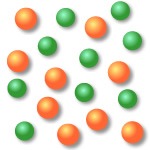

The state of matter in which the molecules/atoms are FURTHEST apart
solid
liquid
gas
The state of matter in which the molecules are CLOSEST together
solid
liquid
gas
This state of matter has no definite shape
gas
solid
liquid
both gas and liquid
When a solid gains energy and becomes a liquid it is called
freezing
melting
vaporization
When a gas molecules lose energy and become a liquid it is known as
vaporization
condensation
melting
freezing


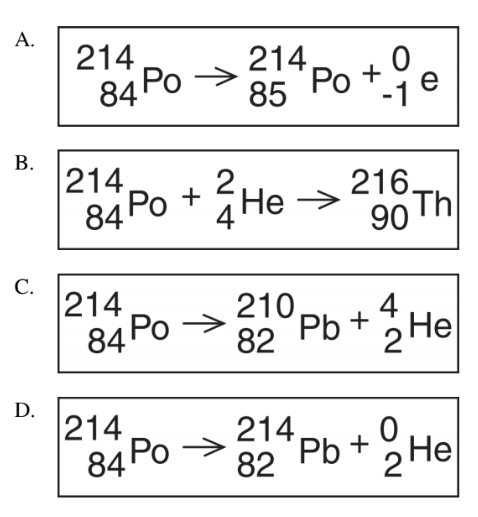
Which equation correctly represents the alpha decay of polonium-214?
A
B
C
D
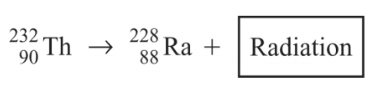
This equation shows the radioactive decay of thorium (Th). Which of the following particles is released in this reaction?
alpha
beta
neutron
gamma

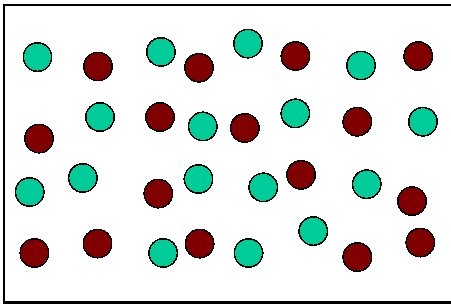
The diagram shows 32 atoms.
16 of the Red are parent isotopes
16 of the Green are daughter isotopes
How many half-lives have occurred?
0
1
2
3

