
Font size
 Worksheets
design
Total questions: 60
Worksheet time: 2hrs 11mins

Which type of perspective does the drawing present?
One-point perspective
Two-point perspective
Three-point perspective
None of the above.
Which one represents a strong password?
Spiderman
UAE#Expo2021
1234
flowers

What is the name of the label shown in the perspective diagram?
Horizon line
Vanishing point
Orthogonal line
Transversal line
Which of the following shape is a 3D?


What do you call a device that prints 3D designs?
3D software
3D printer
3D modelling
3D drawing

What do we call this 3D shape?
Pyramid
Triangle
Cuboid
Rhombus
Why do we need to create new designs?
To make our life difficult
To improve our lives
To make things expensive
To waste time
What is the correct order of the steps in the design creation?


What is the term used for design changing with time?
Design process
3D design
3D model
Design evolution
What is the name of 3D software we study now?
Makers Empire
Powerpoint
3D Paint
Pictures

This is a _______.
Cube
Cuboid
Cone
Cylinder
2 of The formal Elements are?
Gold & Copper
Colour & Form
Purple & Orange
Acrylic & Wood
A 3 Dimensional shape could be described as having?
Form
Pattern
Line
Texture
A Pattern must have?
Tone
Logos
Colour
Repetition
Tone can be used to show what in a piece of art or a design? select 3 options.
Depth
Mood
Form
People
The Secondary Colours are?
Red, Blue and Yellow
Purple, Pink and Brown
Green, Orange and Purple
White, Black and Grey
Select the names of 2 iconic Product Designers from the last 100 years
James Dyson
Leonardo da Vinci
Ettore Sottsass
Pablo Picasso
Select the image showing work by Ettore Sottsass


What Design group was Ettore Sottsass part of?
Memphis group
Bauhaus
Arts and Crafts Movement
Impressionists
You can describe Ettore Sottsass as being................
An Architect and Designer
An Artist
A Fashion Designer
Engineer
Select 3 words which describe the work of Sottsass
Bright
Floral
Geometric
Colourful
What ways can you find inspiration for your own work? select 2 answers
Copy the work of other designers
Choose artworks and designs in styles that you like and which you would like to try
Look at shapes and forms in nature
Use an image of an existing product and tell others it is your own design
Which one of these images show a product that has been inspired by the work of Sottsass?


How do you describe the word ergonomics?
Ergonomics is when you look at the work of other people to inspire your own work
Ergonomics refers to the measurements of the human individual
Ergonomics is about designing a product to be the best it can be for the user
Ergonomics is using shading to create depth in a drawing
What statement best describes Anthropometrics?
Using Interviews and questionnaires
Talking to clients to collect a wide range of information
Looking at products that already exist
Collecting maximum and minimum measurements from your target group
What are the benefits of creating a model when you are designing a new product? select 2 answers
It can take a long time to make and uses expensive materials
It is a quick way to explore lots of ideas
It is cheap as you can use inexpensive materials such as card and paper
there are no benefits, it is better to make a final design without modelling
What is the purpose of analysing and evaluating your work during the design process? select 3
Explain your successes and weaknesses
To help you find ways to improve your product through modifications
Evaluate the effectiveness of your design
To show to a client as a final product
Technical drawings are used by designers to do what?
Show initial design ideas
Communicate the dimensions and sizes of designs
Explain where the inspiration for a design came from
Show different sides of a product in the form of a drawing
What does it mean to render a drawing?
To make models for testing
To add measurements to a technical drawing
To draw an object in 2D
Rendering is the process of adding colour, shading, and texturing to an image
What is a template used for? select 2 answers
Templates can be used for cutting and drawing around
A template is used to produce identical shapes each time you use it
A template is a drawing used to communicate your design ideas
A template is used as a source of inspiration
What is a prototype?
A simple cardboard model with minimal detail
A measurement line shown on a technical drawing
A full scale, fully developed replica of your final design
An initial idea

What is the first step of the design process?
Construct and test a prototype
Define the problem
Develop a solution
Present the solution

What is the 4th step of the design process?
construct and test a prototype
Define the problem
Generate Concepts
Larry

What are two common constraints? (Select 2)
Time
Strength
Money
Avalibility

How many steps are in the design process?
6
7
4
12

What step do you brainstorm?
Step 1
Step 3
Step 4
Step 2
What is the final step in the design process?
Present the design solution
Develop the solution
Build a prototype
Define the problem
define the problem
develop the solution
evaluate the solution
Construct test and prototype
present the solution
generate concepts
construct test and prototype
develop the solution
present the solution
evaluate the solution
Generate concepts
develop the solution
construct test and prototype
evaluate the solution
present the solution
Give an example of criteria involving a product.
Size
Shape
Cost
All the above
When designing a solution you should also create this:
A built selected model
An assessment of your model
A technical drawing
Presenting your solution is like:
Looking for flaws
Pitching your sales idea
Brainstorming
When I look for and collect data for FLAWS in my design, I am at this step:
Design a solution
Build/Test prototype
Evaluate solution
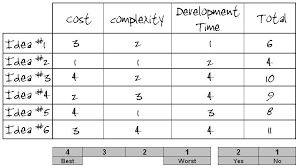
Using one of these will help your group decide on which model to build:
Design Brief
Design Evaluator
Decision Matrix
We usually draw a rough sketch during this step:
Generate Concepts
Build/Test Prototype
Evaluate Solution
What do we call limitations like "time, cost and/or materials" within a challenge?
Complications
Constraints
Criteria

Adding a detailed drawing of the group's idea is completed at this step of the design process.
Define the problem
Design a solution
Evaluate solution

Based on this chart, which idea was best?
Idea 2
Idea 6
Idea 3
Idea 4

What is design thinking?
When you think about designs
A way of building something
A method for creative problem solving
Steps for making lightbulbs

Which is NOT a guideline for the Ideate step?
Consider the practicality of each idea before sharing it.
Generate as many ideas as possible.
Reference the How Might We question frequently.
Don't worry about how good other peoples' ideas are.

Which is NOT true about the Test step?
It is an opportunity to refine the solution.
You should come up with new ideas during the Test step.
Only consider positive feedback to get the best result.
You should assume that your solution can be made better.

During which step do you create a physical, interactive representation of your solution?
Prototype
Ideate
Test
Define

