Worksheets
Geometry Vocabulary Quiz (8/21 and 8/22) - Lessons 1 & 2
Total questions: 45
Worksheet time: 1hrs 11mins
When you (a) a geometric figure, you create the figure without tools. Accuracy is not important.
An (a) line is a line or line segment added to a diagram to help in solving or proving a concept.
When you (a) geometric figures, you can use tools such as rulers, protractors, or a coordinate plane to draw exact lengths and areas.
A CONJECTURE is a mathematical statement that appears to be true, but has not been formally proved.
true
false

Fill in the blank. This angle measures (a) degrees.

180 degrees
125 degrees
55 degrees
65 degrees

What is the measurement of this angle?
70º
110º

What is the measurement of the angle?
75˚
85˚
105˚
115˚


What is the measurement of the angle?
145 degrees
155 degrees
35 degrees
0 degrees

What is the measurement of the angle?
20 degrees
160 degrees
180 degrees
0 degrees

What is the measurement of the angle?
24˚
36˚
156˚
150˚
.
.
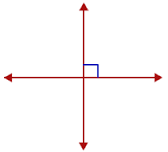
What kind of intersecting lines are these?
Parallel Lines
Perpendicular Lines
adjacent
opposite

What is this?
Line
Ray
Point
Angle

Ray

Line

Line segment

Point

Angle

What does congruent mean?
Opposite
Symmetry
Same
Smaller
.
.
What kind of intersecting lines are these?
Parallel Lines
Perpendicular Lines
adjacent
opposite
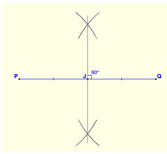
What type of construction do you see?
midpoint
angle bisector
perpendicular bisector
altitude

Identify the perpendicular bisector.
TP
RS
TR
ST

Describe the transformation in the image.
Translation
Reflection
Rotation

Describe the transformation in the image
Translation
Reflection
Rotation

Describe the transformation in the image
Translation
Reflection
Rotation

Describe the transformation in the image
Translation
Reflection
Rotation
Describe the transformation in the image
Translation
Reflection
Rotation

Describe the transformation in the image.
Translation
Reflection
Rotation

Describe the transformation in the image.
Translation
Reflection
Rotation


Identify the transformation from ABCD to A'B'C'D'.
Translation
Reflection across the x-axis
Reflection across the y-axis
90o counter clockwise rotation
A rotation
Has a central point that stays fixed and everything else moves around that point
a transformation that changes the size of a figure
a transformation in which the preimage is flipped across a line
a function that moves an object a certain distance. The object is not altered in any other way.
A translation
Has a central point that stays fixed and everything else moves around that point
a transformation that changes the size of a figure
a transformation in which the preimage is flipped across a line
a function that moves an object a certain distance. The object is not altered in any other way.

Find the midpoint of the segment on the graph. (Hover over picture to expand)
(1,0)
(7,-9)
(4,-3)
(-1,2)

Find the midpoint of the segment on the graph. (Hover over picture to expand)
(2,3)
(-1,2)
(5,-3)
(3,2)

Find the midpoint of the segment on the graph. (Hover over picture to expand)
(1,1)
(-1,-1)
(0,-2)
(-4,-4)


Find the midpoint:
(−1,3)
(3,4)
(4,3)


What is the arrow pointing to in the angle?
a ray
geometry
vertex
line