
 Worksheets
Trauma mod 1 quiz
Total questions: 42
Worksheet time: 35mins
Match each trauma center level with its description regarding 24-hour medical care and surgical residency programs.
Level I
Offers the most comprehensive 24-hour medical care and has a surgical residency program.
Level II
Provides 24-hour care and can manage most trauma cases, but may refer complex cases to higher-level centers.
Level III
Provides initial evaluation and stabilization, but transfers patients needing more comprehensive care.
Level IV
Offers basic trauma care and stabilizes patients for transfer to higher-level centers.
Match each type of injury with its correct description below.
Abrasion
A superficial wound where the top layer of skin is scraped off, often caused by a fall.
Laceration
A deep cut or tear in the skin or flesh, usually caused by a sharp object.
Contusion
A painful, swollen area under the skin caused by a direct blow, without a break in the skin or bone.
Fracture
A break or crack in a bone, often resulting from trauma.
Liam fell off his bicycle and scraped his knee, causing a superficial injury to the skin. Which of the following best describes this type of injury?
Abrasion
Laceration
Contusion
Fracture
Elijah is working in a laboratory where he is exposed to different types of hazards. One day, he is accidentally exposed to ionizing radiation. Which classification of trauma is specific with effects of ionizing radiation to the body?
Chemical
Mechanical
Thermal
Radiation
After a car accident, Mason is rushed to the emergency room. The medical team knows that the first hour after his traumatic injury is termed as “The __________.”
Critical Hour
Red Zone
Crisis Hour
Golden Hour
During a trauma case in the emergency department, a patient arrives requiring cervical spine precautions. Among the following personnel present—Nurse, Physician Assistant, Radiologic Technologist, and Paramedic—which one is not able to stabilize/maintain cervical spine precautions?
Nurse
Physician Assistant
Radiologic Technologist
Paramedic
Henry is found after a car accident and is showing signs that may indicate shock. Which of the following symptoms would you expect to observe?
1. Warm skin to the touch
2. Cool, clammy skin
3. Excessive thirst
4. Decreased need for fluids
5. Diaphoresis
1, 3, 4, 5
2, 3, 5
3, 4, 5
2, 3, 4, 5
A cut or open wound within the skin is called a (a) .
Unequal pupil dilation would indicate which of the following?
Drowsy/Sleepy
Head Injury
Intoxication
Unresponsive
Best practice is to support ________ in all cases for traumatic injuries?
The joint
Below the joint
Above the joint
Above and below the joint
(a) is the maximum ACCEPTABLE time between the injury and initiation of surgery for the seriously injured trauma patient.
A framework for classifying factors associated with injury, death, or events that may cause injury or death is called (a)
Anticipation of the severity of an injury based on the events and circumstances that appear to have caused the injury.
(a)
Match the following:
Study of projectile motion and its interactions
Ballistics
The outward motion of the tissue due to a projectile's passage
cavitation
forces acting on a projectile in motion to slow its progress
drag
Path a projectile follows
trajectory
arrow-shaped projectiles found in some military ordnance.
flechettes
Match the following:
hematemesis
vomiting of blood
hematochezia
passage of stools containing red blood
pulse pressure
difference b/w systolic and diastolic
fibroblast
specialized cells that form collagen
blue-black discoloration of the skin due to leakage of blood into the tissues
ecchymosis

The image can be described as:
hematoma
contusion
laceration
avulsion
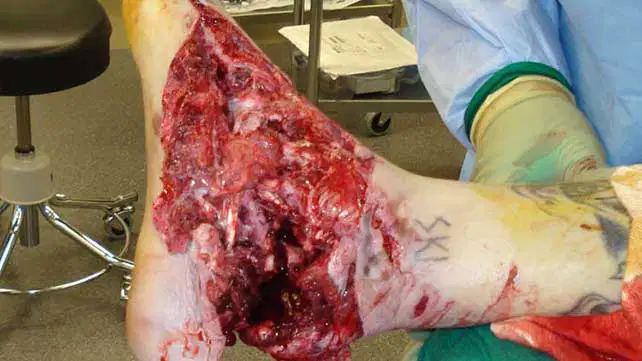
Identify the injury
avlusion
laceration
degloving
amputation
During which stage of hemostasis does the smooth muscle inside the blood vessel begin to contract, causing the vessel to withdraw into the wound and constrict?
Vascular phase
Constricting phase
Platelet phase
Aggregate phase
What are the three different types of vessel hemorrhage?
Match the following: Phases of Hemostasis
First step in the process of hemostasis, in which smooth blood vessels muscle contracts, reducing the vessel lumen and the flow of blood through it.
Vascular phase
Second step in the process of hemostasis in which platelets adhere to blood vessel walls and to each other
platelet phase
Final step in the process of hemostasis, which involves the formation of a protein called fibrin that forms a network around a wound to stop bleeding, ward off infection, and lay a foundation for healing and repair of the wound
coagulation phase
As the various clotting factors are released during the coagulation phase, which protein is formed and begins to form a mesh to trap red blood cells and form a clot?
Erythropoietin (red blood cells)
Angiotensinogen
Fibrin
Platelets
New advances in pharmacology provide many patients with alternatives to coumadin for thinning the blood. All of the following are commercially available blood thinning medications except:
Plavix
Tylenol
Lovenox
Pradaxa
You apply a tourniquet on a patient who has a near amputation of the left hand that was bleeding significantly. Once the tourniquet is in place, how often should you release it to prevent limb ischemia?
Every 30 minutes for 60 seconds
Every 5 minutes for 60 seconds
Every 15 minutes for 25 seconds
Do not release the tourniquet
Tranexamic acid (TXA) is utilized in hypotension associated with hypovolemia because it:
inhibits fibrinolysis
stimulates RBC release from the bone marrow.
speeds up the vascular process
stimulates the renin angiotensin aldosterone system.
Match the following: stages of hemorrhage
Blood loss up to 15% HR increases, some nervousness with cool skin and slight pallor
Stage 1
Blood loss up to 30%, HR increase, pulse strength weakens, Resp. rate increase. the patient is becoming anxious
Stage 2
25-40% blood loss, patient experiences dsypnea, anxiety, restlessness
Stage 3
Blood loss greater than 40%, pulse barely palpable; respiratons ineffective, patient lethargic/confuse slowly becoming unresponsive
Stage 4
The patient was involved in a lateral collision with significant force and the occupied vehicle was pushed into a guard rail. As the vehicle has been stabilized, the medic begins the assessment and notes the following: Head bobbing, moaning, and making inappropriate sounds. The patient shows periods of rapid breathing followed by periods of apnea, The Carotid pulse is weak and thready with an absent radial pulse, and the patient appears to be pallor with cyanosis around the nail beds and oral mucosal. Which stage of hemorrhage would the medic classify the patient to be?
Stage I
Stage II
Stage III
Stage IV
The patient was involved in a lateral collision with significant force and the occupied vehicle was pushed into a guard rail. As the vehicle has been stabilized, the medic begins the assessment and notes the following: Head bobbing, moaning, and making inappropriate sounds. The patient shows periods of rapid breathing followed by periods of apnea, The Carotid pulse is weak and thready with an absent radial pulse, and the patient appears to be pallor with cyanosis around the nail beds and oral mucosal. Base of the impact, what injuries can be associated with lateral collisions? Select the two correct answers
Fracture ribs, pelvis, and or femur on opposing side of impact
head injury, due to striking the windshield
diaphragmatic rupture
Fracture ribs, pelvis, and or femur on same side of impact
Michael is brought to the emergency room after a car accident. His systolic blood pressure is measured at 60 mmHg. True or False: A systolic b/p of 60 or less is insufficient to perfuse the human body
TRUE
FALSE
During a scuba diving accident, Mason is rushed to the emergency room with symptoms of air embolism. In cases like Mason's, which would be greatest concern involving the heart and or lungs (a)
Cardiac arrest
Pneumothorax
Pulmonary embolism
Hypoxia
A medic administered sodium bicarbonate to a patient who was pinned to the ground from a falling tree. The patient was trapped for no more than 7 minutes. Based on content from the textbook, was the medic's intervention correct?
Yes, sodium bicarb can be administer with any entrappment, duration of entrappment is not pertinent
NO, sodium bicarbonate should only be administer if Calcium chloride is ineffective
No, sodium bicarbonate should only be administer if entrapment was greater than 20 minutes
Yes, medic can administer sodium bicarbonate if patient exhibits signs/symptoms of shock.
Henry is being treated for trauma and the medical team needs to be aware of medications that can interfere with coagulation. BE SURE TO READ OF MEDICATIONS THAT CAN INTERFERE WITH COAGULATION!!
pg. 66
James is a trauma patient who has lost a significant amount of blood after an accident. The medical team observes that his heart rate has increased, his pulse pressure has narrowed, and his peripheral vascular resistance has gone up. In which class of hemorrhage are these changes first noted?
Class IV hemorrhage
Class I hemorrhage
Class II hemorrhage
Class III hemorrhage
You are caring for a victim who suffered extensive abdominal trauma. Initially the blood pressure was within normal parameters. Then it transitioned to a narrowing pulse pressure, but now the systolic pressure is beginning to fall. You correctly identify this as what stage or class of hemorrhage?
Class II hemorrhage
Class IV hemorrhage
Class III hemorrhage
Class I hemorrhage
Medivac helicopters should be utilized when (a) .
You are dispatched to a private residence to care for an unconscious victim with possible smoke inhalation. You arrive on scene to find an 81-year-old woman outside being attended to by fire department personnel. The firefighters report that the patient was found on the floor in the kitchen by her grandson. The kitchen was full of smoke, and the grandson carried her outside. The patient is conscious but combative and asks repetitive questions. The firefighters transfer the patient to the ambulance, where you begin your assessment.
The patient’s blood pressure is 150/90 mm Hg, respirations are 18 breaths/min, heart rate is 110 beats/min, and pulse oximetry is 95% while breathing room air. You notice a significant amount of soot around the patient’s face, especially in the nostrils, mouth, and oral airway. You noticed blistering and charred skin on the patient's entire right arm and across the patient's chest. The patient remains conscious but does not recognize her family and continues to ask repetitive questions. You insert an IV line, give lactated Ringer’s solution, and begin your transport to the local burn center, which is approximately 25 minutes away.
The BSA of this patient is (a) .
Anika falls from a significant height and lands on her feet. What type of injury is most likely to result from axial loading in this scenario?
spinal disc injuries
sheering injuries to the liver and spleen
compression injuries
While playing soccer, Michael fell and suffered a jagged, irregular tear in his skin. Which type of open wound did Michael most likely experience?
Abrasion
Laceration
Contusion
Fracture
Elijah is helping a friend who has a bleeding wound. He decides to apply a pressure dressing. What is the primary purpose of applying a pressure dressing to a wound?
To prevent infection
To immobilize the wound
To control bleeding
To reduce pain
William was involved in a car accident. He is conscious but complains of severe abdominal pain. On examination, which of the following would be a sign of internal bleeding?
Bright red blood spurting from a wound
Bruising around the navel or flanks
Clear fluid draining from the nose
Swelling at the site of a fracture
Which of the following best describes an injury where the skin is scraped off, usually by friction?
Laceration
Abrasion
Avulsion
Contusion
During the initial assessment of a trauma patient, you notice rapid, shallow breathing, weak pulses, and cool, clammy skin. These findings are most consistent with the stage of shock known as (a) .
Which of the following is the primary reason for immobilizing a suspected fracture in a trauma patient?
To prevent infection
To reduce pain
To prevent further tissue damage
To stop bleeding

