
NEW
Font size
 Worksheets
RICA Multiple Choice
Total questions: 58
Worksheet time: 29mins
A kindergarten teacher plays the following game with students. The teacher says, "Guess whose name I'm going to say now?" The teacher then says the initial sound of a student's name (e.g., /m/ for Mariko), and the children try to guess the name. This activity is likely to promote the reading development of students primarily by helping them:
blend separate sounds in words.
recognize that a spoken word is made up of sounds.
understand the principles of phonics.
learn how to spell their own names.
Which of the following informal assessments would be most appropriate to use to assess an individual student's phonemic awareness?
asking the student to identify the sound at the beginning, middle, or end of a spoken word (e.g., "What sound do you hear at the end of step?")
having the student listen to a tape-recorded story while looking at the book and then answer several simple questions about the story
asking the student to identify the letters in the alphabet that correspond to the initial consonant sounds of several familiar spoken words
having the student listen to the teacher read aloud a set of words with the same beginning sound (e.g., train, trap, trouble) and then repeat the words

A kindergarten teacher is preparing a student for a phonemic awareness assessment. This assessment would be an appropriate way to test the student's ability to perform which of the following phonemic awareness tasks?
counting and blending the phonemes in a word
identifying onsets and rimes
recognizing how many phonemes are contained in a word
relating phonemes to letters
The use of rhyming texts for kindergarten read-alouds is likely to promote the reading development of kindergarten students primarily by:
fostering their phonological awareness.
increasing their vocabulary knowledge.
enhancing their understanding of story elements.
improving their letter recognition skills.
Which of the following strategies would best help a kindergarten student who is having difficulty visually distinguishing between the letters b and d?
helping the student focus on the directionality of each letter as the student traces it
having the student look for the letters within the text of a favorite picture book
repeating the name of each letter several times as the student points to the letter
encouraging the student to observe closely as the teacher writes the letters
A first grader can identify the letters of the alphabet and decode a number of simple words. He becomes confused, however, when tracking print in consecutive lines of print. Which of the following strategies is likely to be most effective in helping the student read a short paragraph of simple text?
Help him sound out unfamiliar words included in the text before he attempts to read the entire paragraph.
Have him use his finger or a marker as he reads the text.
Help him increase his reading rate to improve his understanding of the continuity between words and sentences in the paragraph.
Modify the paragraph by using a yellow highlighter to identify natural groupings of words and phrases within the paragraph.
Which of the following instructional practices would be most effective in promoting kindergarten students' understanding of the alphabetic principle?
routinely saying the sounds in words when writing the words on the board
creating a writing center in the classroom, stocked with paper and writing implements
labeling key objects in the classroom such as the clock and tables
stopping frequently during read-alouds to carefully pronounce and define important words
An emergent reader frequently reverses some letters and numbers during writing tasks. Which of the following strategies would be most effective in helping this student develop more accurate letter formation skills?
providing the student with supplemental practice writing lists of words that are spelled with the target letters
having the student practice tracing the target letter shapes with a finger while saying aloud the sequence of steps to form each letter
providing the student with a supplemental handwriting workbook that describes the formation of the target letters in a series of steps
encouraging the student to vocalize words when writing, especially when the words contain the target letters
In the word chimpanzee, which of the following pairs of letters is a digraph?
ch
mp
an
ee
A kindergarten student has demonstrated the ability to write words phonetically, but she is reluctant to write because she is worried about misspelling words. The teacher could best promote the student's reading and writing development by:
reassuring her that it is okay for now to express herself in writing by spelling words as they sound.
giving her a spelling list of high-frequency sight words to copy and learn each day.
helping her make a list of words that she already knows how to spell correctly.
suggesting that she spend time copying some of the words found in her favorite stories.
During which of the following stages of spelling development do students typically begin to show an understanding of the correspondence between letters and sounds?
precommunicative
semiphonetic
phonetic
transitional
Function words such as to, the, and of are most appropriately taught in the context of which of the following areas of reading instruction?
phonics skills practice
structural analysis skills
academic-language development
sight-word vocabulary
A first-grade teacher provides students with explicit, systematic phonics instruction to promote their reading development. When designing activities to teach letter-sound correspondences, the teacher should:
provide reading opportunities for students to practice sounds in context after studying the sounds in isolation.
make certain that students have mastered vowel sounds before focusing on consonants.
ensure that students master the spelling of practice words using the target sound before teaching a new sound.
include instruction in related consonant blends when introducing individual consonants.
Early in the school year, a first-grade teacher wants to conduct an assessment of students' ability to read grade-appropriate words, including phonetically regular words and high-frequency irregular sight words. Which of the following informal assessments would be most appropriate and effective for this purpose?
The teacher pairs each student with a partner for shared oral reading of simple texts and makes anecdotal notes on their performance.
The teacher meets individually with students and asks each student to write a list of words the student knows how to read.
The teacher allows each student to select a grade-appropriate text from the classroom library and asks each student to try reading the text aloud.
The teacher prepares a list of grade-appropriate words, asks each student to try reading the words aloud, and records the results.
Several first graders have mastered sounding out and blending words that follow simple short-vowel phonics patterns. Their teacher would like to help them begin to develop whole-word reading (i.e., automatic word recognition) of words that follow these patterns. Which of the following instructional approaches would be most effective for this purpose?
using teacher read-alouds followed by echo reading and then choral rereading of the students' favorite texts that include some simple words
scheduling frequent silent independent reading practice of word lists based on the students' oral language vocabulary
providing modeling and guided student practice sounding out simple, regular words subvocally and then reading them aloud normally
exposing students to common environmental print to provide frequent exposures to everyday words and phrases
When reading aloud texts, a second-grade English Learner often makes errors in pronunciation that are unrelated to her ability to accurately decode the words. The teacher's best response would be to:
write down words the student mispronounces and include them on a list for her to practice reading aloud.
analyze the student's pronunciation patterns and plan an intervention to address difficulties that may affect her reading comprehension.
encourage other students in the class to help the student work on improving her accuracy in pronunciation.
help the student avoid having pronunciation errors count as reading miscues by stopping her and having her correct her own errors.
Which of the following approaches would be most effective in helping first-grade students who have the prerequisite decoding skills learn to decode words that end in the inflectional morpheme -ing?
explicitly teaching the students to read the unit -ing in isolation before teaching them to decode familiar words that end in the inflection
using think-aloud during a guided reading to model how to use contextual analysis as a strategy for recognizing words ending in -ing
having students practice reading word lists that include words ending in both the more familiar rime -ing as well as the inflection -ing
teaching the inflectional ending -ing in the context of an instructional unit on identifying open and closed syllables in multisyllabic words

An eighth-grade teacher wants to help students improve their spelling of scientific vocabulary, including the terms listed below. Which of the following instructional strategies is likely to be most effective for this purpose?
showing students how to divide scientific terms into syllables to facilitate accurate spelling
conducting practice drills to help students memorize the irregular spelling patterns of the words
familiarizing students with the spelling and meaning of Greek morphemes in scientific terms
helping students determine correct spellings by dividing the words into onsets and rimes
A sixth-grade teacher observes that several students have misspelled the word pasteurize. After writing pasteurize and Louis Pasteur on the board, the teacher explains how Pasteur invented the process of pasteurization. Students then discuss how the word Pasteur relates to the word pasteurize. This instructional activity fosters students' reading and writing development primarily by:
helping them learn to use etymology to improve spelling and decoding of multisyllabic words.
helping them improve their ability to distinguish between similarly spelled words.
motivating them to use orthographic patterns to expand their vocabulary knowledge.
motivating them to improve their spelling and decoding through the use of systematic study skills.
A third-grade student who is an advanced learner has already demonstrated mastery of the derivational suffixes -ness and -ment, which will be the focus of an upcoming whole-class decoding and spelling lesson. Which of the following strategies for differentiating instruction for this lesson would be most appropriate for this student?
having the student work on inflectional suffixes
teaching the student the content planned for the following lesson
encouraging the student to engage in independent silent reading
introducing the student to higher-level derivational suffixes
Which of the following word pairs are homophones?
answer and reply
playful and replay
table and stable
sight and site
A second-grade teacher would like to include independent silent reading as one of several approaches used to promote students' fluency development. When planning differentiated fluency instruction for individual students in the class, the teacher should keep in mind that using independent silent reading to promote fluency:
is most critical for students whose sight-word knowledge is below grade level.
should be limited to narrative texts in the early elementary grades
is most effective when students select texts at or above their instructional reading level.
should be limited to students who have already acquired automaticity.
A fourth-grade student who reads grade-level narrative texts with fluency and excellent comprehension is struggling to read aloud a grade-level content-area passage about a topic with which the student is familiar. The student reads the passage hesitantly, frequently stopping to reread clauses or entire sentences. Afterward, the student demonstrates limited comprehension of what was read. Which of the following factors is most likely disrupting the student's fluent reading of this text?
insufficient background knowledge to support basic comprehension of the text
lack of experience with the academic-language structures used in the text
insufficient monitoring of comprehension while reading the text
lack of grade-level word analysis skills for accurate decoding of the words in the text
Which of the following instructional activities would best help upper-elementary English Learners develop intonations and rhythms of the English language to support fluent reading?
leading a class discussion on an age-appropriate topic, then having each student read aloud a section of a text that is written about the same topic
having the students record their own oral reading of a passage and then listen to the recording while silently rereading the passage
giving an expressive oral reading of a short text, then having the students echo read the text as the teacher reads it aloud again
encouraging the students to practice reading aloud a text in which stressed words and punctuation marks are highlighted
A second-grade teacher would like to plan an activity to improve the reading rate of two students who read at about the same rate and level and are both automatic readers. Which of the following activities would best address the students' needs?
a cooperative silent reading activity, in which the students read the same passage together silently, stopping periodically to share their understanding of the text
a repeated reading activity, in which each student takes several turns reading aloud a decodable passage to the other student while the other student follows along silently
a paired reading activity, in which the students sit side by side and read a shared text aloud in unison, gradually increasing their pace as they proceed through the text
a timed partner-reading activity, in which the students take turns silently reading a shared text for one minute while the other student keeps time and says when to stop
A second grader has demonstrated the ability to decode individual words accurately, but she reads very slowly and laboriously. When the teacher tries to engage the student in oral reading activities, she says she feels "embarrassed" and would rather read silently. Which of the following modifications to instruction would be most appropriate and effective for helping this student improve her reading fluency?
encouraging her to serve as an "audience" for other students' oral reading until she demonstrates willingness to read aloud herself
having her reread a text several times using whisper reading to build her fluency and confidence with respect to the text
teaching her how to use self-monitoring as she reads to improve her literal comprehension and ability to read with prosody
providing her with explicit phonics instruction to improve her word identification skills before requiring her to read aloud
Lately, when choosing a book to read, a third grader who reads at grade level always selects books from a series that is written in a very formulaic style that does little to extend his conceptual or language development. The teacher's best response to this behavior would be to:
avoid interfering with the student's selection of books as long as he finds his choices enjoyable.
provide the student with books with similar themes or on similar topics that are more challenging for him.
point out to the student some of the major limitations of the books he is choosing to read and ask him not to read those books at school.
advise the student that he should choose books that will prepare him for the more difficult reading he will encounter in fourth grade.
A second-grade student has limited vocabulary knowledge, which hinders the student's word recognition and reading comprehension. The student's oral reading is slow and labored, and the student typically spends the majority of independent reading time browsing through books, making little effort to read the actual words on the page. Research has shown that which of the following is most likely to happen if this student receives no instructional intervention?
The student will always be behind average-performing peers but will achieve an adequate reading level to be academically successful.
The student will naturally begin to show more interest and proficiency in reading as the student matures and will catch up with average-performing peers in third grade.
The student will remain approximately at a second-grade reading level and will not be able to progress beyond this level.
The student will begin to fall behind peers in reading development and will continue to fall further behind in later grades as texts include increasingly difficult vocabulary.
Which of the following statements best explains an important limitation of teaching students to rely on context as their primary strategy for determining the meaning of unfamiliar words in texts?
Context clues have limited usefulness for students who already have well-developed background knowledge related to a text's subject or content.
Using context to determine the meaning of an unfamiliar word disrupts students' reading fluency more significantly than simply consulting a dictionary.
Explicit context clues about a word's meaning are not very common in most texts, while implicit contextual clues often require students to apply background knowledge they lack.
Overreliance on context as a word-learning strategy hinders students' vocabulary growth, since they should be learning most new words in direct vocabulary instruction.
A fifth-grade teacher is planning a multidisciplinary unit on water pollution. For this unit, students will read chapters from their social studies and science textbooks as well as relevant fictional narratives. These materials will also be incorporated into a variety of instructional activities designed to promote students' reading development. Which of the following statements best describes an important advantage of using a cross-curricular approach such as this unit to promote students' reading development?
Interdisciplinary reading instruction provides more opportunities for teachers to tailor teaching strategies to the needs of individual students.
Reading instruction that focuses on both literature and content-area texts helps students recognize and understand differences between written and oral English.
Interdisciplinary reading instruction motivates students to apply a variety of word identification strategies to clarify the meaning of texts.
Reading instruction that integrates a variety of related texts promotes deep processing of new vocabulary through multiple exposures to key words and concepts.

A middle school teacher writes the morpheme dict on the board, pronounces it, and explains that dict derives from the Latin word for "speak." The teacher then asks students if they can think of English words that start with or include dict. The teacher uses the students' suggestions to create the diagram shown below. This activity is likely to promote students' vocabulary development primarily by helping the students:
recognize common prefixes and suffixes.
learn the techniques of concept mapping.
apply knowledge of word roots as a word-learning strategy.
draw on a knowledge of phonics to unlock word meanings.
A teacher substitutes blank spaces for several nouns, verbs, adjectives, and adverbs in an appropriate level text and asks students to determine reasonable and logical words to complete each blank. This technique is useful as an informal assessment of students' understanding of English language structures primarily because it requires them to:
define various grammatical categories in their own words.
select appropriate words based on their grammatical function as well as on their meaning.
group words into grammatical categories to clarify their meaning.
draw on grammatical knowledge to identify the subjects and predicates of complex sentences.
A fifth-grade teacher gives students the following sentence:
"Neither walking on the beach nor running around the track cheered Ahmed up."
The teacher asks the students how the phrases that come just after neither and just after nor are similar. This exercise can promote students' reading comprehension by helping them:
distinguish between explicit and implied main ideas.
apply literal comprehension skills.
identify cause-and-effect relationships.
recognize parallel grammatical structures.

A middle school teacher designs an instructional activity in which students combine several sentences to form a single sentence, as illustrated below. This activity is likely to be most effective in helping students:
strengthen their ability to comprehend and write complex sentences.
apply literal comprehension skills to identify and write main idea statements.
improve their inferential comprehension skills.
use self-monitoring techniques to clarify the meaning of text.
Structural analysis would be the most appropriate strategy for a student to use to determine the meaning of which of the following words?
impassable
elephant
interim
examine
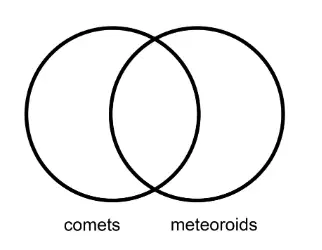
To promote students' comprehension of a passage about comets and meteoroids, a middle school teacher shows the students how to use facts from the text to complete the following Venn diagram. This comprehension strategy is most effective in facilitating students' ability to:
use inferential comprehension skills to identify cause-and-effect relationships.
draw on their prior knowledge to clarify understanding.
organize textual information according to similarities and differences.
apply their vocabulary knowledge in new contexts.
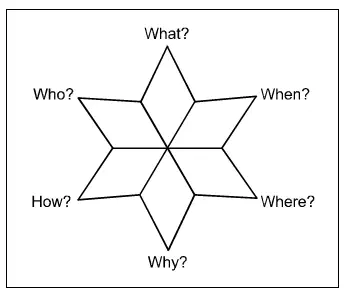
After reading an assigned story, students divide into small groups, and the teacher distributes a copy of the star diagram to each group. The members of each group discuss how the six questions (who, what, when, where, why, and how) apply to the story and write answers in the six points of the star. The teacher then displays the completed star diagrams and leads a whole-class discussion about them. This instructional activity is most likely to promote students' reading proficiency in which of the following ways?
improving students' comprehension by encouraging them to analyze a text's underlying theme
helping students learn a strategy for using visual representation to analyze key elements of a text
improving students' comprehension by encouraging them to connect personal experience to a text
helping students learn to use evaluative comprehension skills to determine an author's point of view
Answer
An eighth-grade class will be reading a drama that is a challenging grade-level text. The teacher is concerned that a student in the class who has a reading disability will have difficulty keeping up with and understanding the reading assignments. Which of the following strategies would be most effective for the teacher to use to promote the student's access to the text and his ability to participate fully in class discussions related to it?
assigning the student the play several weeks before his classmates are scheduled to begin reading it
providing the student with a narrative version of the play to read rather than the original, dramatic version
assigning the student only selected portions of the play, such as a few key speeches and dialogues
providing the student with an audiorecording of the play to listen to in conjunction with his reading
A first-grade teacher plans to assess a student's comprehension of a short story through oral retelling. After the student silently reads the story, the teacher will prompt the student's retelling by asking open-ended questions. To prepare for this assessment, the teacher reads the story carefully and composes the questions. Which of the following additional steps would be most helpful for the teacher to take before the retelling activity begins?
Prompt the student to recall similar tasks the student has previously performed.
Prepare a checklist of the key elements that an effective retelling of this story should include.
Review grades earned by the student on recent tests and quizzes in language arts.
Remind the student to concentrate on recalling as many details as possible during the retelling.
A fifth-grade teacher is teaching a unit on fiction. To begin, students read several simple fairy tales and discuss the moral or meaning of each one. The teacher then assigns a more complex story and leads a discussion about the moral of the story after students finish reading it. This instructional strategy is most likely to promote students' reading proficiency by:
guiding students to analyze the relationship between plot and character in a literary text.
helping students identify and understand the theme of a literary text.
fostering students' ability to distinguish an author's use of fact versus opinion in a text.
enhancing students' ability to use self-monitoring strategies to clarify the meaning of a text.

A sixth-grade teacher has students read a short expository text. After the students finish reading the text, the teacher uses guided discussion to help them complete the form shown below.This writing activity promotes students' comprehension and analysis of expository texts primarily by:
developing their ability to evaluate the adequacy of an author's conclusions.
teaching them explicit strategies for distinguishing facts from opinions.
encouraging them to identify ways in which a text reflects the traditions and beliefs of its author.
helping them clarify their understanding of a text through the use of outlines.
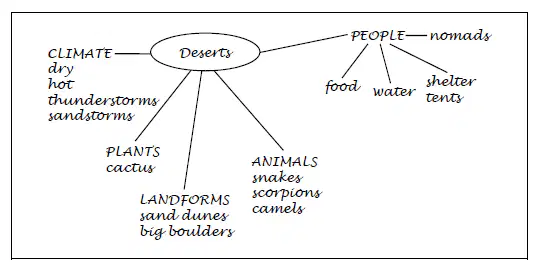
A fourth-grade class is beginning a unit on deserts. The teacher starts the unit by having the students form small groups and list everything they know about deserts. Then the whole class meets to share their lists, and the teacher helps the students arrange their ideas into a web. The class's partially completed web is shown below. Creating such a web is likely to promote students' ability to retain and use information they read about a topic by:
encouraging students to attend to new information on the topic rather than to familiar information.
providing students with the vocabulary they need to make sense of their reading.
prompting students to assess the accuracy of their prior knowledge of the topic.
helping students learn to use categories to organize their thinking about the topic.
After giving each student a copy of the web developed by the class, the teacher could best help students make use of the web to learn and retain facts from their reading by asking them to:
add continuously to the web as they encounter and analyze new information in their reading.
compare the content of this web to the content of webs on other topics.
review each category on the web to ensure that it is an appropriate one to have included.
memorize the information on the web before they begin their reading

A sixth-grade teacher reads his students the nonsense poem "Jabberwocky" by Lewis Carroll. The first four lines of the poem are shown below.The teacher reads aloud the clause "All mimsy were the borogoves" and asks students what that might mean. One student responds, "It means that the borogoves were all mimsy!" This student's response demonstrates skill in which of the following reading comprehension strategies?
applying relevant content knowledge
recognizing cause-and-effect relationships.
analyzing the use of figurative language
interpreting unusual grammatical constructions
The teacher plans a variety of activities related to "Jabberwocky." Students will work in pairs to make up definitions for some of the nonsense words (e.g., slithy). They will read the poem aloud using tone of voice to express various moods. Finally, they will create their own nonsense poems and give oral readings of them. These activities are most likely to promote students' reading development by:
providing students with the opportunity for an in-depth analysis of a specific literary genre.
developing students' understanding of the differences between written and oral English.
fostering students' enjoyment of playing with and thinking about language.
helping students make distinctions between serious and whimsical literature.
One student pronounces gyre with a hard g sound, while his classmate uses a soft g sound. They ask the teacher who is correct. The teacher's best response would be to:
remind students to use their knowledge of syntactic principles to determine the pronunciation.
explain that one strategy for determining a likely pronunciation of a new word is to consider other words that contain a similar root (e.g., gyrate, gyroscope).
have the class vote and suggest that students use the pronunciation that is preferred by the majority.
advise them that since gyre is a nonsense word, it does not really matter whether they pronounce it with a hard g or a soft g, so both pronunciations are correct.
The teacher asks the students if they can tell which of the nonsense words in the poem are nouns. One student says that toves is a noun. Another says that wabe and borogoves are nouns and adds that gyre and gimble are verbs. The class then discusses how students were able to draw these conclusions. This exercise would be especially useful for helping students understand that:
being familiar with conventions of capitalization and spelling can help a reader interpret a text.
recognizing the roots of words can help a reader decode the words.
being familiar with common language structures can help a reader interpret a text.
recognizing a text's genre can help a reader comprehend the text.

A sixth-grade class that includes several English Learners has been studying volcanoes. The teacher designs the following paragraph-building activity as part of a chapter review toward the end of the unit.After participating in this activity, all of the students review the chapter in their science text about volcanoes.
The paragraph-building activity described is likely to promote students' reading development primarily by helping them:
apply knowledge of common text structures to improve comprehension as they read.
transfer skills from oral language to written language.
use a variety of word identification strategies.
understand differences between spoken and written English.

After assessing the effectiveness of this activity, the teacher decides to include an additional step. For step 5, the teacher will guide students to develop topic sentences for the paragraphs they generated. This modification is most likely to promote students' reading development by:
encouraging students to draw on prior knowledge to clarify their understanding as they read.
helping students distinguish between facts and opinions as they read.
encouraging students to apply vocabulary knowledge in new contexts.
helping students recognize main ideas and how supporting details relate to main ideas.
Which of the following best describes one important way in which this activity is likely to benefit English Learners?
Arranging sentences in a meaningful order helps English Learners develop skills for locating and retrieving related information from content-area texts.
Combining sentences into paragraphs encourages English Learners to employ a variety of word identification strategies.
Discussing and writing about a content-area topic support English Learners' reading related to the topic by reinforcing key concepts and academic-language development.
Analyzing and editing individual sentences improve English Learners' reading fluency by helping them chunk text as they read.
A sixth grader who is advanced in most areas of reading has difficulty completing assigned reading selections. He appears motivated when he begins reading, but he has difficulty keeping his attention on the task at hand. Which of the following would be his teacher's best initial strategy for addressing this difficulty?
adapting the student's reading assignments to reduce their complexity and level of cognitive challenge
telling the student that his grades will be based in part on his ability to improve his concentration when he works on reading assignments
breaking down the student's reading assignments into small steps and helping him learn to monitor his own attention and progress
managing the student's reading assignments so that he generally has only one to work on at any given time
When creating lesson plans to promote specific reading skills, a teacher should make sure that:
each planned activity for students is designed to strengthen two or more specific reading skills.
the targeted reading skills relate to an appropriate instructional progression and reflect students' needs.
each planned activity connects students' reading, writing, listening, and speaking skills.
the targeted reading skills are grade-appropriate and taught to all students using the same instructional methods.
An early elementary teacher could most effectively support at-home reading by:
sending parents/guardians a regular newsletter describing classroom reading activities.
sharing with parents/guardians important articles from professional reading journals.
recommending books that parents/guardians would likely enjoy reading with their children.
providing parents/guardians with periodic reports on their children's progress in reading.
A sixth-grade teacher wants to ensure that the classroom reading environment supports content-area learning for the English Learners in the class. Which of the following strategies is likely to be most effective in addressing this objective?
replacing classroom content-area books with simpler texts on the same subjects that the English Learners can understand more readily
providing English Learners with grade-level, English-only content-area books to promote academic language
making available in the classroom content-area texts at various levels that supplement and reinforce the information presented in students' textbooks
setting up an area in the classroom where students can go to reread the content-area textbook quietly and independently
Of the following questions, which would be most important for a teacher to consider when interpreting the results of a reading assessment for a particular student?
How did the student's performance on this assessment compare with that of the student's classmates?
Are these findings sufficient to assign a grade to the student's performance?
How do these findings relate to the student's performance on other recently administered reading assessments?
Do these findings provide information about the student's ranking in regard to national norms of reading achievement?
A fourth-grade class includes two students with Individualized Education Programs (IEPs). When planning classroom entry-level and progress-monitoring assessments for these students, the teacher should:
make arrangements for the students to be tested in an environment that is quiet and free from distractions
consult the Reading/Language Arts Framework for California Public Schools to determine appropriate assessments for students with IEPs.
recognize that these students may require additional time to complete their work on these assessments.
onsult each student's IEP to determine any specific testing accommodations required for that student.
A middle school teacher is preparing for the class to take the sixth-grade California Standards Test (CST) in English-language arts. The teacher believes that a student in the class with a Section 504 Plan would perform significantly better on the assessment if she were allowed to have frequent supervised breaks within sections of the test. Which of the following guidelines would be most important for the teacher to follow to ensure that arrangements for this student during the test are appropriate?
providing the student with this testing accommodation only if it is specified in her Section 504 Plan
using good teacher judgment to determine if such an accommodation is warranted
following whatever accommodations are generally recommended for students with Section 504 Plans
requesting testing accommodations for the student in writing at least eight weeks before the test is given
Midway through the year, a second-grade teacher convenes a student success team to plan additional support for a student who is performing somewhat below grade-level standards in reading. Other members of the team include the student and her parents, another teacher who works closely with the student, and a school administrator. In the context of developing an improvement plan for the student, which of the following pieces of information would be most important for the teacher to communicate to the success team?
a comparison of the student's reading skills with those of her peers who are performing at grade level
a list of each of the formal and informal reading assessments that the student has taken so far during this school year
a list of appropriate formal reading assessments that could be used for the student's summative evaluations
a description of the student's assessed strengths and weaknesses that could serve as a foundation for addressing her needs

