wayground logo

Free Printable Worksheets

NEW

Font size

S
M
L
XL
Worksheets

Energy and Sankey Diagram

Total questions: 48

Worksheet time: 46mins

Name
Class
Date
1.
a)
Potential Energy
b)
Kinetic Energy
2.
a)
Potential Energy
b)
Kinetic Energy
3.
a)
Potential Energy
b)
Kinetic Energy
4.
a)
Potential Energy
b)
Kinetic Energy
5.
a)
Potential Energy
b)
Kinetic Energy
6.
a)
Potential Energy
b)
Kinetic Energy
7.
a)
Potential Energy
b)
Kinetic Energy
8.
a)
Potential Energy
b)
Kinetic Energy
9.
a)
Potential Energy
b)
Kinetic Energy
10.
Potential energy is related to 
a)
position or height of an object
b)
speed of an object
11.
Kinetic energy is related to 
a)
position or height of an object
b)
speed of an object
12.
Kinetic energy is related to 
a)
position or height of an object
b)
speed of an object
13.
The energy of motion.
a)
Potential Energy
b)
Kinetic Energy
14.

Energy stored because of gravity is called:

a)

Gravitational Potential Energy

b)

Kinetic Energy

c)

Mechanical Advantage

d)

Chemical Energy

15.

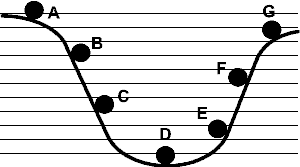
At which point does the ball has the greatest gravitational potential energy (GPE)?

a)

A

b)

G

c)

D

d)

C

e)

G

16.

At which position does the child on the swing have the most gravitational potential energy?

a)

W

b)

X

c)

Y

d)

Z

17.

What is the gravitational potential energy (GPE) of a 1 kilogram book that is 1 meter above the ground?

g = 9.8 m/s2

a)

9.8 Joules

b)

1.0 Joule

c)

0.10 Joule

d)

11.8 m/s2

18.
How much kinetic energy does a moving 6 kg object have if it moves with a velocity of 3 m/s?
a)
27 J
b)
18 J
c)
9 J
d)
2 J
19.

What is the kinetic energy of a 4kg shotput thrown with a velocity of 13m/s

a)

676 J

b)

52 J

c)

17J

d)

338 J

20.
A 70 kg runner has a velocity of 5 m/s. Her kinetic energy is
a)
875 J
b)
175 J
c)
1750 J
d)
350 J
21.

What is the gravitational potential energy (GPE) of a 3 kilogram of an object that is 2 meter above the ground? (use g= 10 m/s2)
a)
60 Joules
b)
30 Joules
c)
6 Joules
d)
3 Joules
22.
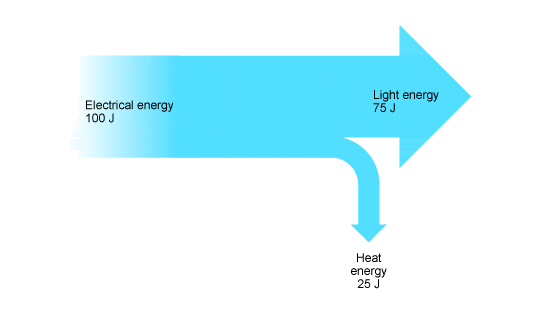
Where does most of the energy go in this transformation.
a)
Electrical energy
b)
Light
c)
Heat
d)
other
23.
Where does most of the energy go in this transformation.
a)
Electrical energy
b)
Light
c)
Heat
d)
other
24.
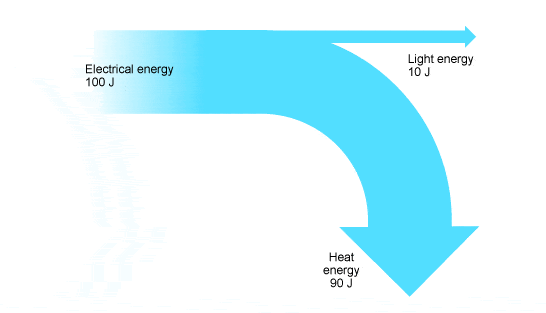
Where does most of the energy go for this transformation.
a)
heat
b)
electrical
c)
light
d)
joules
25.

What is this diagram called?

a)

Stankey Diagram

b)

Sankey Diagram

c)

Sankay Diagram

d)

Samkay Diagram

26.
What type of energy is best represented by a battery?
a)
Sound
b)
Thermal
c)
Mechanical
d)
Chemical
27.

Identify the energy transfer

a)

electrical to chemical to light

b)

kinetic to potential

c)

chemical to electrical to light

d)

light to sound

28.

Identify the energy transfer

a)

chemical to kinetic

b)

solar to electrical

c)

thermal to light

d)

electrical to light

29.
Which of the following is NOT a form of energy?
a)
movement
b)
body mass
c)
heat
d)
food
30.
Assume there are 10 pieces of energy.  Which is a close approximation to the number of pieces that transform into kinetic energy?
a)
1
b)
3
c)
6
d)
10
31.
What type of device might this Sankey be about?
a)
A very efficient LED light bulb
b)
A very inefficient incandescent light bulb
c)
A coal power plant
d)
A wind turbine
32.
Where does most of the energy go in this transformation.
a)
Electrical energy
b)
Light
c)
Heat
d)
other
33.
What is energy measured in?
a)
Joules
b)
Watts
c)
kilograms
d)
Newtons
34.
According to the Law of Conservation of Energy...
a)
energy changes form
b)
energy can be created and destroyed
c)
energy flows from one material to the next
d)
energy cannot be created or destroyed
35.

Which of these equations is correct?

a)

efficiency = useful energy outputtotal energy input×100%efficiency\ =\ \frac{useful\ energy\ output}{total\ energy\ input}\times100\%  

b)

efficiency = total energy transferreduseful energy transferredefficiency\ =\ \frac{total\ energy\ transferred}{useful\ energy\ transferred}  

c)

energy = efficiency ×100%energy\ =\ efficiency\ \times100\%  

d)

efficiency = wasted energy outputtotal energy inputefficiency\ =\ \frac{wasted\ energy\ output}{total\ energy\ input}  

36.

Which bulb is the most efficient?

a)

Filament bulb

b)

LED light

c)

CFL lamp

37.

A kettle uses 100J of electrical energy to produce 7J of sound energy and 93J of thermal energy. How efficient is the kettle?

a)

100%

b)

7%

c)

93%

d)

95%

38.

A washing machine uses 250J of electrical energy to produce 125J of useful energy. How efficient is it?

a)

5%

b)

50%

c)

55%

d)

100%

39.

An iPhone charger coverts 75J of electricty in to 50J of charge and 25J of thermal energy. How efficient is the charger?

a)

10%

b)

100%

c)

33%

d)

67%

40.
The Ability to do work
a)
Soil 
b)
Energy 
c)
Matter
d)
Math
41.
Energy stored in atomic bonds that form molecules
a)
Thermal Energy
b)
Chemical Energy
c)
Electrical Energy
d)
Electromagnetic Energy
42.
Energy of electric charges moving through conductors
a)
Electrical Energy
b)
Electromagnetic Energy
c)
Thermal Energy
d)
Chemical Energy
43.
Energy that travels in waves( ex. microwaves, radio waves, energy from the sun)
a)
Chemical Energy
b)
Electrical Energy
c)
Electromagnetic Energy
d)
Thermal Energy
44.
One form of energy changes to another
a)
Energy Transformation
b)
Energy Transfer
45.
Energy stored in the nucleus of an atom, released when protons or neutrons are added to or removed from the nucleus 
a)
Chemical Energy 
b)
Electrical Energy 
c)
Mechanical Energy 
d)
Nuclear Energy 
46.
According to which law of energy, energy can't be created or destroyed?
a)
First law of motion
b)
The law of tacos
c)
Laws of Energy
d)
law of conservation of energy
47.
Stored energy is called ______ energy.
a)
Kinetic
b)
Potential
c)
Pacific
d)
Safe
48.

Steam is an example of _____________energy.

a)

light

b)

thermal

c)

sound

d)

electrical