
 Worksheets
2.1 Properties of Water
Total questions: 14
Worksheet time: 21mins

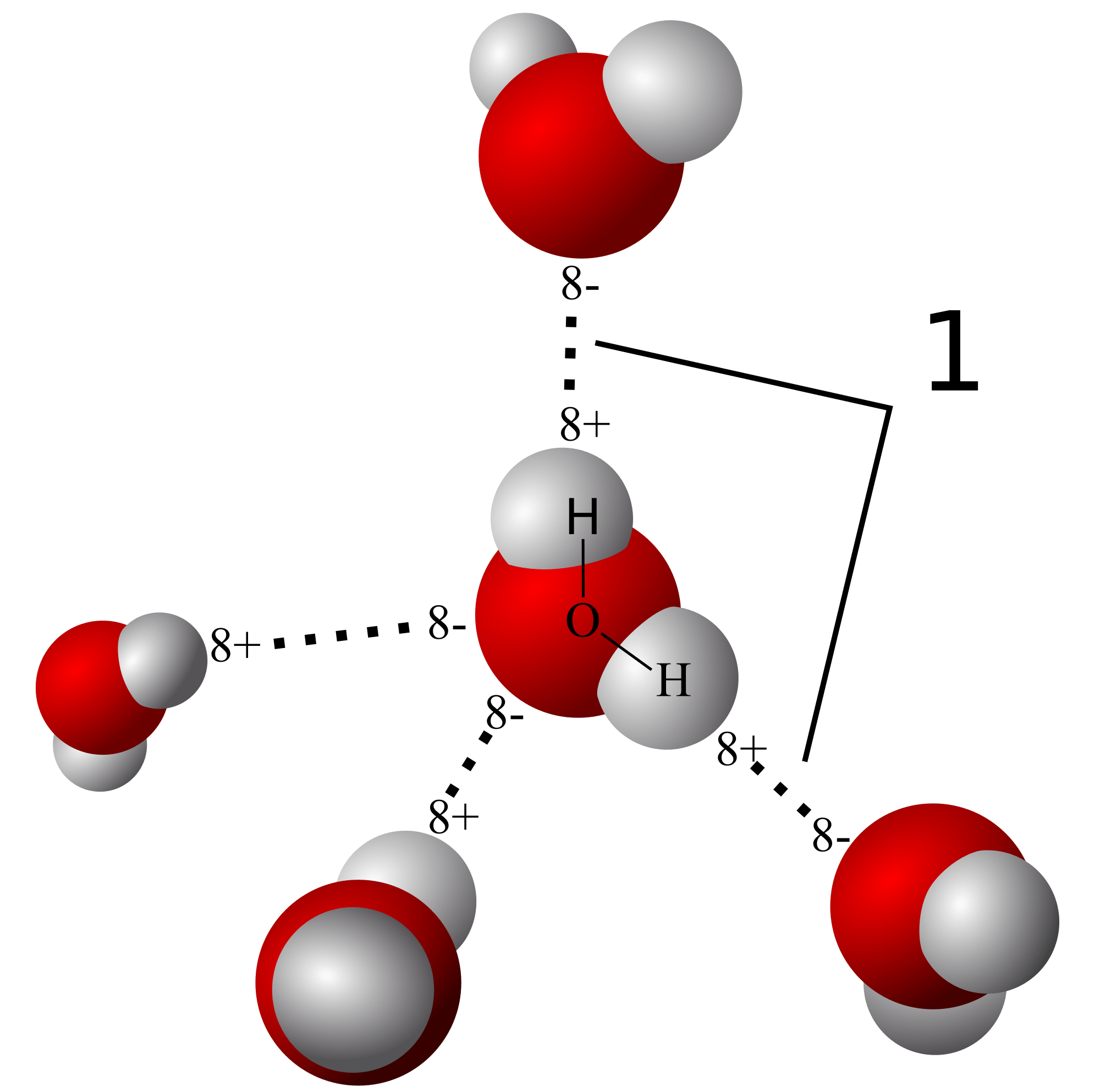
Water is a polar molecule. What is the slight charge of hydrogen (H) and the oxygen (O)?
Hydrogen (+)
Oxygen (-)
Hydrogen (-)
Oxygen (+)
Hydrogen (-)
Oxygen (-)
Hydrogen (+)
Oxygen (+)
Water is a polar molecule, which gives it 5 special properties important for life.
From the list below, which is NOT a property of water?
Cohesion and Adhesion
Universal solvent
High specific heat
Expansion when freezing
Produces energy through photosynthesis
The equal sharing of electrons gives the water molecule a slight negative charge near its hydrogen atoms and a slight positive charge near its oxygen atom.
The water molecule is neutral, so it has no charges on any of the atoms present.
Which of the following is LEAST likely to dissolve in water?
nonpolar fats and oils
polar sugar molecules
salt made of a positive sodium ion and a negative chloride ion
all of the substances will dissolve easily in water

Which properties of water enable it to travel upward from a plant's roots to its leaves against gravity?
Cohesion and Adhesion
High Specific Heat
Expansion upon Freezing
Transpiration
The cohesive behavior of water molecules is due to hydrogen bonding, which also contributes to surface tension.
How does surface tension benefit living organisms?
It enables small organisms, like insects, to move across the surface of water.
It enables large organisms, like hippos, to move across the surface of water.
It reduces the rate of photosynthesis in aquatic plants.
It increases the boiling point of water.

As a solid, water floats. This is unlike most solids.
Observe the image:
How does this property help organisms in the pond?
All the fish freeze but will return to life in the spring.
The plants keep the water temperature warm for the other living organisms.
The water temperature below the ice allows it to stay a liquid so the organisms can survive.
The ice will eventually sink to the bottom and the liquid water will return to the top.

The beach is a very popular place for people to visit. The photo below is of Jacksonville Beach.
Which of the following correctly explains how water’s properties affect the beach?
The sand has a lower temperature than the water due to the water’s low specific heat.
The water has a lower temperature than the sand due to the water’s high specific heat.
The sand and the water will be the same temperature due to water’s high specific heat.
The water has a higher temperature than the sand due to the water’s high specific heat.
Water is often found as a part of a mixture. A mixture is a material that is composed of two or more elements or compounds that are physically mixed together but not chemically combined.
Which property of water allows for it to be a part of many mixtures?
cohesive behavior
versatility as a solvent
expansion upon freezing
ability to moderate temperature

Why is water being a universal solvent important for oxygen transport in the blood?
Water allows oxygen to dissolve in blood plasma so it can be transported to body cells.
Water causes oxygen to be produced by red blood cells and released into the bloodstream.
Water converts oxygen into glucose so that cells can use it for energy.
Water prevents oxygen from entering the blood and keeps it stored in the lungs.

Label the solution, solute, solvent
A = solvent
B = solution
C = solute
A = solute
B = solvent
C = solution
A = solution
B = solvent
C = solute
A = solvent
B = solute
C = solution
Which of the following are ways that water's unique properties support life on Earth?
(Select all that apply.)
Cohesion and Adhesion allows water to move upward through plants and blood to flow through vessels.
Water expands when freezing, causing ice to float and insulate marine life beneath it.
Water's high heat capacity helps regulate temperature and resist rapid changes
Water acts as a universal solvent, helping cells transport key nutrients and gases.

