
 Worksheets
Unit 1 Practice Test_2
Total questions: 24
Worksheet time: 43mins
Adipose tissue is present beneath the skin's surface and serves to cushion and insulate the body. Which important organic molecule is most likely present in this tissue?
lipids
proteins
carbohydrates
nucleic acids
What controls and directs the production of proteins in living things?
amino acids
carbohydrates
lipids
nucleic acids
Why are carbohydrates important for organisms?
They are structural components and the primary source of energy.
Which statement describes the structure of protein?
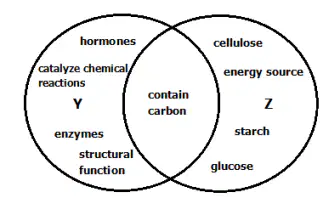
Use the Venn diagram to compare and contrast two macromolecules.
What are the titles for the letters Y and Z?
Y: Carbohydrates; Z: Proteins
Y: Lipids; Z: Carbohydrates
Y: Nucleic Acids; Z: Lipids
Y: Proteins; Z: Carbohydrates

The table identifies the four major groups of organic compounds.
Which section of the table would be described correctly with the phrase “contains nitrogenous bases”?
W
X
Y
Z
A scientist discovered a new organism in a rainforest. She is studying the DNA of the organism to find its similarity to other organisms.
What nucleotides will be present in the DNA sequence of the newly discovered organism?
A, T, G, C
A, U, G, C
G, C, U, T
G, U, A, T
Which statement is true of every living organism?
DNA is found in 46 chromosomes.
DNA is protected inside a nucleus.
DNA is made of four types of nucleotides.
DNA is found in 23 homologous chromosome pairs.
Scientists are working to design the genetic code of an organism they intend to create in a lab. Which nucleotides can they use to sequence the DNA of the organism?
A, G, T, U
A, C, G, U
A, C, G, T
A, C, T, U
An engineer is designing a new synthetic product that requires a waterproof coating. What biomolecule has the characteristics that he should try to replicate.
Lactose intolerance is the inability of the human body to digest lactose, a single sugar found in milk and dairy products. Inhibition of which biomolecule's function results in lactose intolerance.
proteins that serve as enzymes
proteins that act as hormones
carbohydrates that are important fibers
carbohydrates that store energy
Why do people training for athletic events consume lots of carbohydrates in their diets?
Carbohydrates help transport fluids in the body.
Carbohydrates help control the movement of muscles.
Carbohydrates act as an immediate source of energy.
Carbohydrates can be converted to proteins and fats by the body.
What relationship exists between amino acids and proteins?

The graph shows the action of trypsin in different pH levels. Based on the data, what can be concluded?
Trypsin works best around a pH of 6.
Trypsin works best around a pH of 8.
Trypsin does not work under acidic conditions.
Trypsin does not function under basic conditions.

Chemical reactions in the body are catalyzed when enzymes interact with substrates as shown in the diagram. What happens to the enzyme after the chemical reaction occurs?
The enzyme is used up during the reaction, so it no longer exists.
The enzyme is changed during the reaction, so it no longer works.
The enzyme becomes a part of the product of the reaction, so it no longer exists.
The enzyme is unchanged, so it can be reused when more substrate is available.
Enzymes catalyze reactions in the human body. Which statement describes how enzymes work?
The enzyme is unchanged, so it can be reused when more substrate is available.
They slow down chemical reactions by increasing the activation energy.
They speed up chemical reactions by lowering the activation energy.
They slow down chemical reactions by lowering the activation energy.
Enzymes are substances that catalyze chemical reactions. A change in the pH of the medium is known to decrease the activity of an enzyme.
Which statement explains how a change in pH affects the activity of an enzyme?
It alters the shape of the enzyme.
It alters the density of the enzyme.
It alters the solubility of the enzyme.
It alters the concentration of the enzyme.

Which macromolecule, along with its examples, is decreased in the table?
Carbohydrate : starch and cellulose
Lipid: oil and wax
Nucleic Acid: DNA and RNA
Protein: enzymes and hemoglobin
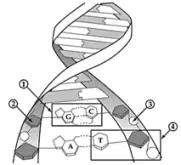
Which number shows the structure of a nucleotide?
1
2
3
4
Proteins are compounds formed in the cells of plants and animals. Which element is included in every protein molecule?
calcium
carbon
flourine
sodium

The structural diagram demonstrates two joined amino acids.
Which arrow points to the peptide bond?
1
2
3
4

The diagram shows the structural formula for starch. Which of the following explains why starch is a polymer?
repetitive combination of simple subunits
organic compound molecule
high mobility as a result of its long length
contains carbon-based functional groups

The image shows the production of petal color in a flower. What can be concluded from the diagram?
DNA and a protein mix together to produce purple flowers.
Proteins stop the DNA from keeping the flower petals white.
DNA codes for a protein that makes pigments so the flower appears purple.
A pigment protein makes DNA, which causes the flower to appear purple.
Nucleotides are subunits of (a) , which code for (b) in a sequence that makes up a (c) .

