
 Worksheets
Recreational UAS Safety Practice Test
Total questions: 25
Worksheet time: 13mins
Which authority requires The Recreational Unmanned Aircraft Systems (TRUST) Safety Test?
National Aeronautics Space Administration (NASA)
Federal Aerospace Association (FAA)
Federal Aviation Administration (FAA)
The Recreational Unmanned Aircraft Systems Administration (TRUST)
What does the § symbol mean before each United States Code?
Section
Symbol
Safety
Code
For the purpose of the safety course, what is defined as a drone?
Airplanes, helicopters, and quad-copters
Remote controlled (RC) cars, RC helicopters, and quad-copters
Remote Controlled (RC) airplanes, RC Helicopters, and quad-copters
All remote controlled vehicles
What is the risk of flying a quad-copter drone?
Colliding with aircraft
Injuring people
Property damage
All of the above
Why are recreational drone flyers required to take a safety course?
To pass an aeronautical knowledge and safety test required by title 49 United States Code (U.S.C.) §44809(a)(7)
To pass an aeronautical knowledge and safety test required by title 49 Texas State Code (U.S.C.) §44809(a)(7)
To pass an aeronautical knowledge and safety test required by the manufacture.
To obtain a better rate on drone liability insurance
One of the Exceptions for Limited Recreational Operation of Unmanned Aircraft is-
Fly professionally
Fly for recreational purposes only
Fly for special sporting events
One of the Exceptions for Limited Recreational Operation of Unmanned Aircraft is-
Follow the manufacture's directions
Follow the safety guidelines of a Community Based Organization (CBO)
Follow the FAA guidelines for remote controlled vehicles
One of the Exceptions for Limited Recreational Operation of Unmanned Aircraft is-
Keep your drone in your visual line of sight (VLOS)
Keep your drone in the visual line of sight of your on-the-ground spotter
Fly in controlled airspace with without authorization
One of the Exceptions for Limited Recreational Operation of Unmanned Aircraft is- When you are flying your drone-
Communicate with airport control within the immediate area
Communicate with manned aircraft in the immediate airspace
Always give way and never interfere with manned aircraft
One of the Exceptions for Limited Recreational Operation of Unmanned Aircraft is-
Get an airspace authorization before flying in controlled airspace
Get an airspace authorization after flying in controlled airspace
Get an airspace authorization before flying in uncontrolled airspace
One of the Exceptions for Limited Recreational Operation of Unmanned Aircraft is-
Do not fly higher than 50ft above the ground in uncontrolled airspace
Do not fly higher than 100ft above the ground in uncontrolled airspace
Do not fly higher than 200 feet above the ground in uncontrolled airspace
Do not fly higher than 400 feet above the ground in uncontrolled airspace
One of the Exceptions for Limited Recreational Operation of Unmanned Aircraft is-
Mark and register your drone with the FAA
Mark and register your drone with the manufacturer
Register your drone for warranty with the manufacturer
Flying for recreational purposes means-
Flying for a little business
Flying for payment
Flying for work
Flying only for fun
If you fly for money or to help your business, you must fly under 14 Code of Federal Regulations
CFR Part 100
CFR Part 107
CFR Part 2023
CFR Part 2000
It is important that you understand that your drone will be flying in the same airspace as-
Manned Aircraft
Other Unmanned Aerial Vehicles
Both A & B
Airspace in the United States is designed to ensure-
a safe space for everyone.
a dangerous space for aircraft
only licensed professionals are able to fly.
Airspace is divided into two main categories-
manned and unmanned aeronautical vehicles
below 400 feet and above 400 feet
controlled and uncontrolled
Flying in uncontrolled airspace means that you
have to comply with all the rules under the Exception for Recreational flyers.
DO NOT have to comply with all the rules under the Exception for Recreational flyers.
are able to fly above 400 feet altitude.
Airspace restriction can be temporary or permanent.
True
False
Unless specifically authorized by the FAA, recreational drone flying is limited to no more than ______ ft above ground level in uncontrolled space.
100 feet
200 feet
400 feet
500 ft
Select ALL the types of airspace restrictions in the United States.
Stadiums and Sporting Events
Military Airfields
The White House
Near Airports
Flying a drone near a wildfire is dangerous and can cost lives. When people fly drones near wildfires, fire response agencies often ground their aircraft to avoid the potential for a midair collision. Delaying airborne response poses a threat to firefighters on the ground, residents and property in nearby communities, and it can allow wildfires to grow larger. What level of crime is it to fly a drone in a wildfire?
Federal, punishable by up to 12 months in prison and $20,000
State, drone will be confiscated.
City, fine charged
No crime. No penalty
Why is it so dangerous to fly a drone near a wildfire?
Firefighting aircraft fly at very low altitudes, typically just a couple of hundred feet above the ground.
The drone will melt.
The drone will lose radio connection.
It is not dangerous because the drone is unmanned.
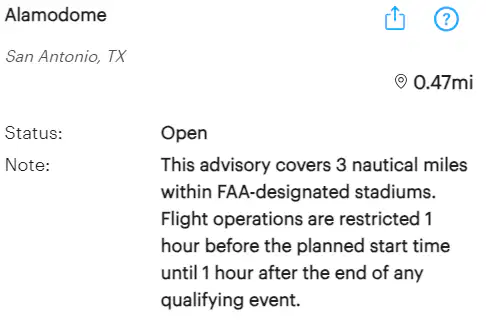
This notice is shown when the Alamodome area is selected. The 3 hour restriction applied before and after an event means-
A temporary restriction is in place.
A permanent restriction is in place.
Helicopters will be in place.
Only licensed pilots are allowed to fly their drones.
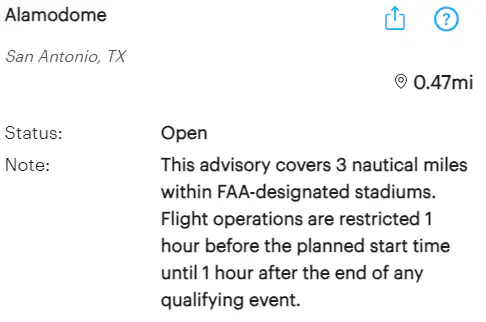
If you are in controlled airspace you will most likely need to get airspace authorization from-
NASA
FAA
Airport
Local police station

