
 Worksheets
Chapter Two
Total questions: 26
Worksheet time: 16mins
matter can exist as which of the following states (more than one answer is correct)
The picture is only for amusement
Smog
A roller coaster zooming down a hill is using tremendous amounts of kinetic energy. When that energy has enabled it to get to the top of a hill and it is about to go down again, it has a great deal of (a) energy
What is the type of energy that is the electromagnetic spectrum and that travels in waves?
Electric Energy
Mechanical Energy
Which of the following elements, while still important, is not one of the most common in the body?
Iron
Carbon
An ion like Na+ or Ca+ has (a) at least one electron
The Atomic Mass number of an element is the sum of the atom's ______________ (more than one answer is correct)
electrons
neutrons
quarks
protons
What is an isotope?
Ions that have lost or gained MORE than one electron
Atoms that have the same number of protons and electrons but vary in the number of neutrons
A proton without electrons or neutrons
A neutron without protons or electrons
Which of the following is NOT true of a radioisotope?
it tends to be unstable
has no medical usage
it is the heavy isotope of certain atoms
it decomposes to more stable isotopes
Which electrons are most likely to interact with other electrons?
What is the Rule of Eights?
The key to chemical reactivity
Atoms are considered stable when their outer valence shell has eight electrons (or two in shell 1)
Atoms with 8 electrons in their outer valence shell (or two in shell 1) are considered stable and chemically inert.
all choices are true
Sodium has 1 electron in it's outer valence shell
Oxygen has 2 electrons in it's outer valence shell
Neon has 8 electrons in it's out valence shell.
Which of these will be LEAST reactive?
Sodium
Oxygen
Neon
All will be equally reactive
A/an (a) bond is formed when one or more electron is completely transferred from one atom to another
A/an (a) bond is formed when atoms share electrons
In a polar covalent bond, as in water, which of the following is NOT true
The molecule has a positive and a negative side
What is a hydrogen bond?
Weak chemical bonds formed when a hydrogen is attracted to the negative portion of a polar molecule
An important type of bond that only exists in water molecules
Which of the following will NOT increase the speed of a chemical reaction
increasing the size of the particles
High heat capacity, polarity, solvent properties, chemical reactivity, and cushioning are some of the vital capacities of (a)
What is an electrolyte?
important trace minerals in our diet
Ions that conduct electrical currents
What is a strong acid?
an acid that ionizes completely in water and liberates all its protons
a substance with a high pH value
a substance with pH value lower than 7
an acid that releases OH- in solution
Our blood has a pH of
7.4
6.4
8.2
7.8
When a polymer is broken by the addition of a water molecule, that is an example of a _____ reaction
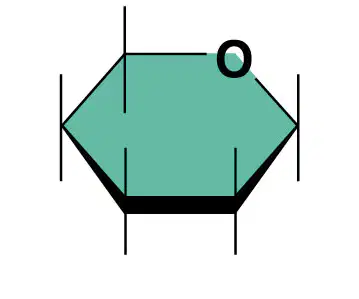
The molecule pictured is an example of a
Monosaccharide
Disaccharide
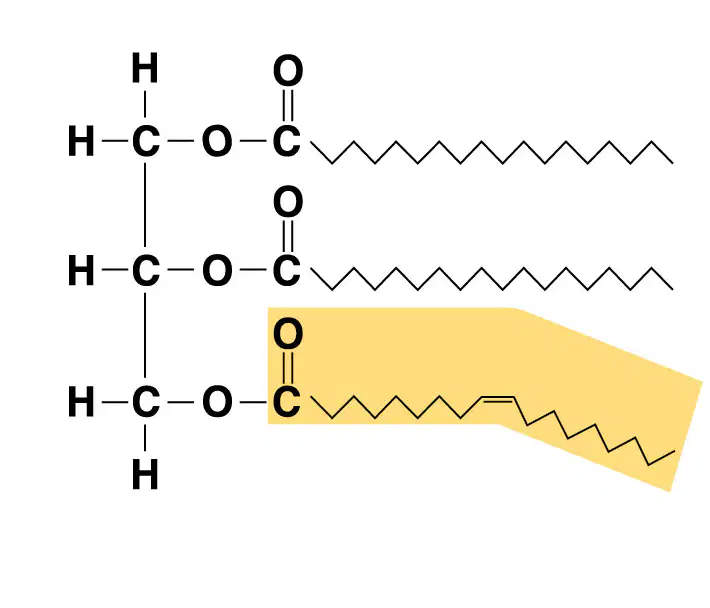
The molecule pictured is an example of
An unsaturated fat
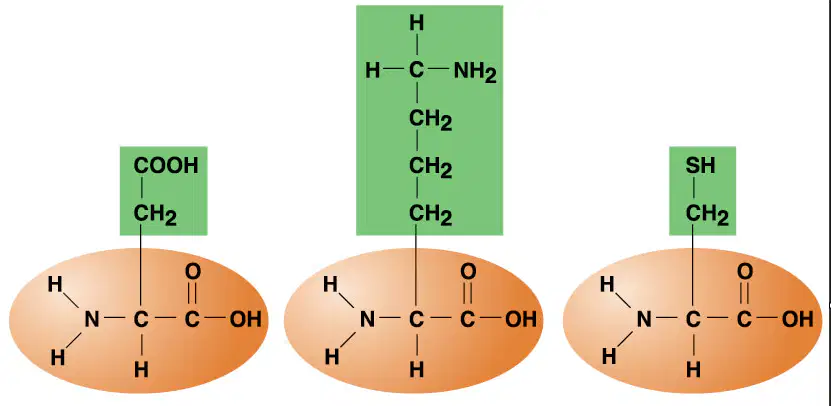
The molecules pictured are examples of
Amino Acids
Which level of protein structure is the result of the combination of two or more polypeptide chains?
Which of the following nitrogenous bases is NOT found in RNA
Adenine
Guanine
Cytosine
Thymine
Uracil

