Worksheets
US History EOC Practice
Total questions: 115
Worksheet time: 2hrs 21mins
The Gulf of Tonkin Resolution issued by Congress on August 7th, 1964 was instrumental in increasing U.S. activity in
Cambodia
Egypt
Korea
Vietnam
This time period in US History lasted from 1890-1915 and included the Spanish American War, the annexation of Puerto Rico, and Cuban independence from Spain.
Imperialism
The Gilded Age
WWI
Western Expansion
This time period consisted of social activism and political reform across the United States, and lasted from 1901-1914.
Imperialism
The Gilded Age
The Roaring Twenties
The Progressive Era
The excerpt below comes from a speech given by President Woodrow Wilson in 1917: “The world must be made safe for democracy. Its peace must be planted upon the tested foundations of political liberty. We have no selfish ends to serve. We desire no conquest, no dominion. We seek no indemnities for ourselves, no material compensation for the sacrifices we shall freely make. We are but one of the champions of the rights of mankind. We shall be satisfied when those rights have been made as secure as the faith and the freedom of nations can make them.”
What was the purpose of this speech?
to justify the acquisition of overseas territory
to persuade the Senate to ratify the Treaty of Versailles
to convince Congress to declare war on Germany
to reassure the public of his commitment to U.S. neutrality.
Which statement describes the role played by the U.S. yellow journalists during the Spanish-American war?
Journalists exaggerated events to build support for the war, giving the president and Congress little chance to resolve the conflict diplomatically.
Journalists ignored the signs of impending war until it was too late to inform the public of the government’s intentions to declare war on Spain.
Journalists focused on bad news rather than good news in order to criticize the decisions made by the president and military leaders
Journalists provided frequent reports of the fighting, allowing the public to follow a foreign war closely for the first time.
All of these were effects of Congress' 1965 Voting Rights Act EXCEPT
an increase in African American voters
an outlawing of literacy tests for voting
federal oversight of elections in the South
greater support for Kennedy's domestic plans
Which event occurred at the 1963 "March on Washington"?
Congress outlawed segregation in all public places
Martin Luther King Jr. gave his "I Have a Dream Speech"
The Southern Christian Leadership Conference was created
Martin Luther King Jr., was awarded the Nobel Peace Prize
Which of these BEST describes the goal of the "Freedom Riders" during the Civil Rights Movement?
to allow blacks to become taxi drivers
to eliminate racial restrictions in air travel
to integrate public transportation in Alabama
to desegregate buses involved in interstate travel
Great Society program would assist the elderly with costs associated wit hospitalization or prescription drugs is
VISTA
Medicaid
Medicare
Peace Corps
Which was the Manifest Destiny president?
James K. Polk
John Brown
George Washington
Andrew Jackson
American belief that it is our God given right to expand the U.S. from the Atlantic to the Pacific.
Manifest Destiny
American System
Spoils System
popular sovereignty

How did tariffs affect imported goods?
Tariffs lowered the prices of imported goods.
Tariffs made imported goods illegal to buy.
Tariffs set weight restrictions for imported goods.
Tariffs raised the cost of imported goods.
Congress passed these acts to prevent US involvement in WW2
neutrality acts
isolationist acts
Roosevelt Acts
nuclear acts
During the Stock Market crasch of 1929,
investors quickly bought more stocks to ensure a profit.
stock prices fell, causing billions of dollars to be lost.
stores hired more employees to capitalize on consumer demand.
banks loaned money to homeowners to cover their mortgages.
"Section 202. (a) Every qualified individual shall be entitled to receive.. . on the date he attains the age of sixty-five,.. . and ending on the date of his death, an old-age benefit. . ."
A major purpose of this section of Federal legislation was to
assure adequate medical care for the elderly
guarantee an annual income to experienced employees
provide economic assistance to retired elderly workers
reward workers for their support of the union movement
The purpose of the TVA (Tennessee Valley Authority) was
to insure bank deposits in the United States.
to provide job opportunities in national parks.
to reduce farm surpluses and raise agricultural profits.
provide electrical power to an underdeveloped region of the U.S.
Which situation was a basic cause of the Great Depression?
excessive profits for farmers
overregulation of the stock market
overproduction of consumer goods
continued increases in wages for workers
What were two basic causes of the Dust Bowl during the early 1930s?
strip mining and toxic waste dumping
over farming and severe drought
clear-cutting of forests and construction of railroads
overpopulation and urban sprawl
The main purpose of New Deal measures such as the Securities and Exchange Commission (SEC) and the Federal Deposit Insurance Corporation (FDIC) was to
provide immediate employment opportunities
develop rules to limit speculation and safeguard savings
enable the Federal Government to take over failing industries
assure a guaranteed income for American families
A major criticism of President Franklin D. Roosevelt's programs to combat the Great Depression was that these programs
reduced the power of the federal government.
provided too much protection for big business.
ignored the plight of homeowners with mortgages.
made people dependent on the federal government.
Who developed the factory assembly line?
Henry Ford
Calvin Coolidge
Warren G. Harding
Charles Lindbergh
What effect did automobiles have on America?
People moved around and took more vacations
Highways and gas stations had to be built
Shopping centers and roadside attractions began to open
All of these
What group of people did the Ku Klux Klan hate?
Jewish people
Catholics
Immigrants
All of these
Why was the economy so good in the 1920s?
People had money to spend on new products
There was no unemployment at all
The government gave money to Americans
The economy was not good in the 1920s
Reconstruction succeeded in its goals of restoring the Union and helping to
regulate the railroads
eliminate the Ku Klux Klan
destroy the Freedmen’s Bureau
repair the war-torn South
The Fourteenth Amendment was part of a series of laws that
ensured the civil rights of African Americans.
shifted the balance of power in favor of the Supreme Court.
changed the way a President could hire government officials.
restored the balance of power between the President and Congress.
Reconstruction came to end when
President Johnson was impeached.
federal troops were removed from the South.
the Fifteenth Amendment was ratified.
the Freedmen’s Bureau was dismantled.
The Reconstruction Act of 1867
gave voting rights to all Southerners.
closed the South to scalawags.
closed the South to Democrats.
put the South under military rule.


What court case made segregation of schools illegal in the 1950s?
Guzman V. School
Brown V. Board of Education
Miranda V. Arizona
Plessy V. Ferguson

During which event did Eisenhower send troops to Arkansas in order to desegregate a high school?
Tuskegee Airmen
Little Rock Nine
Atomic Bombs
Flying Tigers
What acts of protest during the Civil Rights Movement encouraged the government to expand political and economic opportunities for minority citizens?
March on Washington, Freedom Rides, Greensboro Sit-In, Montgomery Bus Boycott
Black Panthers
Mass Support Demonstrations
Little Rock Nine
This program created by Lyndon Johnson introduced programs like Head Start, HUD, Medicare, Food Stamps to reduce poverty and improve everyone’s quality of life-
HUAC
Great Society
New Deal
NAACP
What was one of the results of Plessy v. Ferguson?
The Supreme Court ruled in favor of Plessy saying segregation was illegal.
The Supreme Court never made a ruling.
The Supreme Court ruled that segregation was legal.


In this New Deal program, workers constructed things like roads, bridges, public buildings and parks but it also employed artists and performers...
Tennesee Valley Authority
FDIC
FERA
Works Progress Administration
Where FDR tried to add more members to the Supreme Court to pass his programs.
FDIC
Social Security Act
Court Packing
Fireside Chats
Commanded 1st US Army in the Pacific during WW2
Cesar Chavez
Douglas MacArthur
Dwight Eisenhower
Glenn Curtiss
34th President. Prior to Presidency, served in WWII as commander of Allied Forces in North Africa,
Sicily, and Italy. Promoted to General after D Day. Created the Interstate Highway System as
President.
John F. Kennedy
Harry truman
George Marshall
Dwight Eisenhower
Wrote The Feminine Mystic, co–founded NOW (National Organization of Women)
Betty Friedan
Phyllis Schlafly
Jane Addams
Dolores Huerta
Leader of the Civil Rights Movement; preached nonviolent approach and demanded equal rights for African Americans
Rosa Parks
Lester Maddox
Martin Luther King Jr.
Thurgood Marshall
Commander of the U.S. Army in Europe during WW1
George Patton
Douglas MacArthur
Dwight D. Eisenhower
John J. Pershing
These American Indians were recruited by the military to encode, transmit, and decode messages; the Navajo language was used to develop a code that was not broken by the enemy in WWII
Cherokee
Navajo
Apache
Sioux
African American civil rights activist; in Montgomery, Alabama (1955), refused to give up her seat on the city bus for a white man; led to the Montgomery Bus Boycott
Claudette Colven
Vernon Baker
Ida B. Wells
Rosa Parks
Determined young men who enlisted to become America's first black military aviators at a time when the U.S. military still practiced racial segregation. They participated in over 15,000 sorties and earned over 100 Flying Crosses.
Tuskegee Airmen
Flying Tigers
Charles Lindbergh
Black Panthers
Which of the following was a pull factor that drew African Americans north during the Great Migration?
the sale of inexpensive land by the federal government
the construction of low-cost government housing in growing cities
the absence of segregation and racial discrimination outside the South
the availability of good jobs in the North and the West
The Gentleman’s Agreement between President Theodore Roosevelt and Japan resulted in a decrease of which of these?
Japanese immigration to the US
Japanese troops stationed in Manchuria
tariffs between Japan and the US
U.S. and Japanese fleets in the Pacific Ocean
This time period in US History consisted of economic growth and prosperity, rise of the automobile, and the beginning of the Harlem Renaissance.
1901-1914
1946-1960
1920-1929
1961-1973
This time period in US History lasted from 1890-1915 and included the Spanish American War, the annexation of Puerto Rico, and Cuban independence from Spain.
Imperialism
The Gilded Age
WWI
Western Expansion
Which of the following describes a reason for U.S. involvement in WWI?
U.S. leaders feared that Germany might gain too much control from the Lusitannia and Zimmerman Telegram.
U.S .leaders argued that the stage of war might shift from European soil to territory in the United States.
U.S citizens worried that the Central Powers might be swayed to adopt a non-democratic form of government.
U.S. citizens were persuaded by German propaganda that placed Britain and France's cruelty on display.
Which entrepreneur had a significant impact on the cosmetics industry?
Harriet Beecher Stowe
Madame C.J. Walker
Emily Dickinson
Sojourner Truth
Which of the following was the main reason that the federal government created a method for Native Americans to become U.S. citizens?
to reduce the amount of money spent supporting Native Americans
to encourage Native Americans to assimilate into mainstream society
to undermine the legal basis of the treaties made with Native American tribes
to guarantee that Native Americans enjoyed constitutionally protected civil rights
This time period in U.S History consisted of the struggle to end racism in the United States.
Civil Rights Era
Civil War Era
Progressive Era
Reconstruction Era
What was the main purpose of the Interstate Commerce Act of 1887?
to ensure the spread of manufacturing across the frontier
to remove import taxes for goods shipped from one state to another
to prevent railroads from charging farmers and merchants high shipping rates
to protect American agriculture and industry from foreign competition
Which of the following was a goal of the Dawes Act of 1877?
Push Native Americans to adopt an agricultural lifestyle
Lure Native Americans to migrate to the frontier
Entice Native Americans to move to urban areas
Give Native Americans jobs in the federal bureaucracy
This made the production of steel more efficient and affordable.
Combustion Engine
Horizontal Integration
Vertical Integration
Bessemer Process
Passage of which of these represented a shift from the foreign policy that dominated American politics between the two world wars?
the Wagner Act
the Espionage Act
the Lend-Lease Act
the Taft-Hartley Act

Which Amendment, starting in 1865, abolished slavery?
(a)
What amendment to the U.S. Constitution made former slaves citizens of the U.S. and gave them equal protection under the law?
13th
14th
15th
19th

What did the 15th Amendment to the U.S. Constitution allow?
Former slaves the right to own land in former Confederate States
African American men the right to vote
The establishment of free public schools for former American American slaves in the South
Former African America slaves the right to apply for a marriage licenses
What was the main purpose of the Marshall Plan?
To rebuild European economies after World War II
To establish a military alliance against the Soviet Union
To promote American culture abroad
To decolonize territories in Asia and Africa
What was the main cause of the Cold War between the United States and the Soviet Union?
Disagreements over post-World War II economic policies in Europe.
Direct military conflict between the two superpowers.
Ideological conflict between capitalism and communism.
The race to develop and deploy nuclear weapons.
Which event marked the beginning of the Great Depression?
The signing of the Treaty of Versailles
The bombing of Pearl Harbor
The stock market crash of 1929
The end of World War II
Which event marked the beginning of American imperial expansion in the Pacific?
The annexation of Hawaii
The purchase of Alaska
The Boxer Rebellion
The Spanish-American War
Which policy aimed to prevent the spread of communism by providing economic and military aid to countries threatened by the Soviet Union?
Marshall Plan
Truman Doctrine
Containment Policy
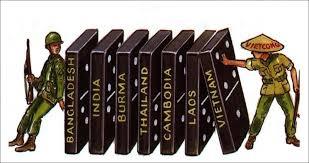
Domino Theory
What was the primary purpose of the Berlin Airlift (1948-1949)?
To supply West Berlin with food and fuel, circumventing the Soviet blockade
To evacuate Allied soldiers from Berlin before the Soviet takeover
To demonstrate Western technological superiority
To transport East German refugees to West Berlin
Which event marked the end of the Cold War?
The signing of the Helsinki Accords
The Cuban Missile Crisis
The fall of the Berlin Wall
The dissolution of the Soviet Union
What was the primary goal of the Reaganomics economic policy?
To increase federal spending on social programs
To reduce inflation by increasing interest rates
To stimulate economic growth through tax cuts and deregulation
To balance the federal budget
Which 1950s U.S. Supreme Court case declared 'separate but equal' public schools unconstitutional?
Brown v. Board of Education
Roe v. Wade
Marbury v. Madison
Plessy v. Ferguson
During the 1920s, which amendment initiated the Prohibition era in the United States?
18th Amendment
19th Amendment
21st Amendment
22nd Amendment
He believed that blacks would advance through vocational work
WEB Dubois
Booker T. Washington
George Washington Carver
Homer Plessy
Organization founded by WEB Dubois
NAACP
NCAPP
AANP
CAPP
(TEKS 5B) Jane Addams MOST contributed to Progressivism by --
supporting the emerging philosophy of Social Darwinism
promoting social reform on American Indian reservations
forming the Women’s Christian Temperance Union
spreading the settlement house movement by founding Hull House
One consequence of the Iran Hostage Crisis was
Jimmy Carter lost his bid to be re-elected President
The US got involved in the Gulf War
It caused the collapse of Communism in Europe
The US economy improved significantly

What did Nixon do when audio tapes proved he was covering up the Watergate break in and obstructing justice?
Nixon was impeached by Congress on August 8, 1974
Nixon was removed from office by the Supreme Court
Nixon pardoned himself from crimes he did during Watergate
Nixon resigned on August 8, 1974 to avoid being impeached
Government organization established in 1970 to establish pollution standards, conduct environmental research, and assist state and local governments in pollution control
Environmental Protection Agency (EPA)
Environmental Promotion Agency (EPA)
Environmental Prosecution Agency (EPA)
Environmental Probation Agency (EPA)
Who was the first woman appointed to the U.S. Supreme Court?
Dolores Huerta
Jane Adams
Susan B. Anthony
Sandra Day O’Conner
What agreement dismantled trade barriers between US, Canada, and Mexico, making trade easier?
League of Nations
U.N.
NATO
NAFTA

Which mastermind behind 9/11 was killed under Obama's command.
Saddam Hussein
Osama Bin Laden
Ayatollah Khomeini
Vladimir Putin

Obamacare was significant because it
Gained support of both Republicans and Democrats in Congress
Never passed the Senate
attempted to provide universal healthcare and covered pre-existing conditions
What was the goal of the United Nations?
Many nations wanted to form allies to prepare for war
Many nations wanted to promote global peace and encourage social justice
Many nations wanted to end world hunger
Many nations wanted to defeat the Soviet Union during The Cold War
Term used to describe the panic that Americans were feeling as the communist party grew
McCarthyism
duck and cover drills
blockade
The Red Scare


Who was put in charge of the American forces in Korea and even wanted to use the atomic bomb against China?
John Bassilone
Douglas MacArthur
Harry Truman
Richard Nixon
Who were industry leaders who were determined to have complete control over one or more industries?
Labor Managers
Industrialists
Robber Barons
Captains
What did Alexander Graham Bell invent?
Vertical integration
Horizontal integration
Telephone
Telegraph
What was the name of the process that turned iron into steel?
Bessemer
Carnegie
Rockefeller
Riis
The religious wing of the progressive movement which had the aim of combating injustice, suffering and poverty in society.
Social Gospel
Pie Social
Social Butterfly
Social Muckraker
The process through which cities grow, and higher and higher percentages of the population comes to live in the city.
Retraction Theory
Urbanization
Recidivation
Immigration
Who was the leader of Tammany Hall (New York Political Machine)?
Andrew Carnegie
Henry Ford
John D. Rockefeller
Boss Tweed
Who was the oil tycoon who created the Standard Oil Company
Carnegie
Morgan
Rockefeller
Vanderbilt
Cornelius Vanderbilt made his fortune in...
Oil
Railroads
Textiles
Banking
In which industry did Andrew Carnegie earn his fortune?
Steel
Railroads
Banking
Oil
This man gained his wealth and power from banking and finances during the Gilded Age
John D. Rockefeller
Andrew Carnegie
JP Morgan
Cornelius Vanderbilt
What was the aim of Vietnamization?
To increase American military involvement in Vietnam
To introduce democratic elections in Vietnam
To negotiate peace with North Vietnam
To transfer all military responsibilities to South Vietnam
What are the long-lasting effects associated with Agent Orange?
Improved relations between the US and Vietnam
Deadly herbicide effects
Economic prosperity
Increased vegetation growth