
 Worksheets
electroquest
Total questions: 15
Worksheet time: 21mins
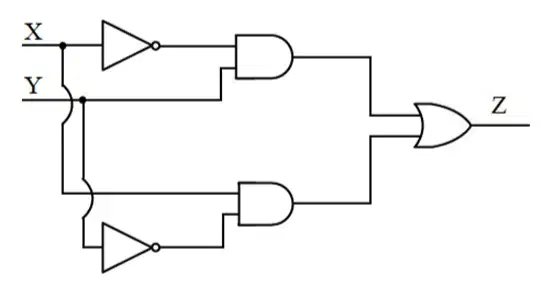
In the circuit shown below X and Y are digital inputs and Z is a digital output .The equivalent circuit is a
NAND Gate
NOR Gate
XOR Gate
XNOR Gate
Which of the following amplifier circuit using junction transistor has the best gain ?
Common Base
Common Collector
Common Emitter
All have the same gain
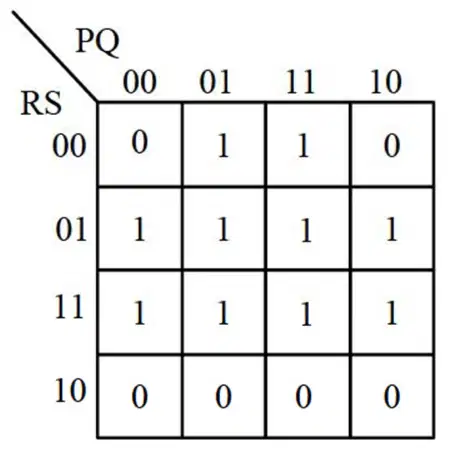
The output expression for the Karnaugh Map shown below is
QR' + S
QR' + S'
QR + S
QR + S'
Time scaling won't work for the function
Unit step
Impulse
Ramp
Signum
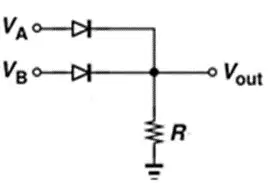
What will be the voltage Vout if VA = 3V and VB = -5V and the diodes are ideal ?
5V
2V
0V
3V
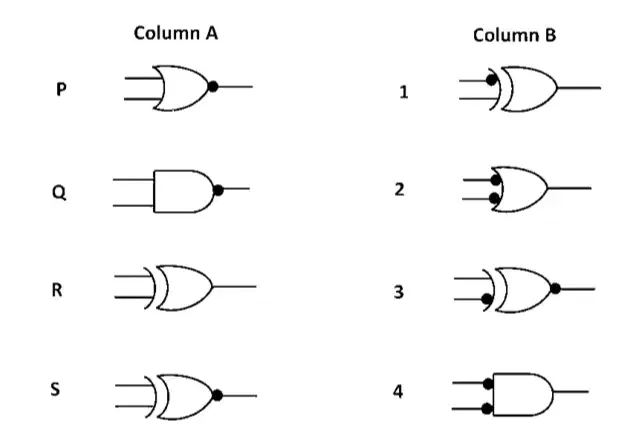
Match the logic gates in column A with their equivalents in column B
P-2, Q-4, R-1, S-3
P-4, Q-2, R-1, S-3
P-2, Q-4, R-3, S-1
P-4, Q-2, R-3, S-1
Batteries (Cells) are connected in two rows in parallel (each row has N number of batteries) to pass the current of 6A through an external resistor of 0.7 Ω. The voltage of each battery is 2.1 V with 0.5 Ω internal resistance. The number of batteries required to achieve 6A current is
10
14
12
16
We can apply the standard test signal to give output to :
Time-Invariant Systems
Time-Variant Systems
Non-Linear Systems
Linear Systems
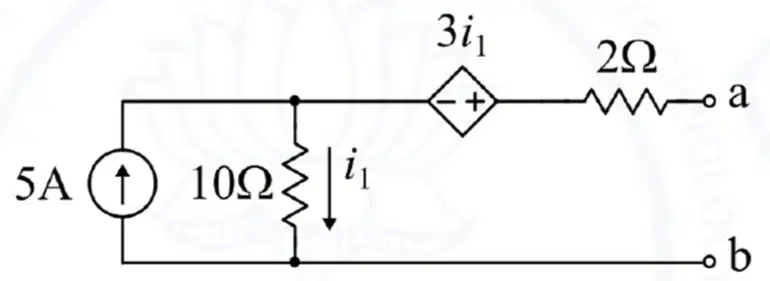
For the network shown, the equivalent Thevenin voltage and Thevenin impedance as seen across terminal 'ab' is
10 v in series with 12 Ω
65 v in series with 15 Ω
50 v in series with 2 Ω
35 v in series with 2Ω
What are the advantages of tuned amplifiers?
Minimize the power loss
Frequency is high
Suitable for all radio transmitters & receivers
amplify defined frequencies
Convert binary 111111010010 to hexadecimal.
EE216
FF216
2FE16
FD216
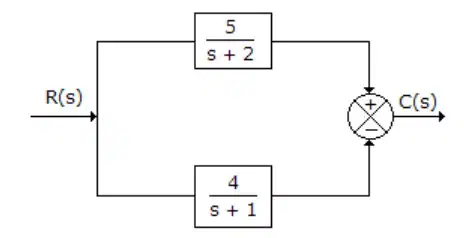
For the given figure C(s)/R(s)
(S+2)(s+1)4(S+2)
(S+2)(S+1)S−3
(S+2)(S+1)9S+13
(S+2)(S+1)1
which of the following statements are true?
a system is said to be finite impulse responses,if the output samples of the system depend only on the present input and a finite number of past or previous input samples.
if the output of a system y(n) depends only on the present input and past inputs, but not on past outputs, then it is called a non recursive system.
if the output of a system y(n) depends only on the present input and past inputs, but not on past outputs ,then it is called a recursive system.
a system is always a recursive one.
Which of the following is correct for a gated D flip-flop?
The output toggles if one of the inputs is held HIGH.
Only one of the inputs can be HIGH at a time.
The output complement follows the input when enabled.
Q output follows the input D when the enable is HIGH.
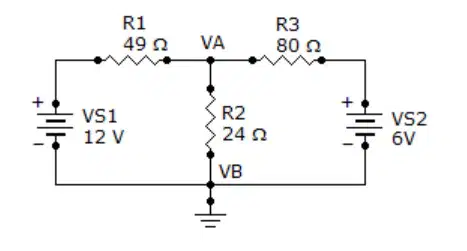
Find the node voltage VA.
6 V
12 V
4.25 V
3 V

