
 Worksheets
Energy, Force, and Motion Test 1 Study Guide
Total questions: 20
Worksheet time: 5hrs 0mins
Define gravitational potential energy.
energy due to an object being stretched or compressed
energy an object possesses because of its position
energy that relies on motion
energy that is stored
Define elastic potential energy.
energy due to an object being stretched or compressed
energy an object possesses because of its position
energy that relies on motion
energy that is stored
How are kinetic and potential energy different?
Kinetic energy relies on motion, while potential energy is stored energy.
Kinetic energy is stored energy, while potential energy relies on motion.
Kinetic energy and potential energy are the same.
Kinetic energy and potential energy are unrelated.
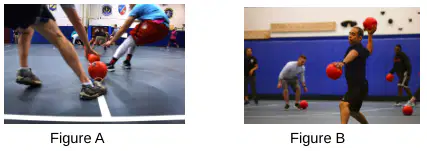
You are playing dodgeball in PE. You lift the ball from the floor towards your body (Figure A) and reach backwards before throwing it (Figure B). When does the ball have the most potential energy?
The ball has the most potential energy in Figure A.
The ball has the most potential energy in Figure B.
The ball has the same potential energy in both Figure A and Figure B.
The ball has no potential energy.
Tom built a model rocket. He launched the rocket from the stand using a burst of air. The rocket flew 25 feet into the air. How is the rocket's potential energy (sitting on the stand) related to the rocket's kinetic energy (flying in the air)?
The rocket's potential energy is unrelated to its kinetic energy.
The rocket's potential energy is equal to its kinetic energy.
The rocket's potential energy is converted into kinetic energy.
The rocket's potential energy is stored in the air.
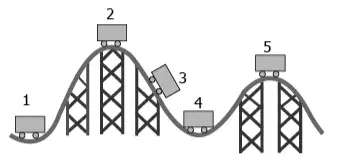
Using the diagram, identify each location as potential or kinetic energy. Explain how energy is changed between 1 and 2, 2 and 4, and 4 and 5.
1. Potential Energy, 2. Kinetic Energy, 3. Potential Energy, 4. Kinetic Energy, 5. Potential Energy
1. Kinetic Energy, 2. Potential Energy, 3. Kinetic Energy, 4. Potential Energy, 5. Kinetic Energy
1. Potential Energy, 2. Kinetic Energy, 3. Kinetic Energy, 4. Potential Energy, 5. Potential Energy
1. Kinetic Energy, 2. Potential Energy, 3. Potential Energy, 4. Kinetic Energy, 5. Kinetic Energy
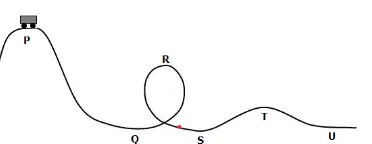
A roller coaster is at Point P. What type of energy does it have? What happens to that energy as the roller coaster moves to point Q?
The roller coaster has the highest kinetic energy at Point P, and at Point Q, it has the highest potential energy.
The roller coaster has the highest potential energy at Point P, and at Point Q, it has the highest kinetic energy.
The roller coaster has the same energy at both Point P and Point Q.
The roller coaster has no energy at Point P or Point Q.
The Hoover Dam stores 10 trillion gallons of water. What type of energy is stored in the water behind the dam?
Potential energy
Kinetic energy
Thermal energy
Chemical energy
In which of the following is kinetic energy transformed to potential energy?
An apple falling from a tree
Stretching a slinky from both sides
Lifting a box from the floor to a desk
A ball rolling down a ramp
David places an arrow in his bow. He pulls backward, releasing the arrow. The arrow shoots up into the air and falls down. When is potential energy transformed into kinetic energy?
When he places the arrow in his bow
When he pulls backward
When he releases the arrow
When the arrow shoots up into the air
A child is pushing a toy car across the floor at a certain speed. If he pushes the toy car with more force, it moves faster. What type of energy increases when he uses more force?
Potential energy
Kinetic energy
Thermal energy
Chemical energy

Using the data in the table, place the objects in order of increasing mass.
(least to greatest)
Object W, Object X, Object Y, Object Z
Object Z, Object Y, Object X, Object W
Object X, Object Y, Object Z, Object W
Object W, Object Z, Object Y, Object X
How does raising an object higher above the ground affect its gravitational potential energy?
Raising an object higher above the ground decreases its gravitational potential energy.
Raising an object higher above the ground increases its gravitational potential energy.
Raising an object higher above the ground has no effect on its gravitational potential energy.
Raising an object higher above the ground converts its gravitational potential energy into kinetic energy.
What is the relationship between mass and force?
Mass and force are unrelated.
Force is used to calculate mass.
Mass is used to calculate force.
Mass and force are equal.
The formula for power is power = work / time. If you perform 5000 Joules of work moving a box in 25 seconds, how much power did you use?
100 watts
200 watts
250 watts
5000 watts
If a car uses 6000 Joules of energy to travel a distance in 30 seconds, what is the power used by the car?
100 watts
200 watts
300 watts
400 watts
How does the kinetic energy of a moving object change if its speed is doubled?
The kinetic energy remains the same.
The kinetic energy doubles.
The kinetic energy quadruples.
The kinetic energy is halved.
A ball is thrown upwards and then it comes down. When does the ball have the maximum potential energy?
When the ball is at the highest point in the air
When the ball is just released
When the ball is halfway up
When the ball is coming down
A car is moving on a straight road. It then starts climbing a hill until it reaches the top and then comes down. How does the car's energy change from the start of the hill to the top?
The car's kinetic energy decreases and potential energy increases
The car's kinetic energy increases and potential energy decreases
The car's kinetic and potential energy remain the same
The car's kinetic and potential energy both increase
What happens to the potential energy of an object when it is lifted higher?
It decreases
It remains the same
It increases
It becomes zero

