
 Worksheets
Sun Properties and Electromagnetic Spectrum
Total questions: 21
Worksheet time: 12mins

What are sunspots?
Areas on the Sun's surface that are cooler than the surrounding areas
Areas on the Sun's surface that are hotter than the surrounding areas
Areas on the Sun's surface that emit more radiation than the surrounding areas
Areas on the Sun's surface that emit less radiation than the surrounding areas

What causes solar flares?
Interactions between magnetic fields on the Sun's surface
Interactions between the Sun's atmosphere and Earth's atmosphere
Interactions between the Sun's core and its outer layers
Interactions between the Sun's radiation and space debris
What is solar wind?
A stream of charged particles emitted by the Sun
A stream of electromagnetic waves emitted by the Sun
A stream of hot gases emitted by the Sun
A stream of cosmic rays emitted by the Sun
What is solar radiation?
Energy emitted by the Sun in the form of electromagnetic waves
Energy emitted by the Sun in the form of charged particles
Energy emitted by the Sun in the form of heat
Energy emitted by the Sun in the form of sound waves
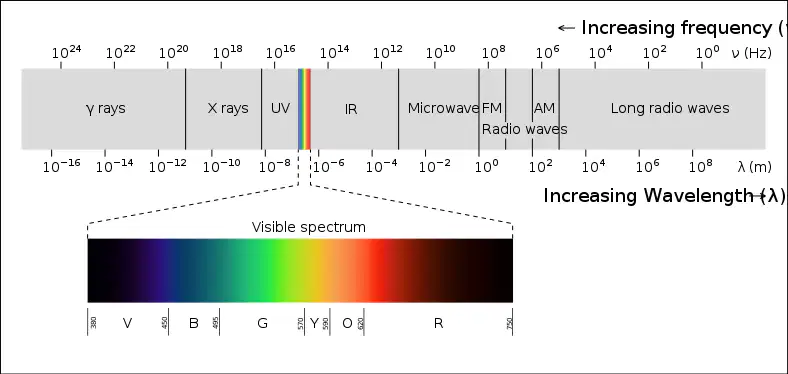
Which of the following is NOT part of the electromagnetic spectrum?
Visible light
X-rays
Sound waves
Radio waves
What is the order of the electromagnetic spectrum from lowest to highest frequency?
Radio waves, microwaves, infrared, visible light, ultraviolet, X-rays, gamma rays
Gamma rays, X-rays, ultraviolet, visible light, infrared, microwaves, radio waves
Radio waves, infrared, visible light, ultraviolet, X-rays, gamma rays, microwaves
Microwaves, radio waves, visible light, infrared, ultraviolet, X-rays, gamma rays

Which type of electromagnetic radiation has the shortest wavelength?
Gamma rays
X-rays
Ultraviolet
Visible light
What is the main source of energy for the Sun?
Nuclear fusion
Nuclear fission
Chemical reactions
Gravitational collapse
What is the approximate temperature of the Sun's core?
15 million degrees Celsius
1 million degrees Celsius
10,000 degrees Celsius
5,000 degrees Celsius
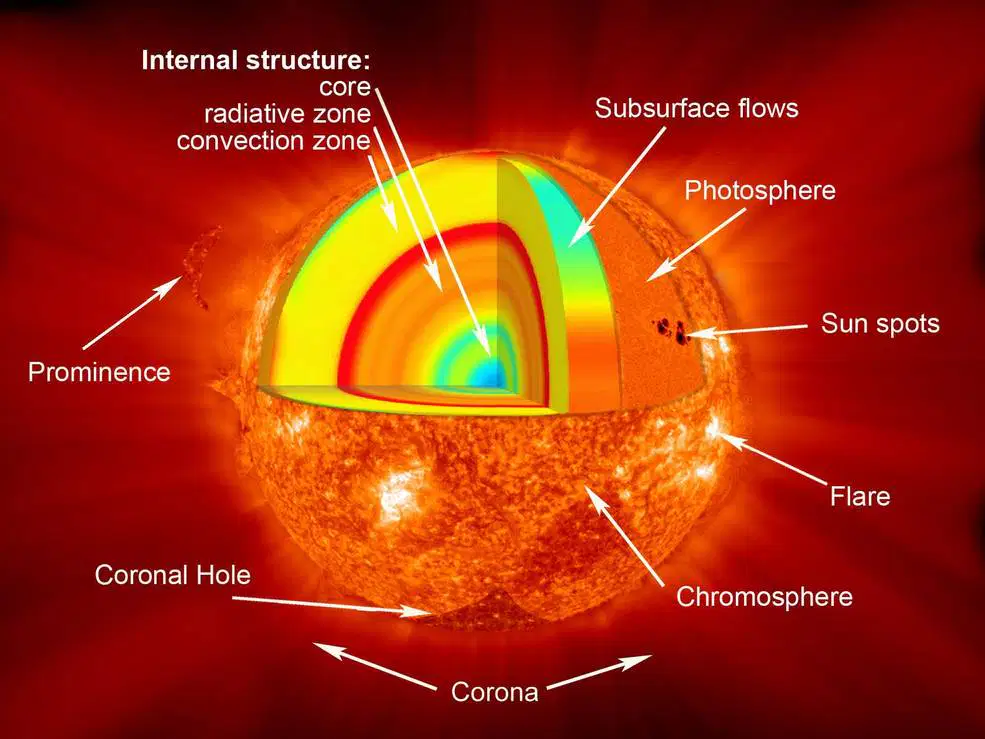
What is the outermost layer of the Sun's atmosphere called?
Corona
Photosphere
Chromosphere
Convection zone
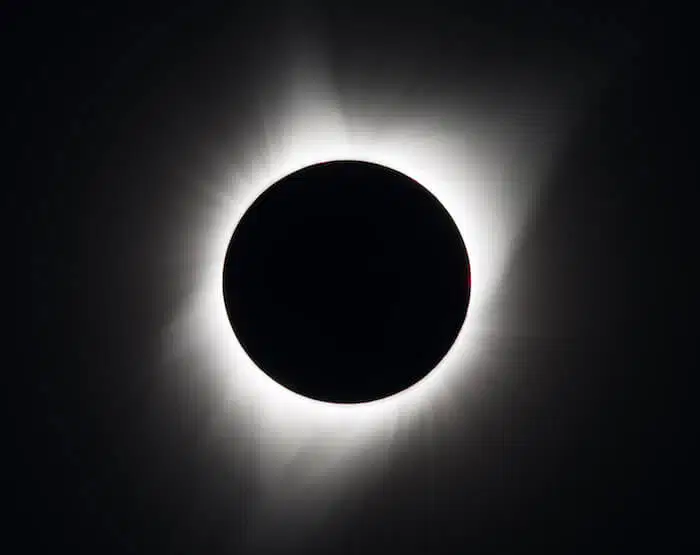
What layer of the sun can be seen in a total solar eclipse?
corona
photosphere
chromosphere

What is a sunspot?
Sunspots are dots in the sun.
Sunspots are large areas on the Sun's surface that are hotter and darker than the surrounding area.
Sunspots are volcanoes in the Sun that erupt every now and then
Sunspots are large areas on the Sun's surface that are cooler and darker than the surrounding area.

What is a solar flare?
Solar flares are explosions of hot gases that occur near sunspots
Solar flares are huge looping eruptions of gases that arc out from the atmosphere.

What is a photoshpere
The core
The surface of the sun
The outer layer.
Large holes in the sun.

What is a corona
The core of the sun
Outer layer of the sun's atmosphere
Surface of the sun
Magnetic Field

What is nuclear fusion
Energy from the sun comes from its core where hydrogen is converted into helium
A nuclear bomb that releases from the sun
The outer layer of the suns atmosphere.
The core of the sun

What is a CME (Coronal Mass Ejection)
When the sun releases a large amount of charged particles all at once.
Large areas on the suns surface that are cooler and darker than its surrounding area.
Large hooping eruptions of gases that arc out from the photosphere.
Explosions pf hot gases that occur near sunspots.

What is a aurora
A rainbow at night
Lasers
When the solar wind charges some of the gases in the earths atmosphere
Shiny cool lights that float in the sky

What are the harmful effects of CME's?
Causes disruptions with radio, telephone. and television signals, and static radios
We all die and go extinct
None
We will be fine

The diagram above shows a Bunsen burner heating a beaker of water on a beaker stand. The arrows represent the transfer of heat energy in the water. Which process is primarily responsible for the transfer of heat in the beaker as indicated by the arrows in the diagram?
conduction
radiation
convection
condensation
Movement that transfers heat in a fluid is called
conduction
convection
radiation
specific heat

