
 Worksheets
Quiz #1 Review Sheet
Total questions: 28
Worksheet time: 23mins
Distance is measured using the (a) and the basic units used to measure this are (b) .
(a) is measured using the (b) and the basic units used to measure this are Liter .
(a) is measured using the thermometer and the basic units used to measure this are (b) .
(a) is measured using the (b) and the basic units used to measure this are gram .
Used to Magnify the image; usually 4x, 10, or 40x
Objective Lenses
Fine Adjustment Knob
Coarse Adjustment Knob
Body Tube
Connects the eyepiece to the revolving nosepiece
Objective Lenses
Fine Adjustment Knob
Coarse Adjustment Knob
Body Tube
Used to bring the object into a clear focus
Objective Lenses
Fine Adjustment Knob
Coarse Adjustment Knob
Body Tube
Used to first bring the object into focus
Objective Lenses
Fine Adjustment Knob
Coarse Adjustment Knob
Body Tube
Used to carry the microscope, connects the rest of the microscope to the revolving nosepiece
Arm
Base
Eyepiece
Revolving Nosepiece
Where the microscope rests, also used to hold the microscope
Arm
Base
Eyepiece
Revolving Nosepiece
What you look through, also has a magnification
Arm
Base
Eyepiece
Revolving Nosepiece
Allows you to switch between the objective lenses
Arm
Base
Eyepiece
Revolving Nosepiece
Where you place the slide on the microscope
Diaphragm
Light
Stage
Stage Clips
Used to control the amount of light, located immediately under the stage
Diaphragm
Light
Stage
Stage Clips
Holds the slide in place
Diaphragm
Light
Stage
Stage Clips
Illuminates the object under the microscope
Diaphragm
Light
Stage
Stage Clips
Label the microscope
Base
Coarse Adjustment Knob
Fine Adjustment Knob
Stage
Stage Clips
Diaghram
Eyepiece
Body Tube
Objective Lenses
Revolving Nosepiece
Label the microscope
Revolving Nosepiece
Coarse Adjustment Knob
Fine Adjustment Knob
Base
Stage Clips
Diaghram
Eyepiece
Light
Objective Lenses
Arm
When holding the microscope you carry is by the (a)
Which is correctly paired with it's equal conversion?
10 mm
1 cm
2000 μm
2 mm
1.5 cm
15 mm
2.7 mm
2700 μm
0.5 mm
500 μm
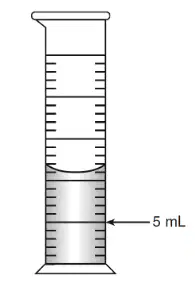
If this scale goes by 1 unit. How many mL are present in the graduated cylinder?
1
5
11
12
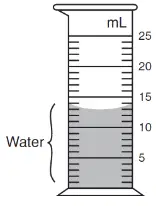
What is the volume of water represented in the graduated cylinder shown?
10.3 mL
13.0 mL
14.0 mL
15.0 mL
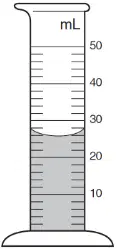
What is the volume of the liquid in the graduated cylinder shown below?
23 mL
26 mL
27 mL
28 mL
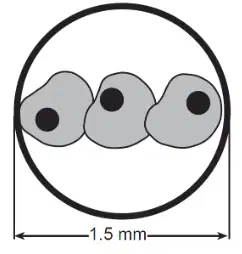
The diagram below shows three cells in the field of view of a microscope. The diameter of the field of view is 1.5 millimeters. What is the approximate diameter of each cell?
50 µm
250 µm
500 µm
4500 µm
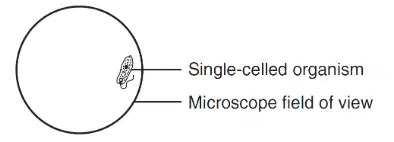
If we want to see this single celled organism centered we need to move the slide towards the (a)
Which of the following does NOT apply while using the microscope?
The specimen will be flipped
The specimen will be enlarged
The specimen will be more detailed
The specimen with be much smaller
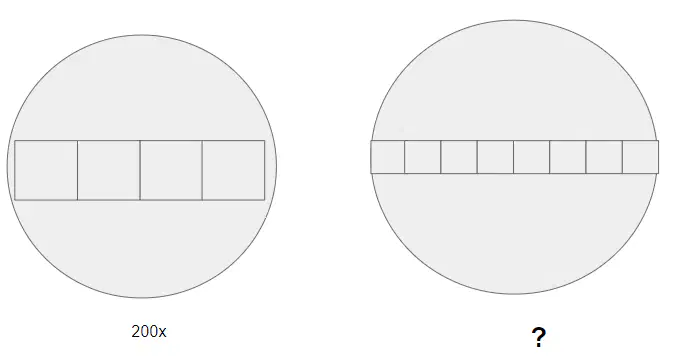
What is the new magnification?
100x
300x
400 x
50x
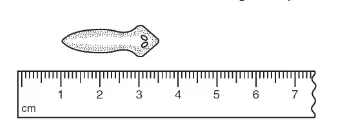
What is the approximate length of the specimen in millimeters?
25 mm
30 mm
35 mm
40 mm

