
 Worksheets
Unit 2 Vocabulary (2.1-2.5)
Total questions: 26
Worksheet time: 28mins
The number of years it takes Plano's population to go from 10,000 to 20,000 is known as...
Crude Birth Rate
Crude Death Rate
Natural Increase Rate
Doubling Time
England had 12 births for every 1,000 people in a year. This is
Crude Birth Rate
Crude Death Rate
Natural Increase Rate
Doubling Time
The CBR of Togo is 30 and the CDR is 10. What is the NIR?
20%
40%
2%
6%
What region of the world has the lowest life expectancy?
Europe
North America
Australia
Africa
Which of the following is a proven way to lower birth rates in a country?
lower taxes
lower food prices
Increase education of women
Increase marriage rates
What is Arithmetic Density?
Calculating by dividing a region's population by its total area.
Calculating by multiplying a region's population by its total area.
Calculating by dividing a certain amount of people in distance.
Calculating by dividing the population by sectors.
What stages of the DTM see the most population growth?
1 and 2
2 and 3
3 and 4
4 and 5

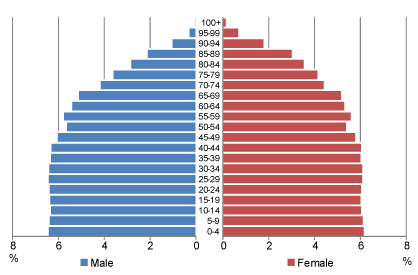
What stage is this population pyramid?
1
2
3
4

What stage is this population pyramid?
1
2
3
4
ETM Stage 3 is known as...
Infectious and parasitic diseases
Receding Pandemics
Degenerative Diseases
Delayed Degenerative Diseases
Which characteristic is shared by European countries?
High IMR
Low NIR
High CBR
High CDR
This population density measure can show the economic development of a country.
Arithmetic Density
Physiological Density
Crude Density
Agricultural Density
In a country that has a growing population...
The birth rate is higher than the death rate
The death rate is higher than the birth rate
The birth rate equals the death rate

What happens during stage one of The Epidemiologic Transition?
Pestilence and Famine- Black Plague
Receding Pandemic- Cholera
Degenerate Diseases- Cardiovascular Diseases
Delayed Degenerate Diseases- Cancer, Cardiovascular Diseases
What happens during stage four of The Epidemiologic Transition?
Pestilence and Famine- Black Plague
Receding Pandemic- Cholera
Degenerate Diseases- Cardiovascular Diseases
Delayed Degenerate Diseases- Cancer, Cardiovascular Diseases
carrying capacity
demography
cultural ecology
Which of these populations would be considered a LDC (less developed country)?


Predicts population change within a particular area as a function of BOTH natural increase/decrease and in/out migration.
Demographic Balancing Equation
Demographic Transition Model
Epidemiologic Transition Model
Demographic Momentum
ability of a country/region to sustain its people with resources available
urbanization
carrying capacity
overpopulation
demography

The tendency for a country/region to continue growing even after fertility rates decline because of the high younger age distribution.
Dependency Ratio
Demographic Balancing Equation
Demographic Transition Model
Demographic Momentum
The Rule of 70 is used to help calculate which of the following? (70 divided by NIR in percentage)
carrying capacity
replacement rate
doubling time
demographic momentum

