
 Worksheets
Astronomy 2
Total questions: 27
Worksheet time: 14mins
What is a force that pulls objects towards each other?
Tension
Gravity
Speed
Inertia
Which variables affect gravity?
mass
speed
distance
volume
weight
More mass equals:
less gravity
less distance
more gravity
more distance
Does your mass increase or decrease if you go to the moon?
Increase
Decrease
It stays the same
Does your weight increase or decrease if you go to the moon?
Increase
Decrease
It stays the same
Choose the image that has the most gravitational pull:


Choose the image that has the most gravitational pull:


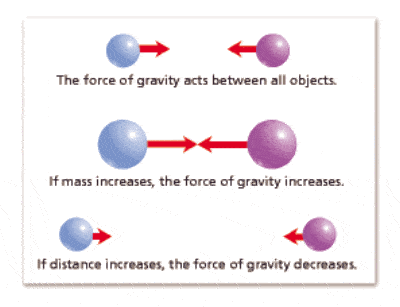
As mass increases, what happens to gravitational force?
increases
decreases
stays the same
As distance increases, what happens to gravitational force?
increases
decreases
stays the same
Who was the mathematician who figured out that the orbits of planets are elliptical and not perfect circles?
Ptolemy
Kepler
Copernicus
Galileo
Who came up with the force, gravity?
Newton
Galileo
Copernicus
Ptolemy
Who is the astronomer who came up with the heliocentric model of the solar system?
Copernicus
Newton
Galileo
Ptolemy
Who used a telescope to look at the sky and discovered the moons around Jupiter to prove the heliocentric model?
Newton
Galileo
Copernicus
Brahe
Who is credited explaining how planets moved in the geocentric model? He said that planets moved in smaller circles called epicycles.
Galileo
Brahe
Ptolemy
Copernicus

Which model is this?
Heliocentric
Geocentric

What model is this?
Heliocentric
Geocentric

What makes a meteoroid, meteor, and a meteorite different? (best answer)
color
size
location
texture
Choose the best description for a meteoroid...
-burns up while entering earths atmosphere
-hits earth surface
-still in space
Choose the best description for a meteor...
-still in space
-burns up in earths atmosphere
-hits earth surface
Choose the best description for a meteorite...
-still in space
-burns up in earth's atmosphere
-hits earth surface
Choose the best description for a meteorite...
-still in space
-burns up in earth's atmosphere
-hits earth surface
Choose the best description for a comet...
icy small body with a tail
chunky rock
rock moving body
Asteroids "hang out" in our solar system in a place called...
A large, rocky object orbiting the sun is called a...
Comet
Asteroid
Meteoroid
Meteor


