
 Worksheets
Exam 3 Block 1 Immuno lecture 26-30
Total questions: 25
Worksheet time: 24mins
Which of the following is not true about aging?
Increased IL-7 production
Increased IgG serum levels
Increased CD8 cells
Increased IL-6
Select the cell least likely to be affected by chemotherapy
Tumor cells
Neurons
GI epithelium
Hematopoietic Cells
A patient comes into the clinic. They present with a headache, fever, sore throat, and generalized lymphadenopathy. Social history shows that their last sexual encounter was 6 weeks ago. If this patient has been infected with HIV, what phase would they currently be in?
Phase I
Phase II
Phase III
Latency
Lab work from the patient in the last question did indicate an HIV infection. When the patient comes back 6 weeks later, they are no longer experiencing any flu-like symptoms. What is not true about this phase of HIV?
It may last for years
CD4 + T cell count is declining
The virus is continuing to replicate in the thymus
The viral load has dropped to the viral set-point
What is an example of an allograft?
Woman donates a kidney to her identical twin sister
Liver transplant from an organ donor in child with biliary atresia
Patellar tendon of patient used for patient’s anterior cruciate ligament (ACL) reconstruction
Using coral as bone grafting material for replacing harvested iliac bone
What statement is true regarding mixed lymphocyte reaction tests?
The test is done in less than a day
It is less sensitive in detecting HLA differences than serology
If reactive, recipient cells proliferate and make cytokines
Recipient lymphocytes are irradiated and mixed with live donor lymphocytes
A patient with end-stage heart failure undergoes heart transplant surgery. Shortly after ensuring proper vascular connections and blood flow to the new heart while the patient is still under anesthesia, there is sudden deterioration in the patient’s condition. There is a rapid drop in blood pressure, signs of shock, and the heart shows poor contractility and circulation. What is the primary mediator of this graft rejection?
NK cells
IgG
T cells
Macrophages
After receiving a bone marrow transplant, a patient experiences rash, widespread erythema, nausea/vomiting, diarrhea, and increasing serum bilirubin. What is happening to this patient?
Recipient APC is presenting ingested graft cells
Recipient antibodies are initiating hyperacute graft rejection
Recipient T cells recognize MHC on donor dendritic cells
Recipient MHC is recognized as foreign by donor T cells
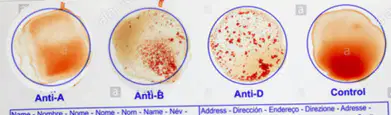
What is this blood type?
A+
B+
A-
B-
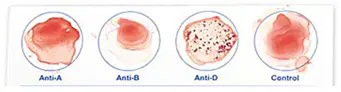
What is this blood type?
D-
O-
O+
Inconclusive
Sophie wants to know who her dad is for her upcoming wedding, but her mother Donna cannot tell her. Sophie invites all 3 possible men to her wedding, and secretly takes a blood sample from them. Mamma Mia! If Sophie is type O+ and her mother is O- who is her father?
Harry who is type O+
Sam who is type A+
Bill who is type B+
It could be any of them
What is not included in a transfusion?
Leukocytes
Erythrocytes
Plasma
Platelets
Within 4 hours of initiating a transfusion in a child, the patient presents with fever (less than 2 degrees celsius), chills, and mild dyspnea. What happened?
Urticarial transfusion reaction
Primary hypotensive reaction
Febrile nonhemolytic transfusion reaction
Acute hemolytic transfusion reaction
When testing to see if a patient is experiencing acute HTR you check to see if they are experiencing hemoglobinuria. If they are experiencing this, what do you expect to see and why?
After centrifuging the urine expect to see red pellet because of antibodies to donor blood antigen causing agglutination
After centrifuging the urine expect no pellet to form and liquid to stay red because RBCs have been lysed due to complement-mediated pathways
After centrifuging the urine expect to see red pellet because RBCs have been lysed due to complement-mediated pathways
After centrifuging the urine expect no pellet to form and liquid to stay red because of antibodies to donor blood antigen causing agglutination
What do you do if a transfusion reaction occurs?
Maintain IV line with saline and discard blood bag
See if bilirubin is elevated within 3-6 hours
Give furosemide to decrease renal blood flow
Do not bother the patient by checking vital signs since they already feel anxiety and dread
Which of the following activates an immune response?
Abatacept an CTLA4-Ig
Ibrutinib which blocks BCR-mediated signaling
Tofacitnib a JAK inhibitor
Sargrastim a GM-CSF
Which of the following prevents activation and reduces the number of self-reactive T cells by preventing binding of T cells to APC?
Alefacept an anti-CD2 medicine
Nivolumab an anti-PD1 medicine
Ipilimumab an anti CTLA4 medicine
Natalizumab an anti-alpha4 integrin
Chimeric antigen receptor (CAR) T cells…
Work best in solid tumors
Cytoplasmic tail contains ITAM and costimulatory domains
Reinforces MHC restriction in T cells
Is an antibody based therapy
Which of the following situations would not be of concern?
Prescribing anti-TNF therapies to a patient that once has tuberculosis
Prescribing anti-CD52 to an MS patient who has JC virus
Prescribing CAR T cell therapy along with a checkpoint inhibitor such as atezolizumab for lung cancer
Prescribing natalizumab, an anti-alpha4 integrin, for Crohn’s disease in combination with interferon beta
Which of the following would most likely be an antitumor mAB prescribed for B cell lymphomas?
Rituximab, specific for CD20
Ipilimumab, specific for CTLA-4
Pembrolizumab, specific for PD-1/PD-L1
Trastuzumab, specific for HER2
What is not true about tumor-associated antigens (TAAs)?
Self-antigens
VEGF is an example
Can be from oncogenic virus proteins
They have low tumoral specificity
Which is an example of immune suppression?
Rapid accumulation of Ag causing T and B cell exhaustion
Shedding immunogenic Ags
Reducing expression of MHC I
Expression of CTLA4
A patient with acute lymphoblastic leukemia is being treated with Blinatumomab which links T cells to CD19. This is an example of a BiTE meaning…
T cell/target cell interaction is independent of MHC
It is a T cell with an inserted cytokine gene
It has an intramembrane and cytoplasmic portion of CD3
Intra-tumor T cells were isolated and expanded ex vivo
Provenge (sipuleucel-T) is a dendritic cell vaccine for prostate cancer. What is false regarding this vaccine?
It is custom to each patient due to cell collection
Drives DC to optimal phenotype
Can be loaded with TSAs or autologous tumor RNA
Do not work well because DC’s are not the APC for naive T cells
Which of the following is not a cancer immunotherapy?
Inhibitor of IL-10
Anti-IL-7
Anti-PDL1
Anti-VEGF

