
 Worksheets
DT 1 (12th Grade) MB2 Physics
Total questions: 7
Worksheet time: 3600secs
An electron is at a distance of 0.50 x 10⁻¹⁰ m from a proton.
[Data: e = 1.6 x 10⁻¹⁹ C ; me, = 9.1 x 10⁻³¹ kg; mp, = 1.67 x 10⁻²⁷ kg; G = 6.67 x 10⁻¹¹ N . m2/kg2].
What is the electrical force exerted on the electron by the proton and what is the gravitational force between these particles?
The electric force between the electron and proton is 9.2 x 10⁻⁸ N, while the gravitational force is 4.05 x 10-47 N.
The electric force between the electron and proton is 4.05 x 10-47 N, while the gravitational force is 9.2 x 10⁻⁸ N
The electric force between the electron and proton is 6.67 x 10⁻¹¹ N, while the gravitational force is 1.6 x 10⁻¹⁹ N.
The electric force between the electron and proton is 1.6 x 10⁻¹⁹ N, while the gravitational force is 6.67 x 10⁻¹¹ N.
The electric force between the electron and proton is 8.99 x 10⁹ N, while the gravitational force is 6.67 x 10⁻¹¹ N.

Two charges are located on the x-axis with q1 = 2.3 x 10⁻⁸ C at the origin, and with
q2 = -5.6 x 10⁻⁸ C at x = 1.30 m (see Fig. 3-4). Find the force exerted by these two charges on a third charge of q = 3.3 x 10⁻⁸ C, which is located at: (a) x = 0.24 m on the x axis and (b) x = 1.55 m on the x axis.
(a) 1.34 x 10⁻⁴ N in the positive x-direction; (b) (2.66-0.03) x 10-4 N in the negative x-direction.
(a) (2.66-0.03) x 10-4 N in the negative x-direction; (b) 1.34 x 10⁻⁴ N in the positive x-direction.
(a) 1.34 x 10⁻⁴ N in the positive x-direction; (b) 1.34 x 10⁻⁴ N in the positive x-direction.
(a) (2.66-0.03) x 10-4 N in the negative x-direction; (b) (2.66-0.03) x 10-4 N in the negative x-direction.
None of the answers.
A charge of 2.5 x 10⁻⁸ C is located at the origin. What electric field (magnitude and direction) does this charge produce at a point on the x-axis at x = 0.87 m?
2.5 x 10⁸ N/C in the positive x-direction
2.5 x 10⁸ N/C in the negative x-direction
2.97 x 10² N/C in the positive x-direction
2.97 x 10² N/C in the negative x-direction
Two positive charges are located a distance of 0.58 m apart on the x axis. At the origin,
the charge is 5.5 x 10⁻⁸ C, and at x = 0.58 the charge is 3.3 x 10⁻⁸ C. At what point is the electric field
equal to zero?
x = 0.58 m
x = 0.33 m
x = 0.25 m
x = 0.42 m
x = 0.48 m
Two charges, Q1= 3.3 x 10⁻⁶ C and Q2 = -5.1 x 10⁻⁶C are located at the origin and
at x = 0.36 cm, respectively. A third charge, q = 9.3 x 10⁻⁷ C, is moved from far away ( r = ∞) to a
point on the y axis, y = 0.48 cm. What is the potential energy between q and Q1 at this point?
3.09 J
5.75 J
-5.75 J
0.48 J
-0.48 J
A proton is moving directly toward a fixed nucleus containing 23 protons. The speed of
the proton when it is at a distance of 5.8 x 10⁻⁹ m from the nucleus is 2.4 x 10⁶ m/s. The proton has a
charge of 1.6 x 10⁻¹⁹ C and a mass of 1.67 x 10⁻²⁷ kg. What was its kinetic and potential energy at this initial distance?
Kinetic Energy: 9.14 x 10⁻¹⁹ J, Potential Energy: 4.81 x 10⁻¹⁵ J
Kinetic Energy: 4.81 x 10⁻¹⁵ J, Potential Energy: 9.14 x 10⁻¹⁹ J
Kinetic Energy: 0 J,
Potential Energy: 0 J
Kinetic Energy: 1.6 x 10⁻¹⁹ J, Potential Energy: 0 J
Kinetic Energy: 0 J, Potential Energy: 1.6 x 10⁻¹⁹ J
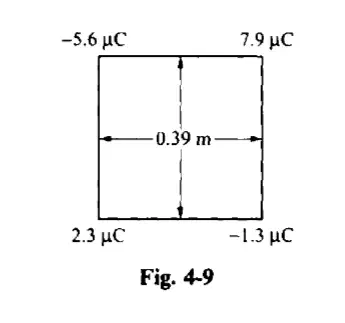
Four charged particles are placed at the corners of a square of side 0.39 m. The particles have charges of 2.3 μC, -5.6 μC, 7.9 μC and - 1.3 μC as in Fig. 4-9. How much work was done by outside forces to place those particles in their positions if they were originally very far away?
-0.71 J
0.71 J
-1.21 J
1.21 J
0 J

