
Font size
 Worksheets
Unit 1A review
Total questions: 135
Worksheet time: 5hrs 1mins
_________________ is the process of reaching a conclusion based on a pattern of examples.
conjecture
deductive reasoning
inductive reasoning
counterexample
A ____________ is an educated guess.
conjecture
conclusion
conjunction
counterexample
A ______________ is a number, drawing, or a statement that proves a conjecture to be false.
conflation
counterexample
confluence
conclusion
A __________________ is a compound statement that consists of a hypothesis and conclusion.
"If p then q"
contrapositive
converse
inverse
conditional statement
A ____________ is the part of the conditional statement that follows the word "if"
hypothesis
converse
conclusion
inverse
A ____________ is the part of the conditional statement that follows the word "then"
hypothesis
converse
conclusion
inverse
A ____________ is formed by exchanging the hypothesis and conclusion of the conditional.
"if q then p"
counterexample
contrapositive
inverse
converse
A ____________ is formed by negating the hypothesis and conclusion of the conditional.
"if ~p then ~q"
counterexample
contrapositive
inverse
converse
A ____________ is formed by exchanging AND negating the hypothesis and conclusion of the conditional.
"if ~q then ~p"
counterexample
contrapositive
inverse
converse
Given:
If the phone is ringing, then someone is calling.
Identify the hypothesis (p) and conclusion (q).
p: someone is calling
q: the phone is ringing
p: the phone is ringing
q: someone is calling
p: the phone is not ringing
q: someone is not calling
p: someone is not calling
q: the phone is not ringing
Given:
If the phone is ringing, then someone is calling.
Write the converse.
If someone is calling then the phone is ringing
If the phone is ringing then someone is calling
If the phone is not ringing then someone is not calling
If someone is not calling then the phone is not ringing
Given:
If the phone is ringing, then someone is calling.
Write the inverse.
If someone is calling then the phone is ringing
If the phone is ringing then someone is calling
If the phone is not ringing then someone is not calling
If someone is not calling then the phone is not ringing
Given:
If the phone is ringing, then someone is calling.
Write the contrapositive.
If someone is calling then the phone is ringing
If the phone is ringing then someone is calling
If the phone is not ringing then someone is not calling
If someone is not calling then the phone is not ringing
Which two statements are logically equivalent ?
(more than one answer)
conditional and converse
inverse and contrapositive
conditional and inverse
conditional and contrapositive
converse and inverse
A ____________ is the linking a conditional and its converse with the words "if an only if".
biconditional
extraconditional
aerconditional
intraconditional
Given:
If Jack ran the fastest mile, then he won first prize.
Write the biconditional for the statement.
Jack won first prize if and only if he didn't win first prize.
Jack ran the fastest mile if and only if he won first prize
Jack didn't win the fastest mile if and only if he didn't win first prize.
Jack won first prize if and only if he didn't run the fastest mile.

39=39


If 9=x, then x=9


What is the fifth Reason?
Symmetric Property of Equality
Subtraction Property of Equality
Multiplication Property of Equality
Division Property of Equality
Name the Property that this statement illustrates:
If x = y, then 3x = 3y.
Multiplication Property Of Equality
Addition Property Of Equality
Symmetric Property Of Equality
Name the property that this statement illustrates:
If g = h, then h = g.
Symmetric Property Of Equality
Subtraction Property Of Equality
If 9=x, then x=9
39=39
6(x + 3)
What is usually the 1st statement in reason column of a proof?
Prove
Given
Reason
Statement


Which of the following is true about the conditional statement below?
If a man is 7 feet tall, then he plays basketball.
Hypothesis: a man is 7 feet tall
Conclusion: he plays basketball
Hypothesis: IF a man is 7 feet tall
Conclusion: THEN he plays basketball
Hypothesis: THEN he plays basketball
Conclusion: IF a man is 7 feet tall
Hypothesis: he plays basketball
Conclusion: a man is 7 feet tall
Which of the following is true about the conditional statement below?
If you are flying, then you are in a
jet.
Hypothesis: you are flying
Conclusion: you are in a
jet
Hypothesis: IF you are flying
Conclusion: THEN you are in a
jet
Hypothesis: THEN you are in a
jet
Conclusion: IF you are flying
Hypothesis: you are in a
jet
Conclusion: you are flying

Which of the following is true about the conditional statement below?
If you are in Alaska, then you are
cold.
Hypothesis: you are in Alaska
Conclusion: you are
cold
Hypothesis: IF you are in Alaska
Conclusion: THEN you are
cold
Hypothesis: THEN you are
cold
Conclusion: IF you are in Alaska
Hypothesis: you are
cold
Conclusion: you are in Alaska
Which of the following is the CONVERSE of the statement below?
If an object is a ring, then it is
made of gold.
If an object is made of gold, then it is a ring.
If an object is not a ring, then it is not made of god.
If an object is not made of gold, then it is not a ring.
There is no converse of the statement.

Which of the following is the CONVERSE of the statement below?
If an object is a bird, then it can fly.
If an object can fly, then it is a bird.
If an object is not a bird, then it cannot fly
If an object cannot fly, then it is not a bird
There is no converse of the statement
Which of the following is the CONVERSE of the statement below?
If your grade is a 96, then you are
making an A.
If you are making an A, then your grade is a 96.
If you are not making an A, then your grade is not a 96.
If your grade is not a 96, then you are not making an A.
There is no converse of the statement.

Which of the following is the CONVERSE of the statement below?
If you play football, then you wear
a uniform.
If you wear a uniform, then you play football.
If you do not play football, then you do not wear a uniform.
If you do not wear a uniform, then you do not play football.
There is no converse of the statement.
Which of the following is the INVERSE of the statement below?
If an object is a computer, then it
has a hard drive.
If an object is not a computer, then it does not have a hard drive.
If an object does not have a hard drive, then it is not a computer.
If an object has a hard drive, then it is a computer.
There is no inverse of the statement.

Which of the following is the INVERSE of the statement below?
If an object is a battery, then it is
rechargeable.
If an object is not a battery, then it is not
rechargeable.
If an object is rechargeable, then it is not a battery.
If an object is not rechargeable, then it is not a battery.
There is no inverse of the statement.
Which of the following is the INVERSE of the statement below?
If an animal is black and white,
then it is a penguin.
If an animal is not black and white, then it is not a penguin
If an animal is a penguin, then it is black and white.
If an animal is not a penguin, then it is not black and white.
There is no inverse of the statement.

Which of the following is the CONTRAPOSITIVE of the statement below?
If a species walks on two feet, then
it is human.
If a species is not human, then it does not walk on two feet.
If a species is human, then it walks on two feet.
If a species does not walk on two feet, then it is not human.
There is no contrapositive of the statement.
Which of the following is the CONTRAPOSITIVE of the statement below?
If a gem is a ruby, then it is red.
If a gem is not red, then it is not a ruby.
If a gem is not a ruby, then it is not red.
If a gem is red, then it is a ruby.
There is no contrapositive statement.

Which of the following is the CONTRAPOSITIVE of the statement below?
If a species is a fish, then it lives in
water.
If a species does not live in water, then it is not a fish.
If a species is not a fish, then it does not live in water.
If a species lives in water, then it is a fish.
There is not contrapositive of the statement.
Which of the following is the BICONDITIONAL of the statement below?
If there is lightning, then there is thunder.
If there is not lightning, then there is not thunder.
If there is thunder, then there is lightning.
There is lightning if and only if (iff) there is thunder.
There is no biconditional statement.

Which of the following is the BICONDITIONAL of the statement below?
If it is water, then it is wet.
If it is not wet, then it is not water.
If it is wet, then it is water.
It is water if and only if (iff) it is wet.
There is no biconditional statement.
Which of the following is a valid conditional statement for the following phrase:
An acute angle has a measure less than 90°.
If an angle is acute, then it has a measure less than 90°.
If an angle is not acute, then it does not have a measure less than 90°.
If an angle is acute, then it is acute.
If an angle does not measure less than 90°, then it is not acute.
If the conditional statement was "If an angle is acute, then it has a measure less than 90°.", which type of statement is the following?
An angle is acute if and only if (iff) it has a measure less than 90°.
Biconditional
Converse
Inverse
Contrapositive
If the conditional statement was "If an angle is acute, then it has a measure less than 90°.", which type of statement is the following?
If an angle does not have a measure less than 90°, then it is not acute.
Contrapositive
Converse
Biconditional
Inverse
If the conditional statement was "If an angle is acute, then it has a measure less than 90°.", which type of statement is the following?
If an angle has a measure less than 90°, then it is acute.
Converse
Contrapositive
Biconditional
Inverse
If the conditional statement was "If an angle is acute, then it has a measure less than 90°.", which type of statement is the following?
If an angle is not acute, then it does not have a measure less than 90°.
Inverse
Contrapositive
Biconditional
Converse
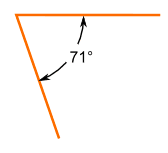


Find the missing angle.
43
47
57
67
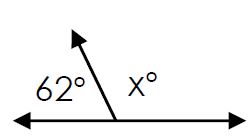


Choose the correct name for the angle marked ∠3.
∠V
∠4
∠IVH
∠JVI

Name the vertex of the angle.
E
F
D
E, F, and D are vertices
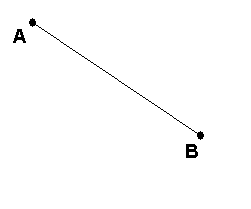
All students at Hermitage take an English class.
If it is Saturday, then the school is closed
If it is Saturday, then the school is closed
If it is Saturday, then the school is closed
Translate the following symbolic form into written form...
p ^ ~ q
Translate the following symbolic form into written form...
~ q ^ p
What is this statement called: If it rains today, then we will not have practice.


If two lines do not intersect then they are coplanar and parallel, or skew. Lines AB and CD do not intersect.
Lines AB and CD are parallel and not coplanar.
Lines AB and CD are parallel and coplanar or they are skew.
Lines AB and CD are skew.
No Conclusion can be made.
If there is lightening, then it is not safe to be out in the open. Mary sees lightening from her home.
It is not safe for the lightening
No conclusion can be made.
It is not safe for Marty to be out in the open.
There is lightening.
If you go to the swimming pool, then you will enjoy yourself. If you enjoy yourself, you will want to return.
If you return to the pool you will enjoy yourself.
If you enjoy yourself, then you went to the pool.
If you go to the pool, you will want to return.
No conclusion can be made.
Given: If an animal is a dog, then they like biscuits.
Sammy is a dog.
Conclusion: Sammy likes biscuits.
If you live in Orlando, then you live in Florida.
You live in Orlando.
If a whole number is even, then its square is divisible by 4.
The number I am thinking of is an even number.
Statement 1: If I study for one hour each day, then I will score well on the exam
Statement 2: I will score well on the exam
Statement 1: If you exercise regularly, then you have a healthy body
Statement 2: If you have a healthy body, then you have more energy
Which law of logic is this?
If I clean the bathroom, then I don't have to do the dishes.
I cleaned the bathroom.
Therefore, I don't have to do the dishes.
Law of Detachment
Law of Syllogism
Law of Contrapositive
None
∠A is 40⁰.
Using the Law of Detachment, what is the logical statement to conclude?
If a quadrilateral is a rhombus, then it is a parallelogram.
If a quadrilateral is a parallelogram, then its opposite angles are congruent.
q→r
∴p→r
Which law is modeled?
p
∴q
Which law is modeled?
Write the statement below as a conditional statement.
Vertical Angles are congruent
Two angles are vertical if and only if they are congruent.
If two angles are congruent, then they are Vertical.
If two angles are Vertical, then they are congruent.
When writing a biconditional statement, we use the phrase ___ between the hypothesis and conclusion.
if
then
if and only if
always
If an electronic device has a screen then it is a television.
Write the conditional statements as a biconditional statement:
1) If B is between A and C, then AB+BC=AC.
2) If AB+BC=AC, then B is between A and C.
Segment Addition Postulate
B is between A and C when AB+BC=AC if and only if Segment Addition Postulate.
B is between A and C if and only if AB+BC=AC.
What is the converse of the statement:
"If a number is divisible by 20, then it is even."
A number divisible by 20 is even.
If a number is even, then it is divisible by 20.
If a number is not divisible by 20, then it is not even.
If a number is not even, then it is not divisible by 20.
What is the truth value of the converse of:
"If a number is divisible by 20, then it is even."
True
False
Cannot be determined
If an electronic device has a screen then it is a television.
What is the converse of the statement:
"If x = 12, then 2x - 5 = 19"
2x - 5 = 19
If x=12, then 2x − 5 =19
If 2x − 5 = 19, then x = 12.
If 2x − 5 = 19, then x =12.
What is the truth value of the statement, If 2x − 5 = 19, then x = 12.
True
False
Cannot be determined
Write the true biconditional for the statement: If x = 12, then 2x − 5 = 19.
If 2x − 5 = 19, then x = 12.
x = 12 if and only if 2x − 5 = 19.
x = 12 and 2x − 5 = 19.
This statement cannot be written as a true biconditional.
Test the statement below to see if it is reversible. If so, write it as a biconditional.
Complementary angles are two angles with measures that have a sum of 90.
Reversible; If two angles are complementary, then the sum of their measures is 90.
Reversible; Two angles are complementary if and only if the sum of their measures is 90.
Not reversible.
Which of the following statements are true biconditionals?
x = 10 if and only if 3x + 2 = 28.
3x + 2 = 11 if and only if x = 3.
x2 = 25 if and only if x = −5.
x3=125 if and only if x = 5.
Consider the statement:
If Julie eats tomatoes, then she likes salad.
Is the statement TRUE/FALSE/Cannot be determined?
True
False
Cannot be determined
Is the statement below a good definition? If not, explain.
A cat is an animal with whiskers.
Good definition
Not good: The statement is not reversible.
Not good: The statement uses vague terms.
Not good: The statement uses terms that are not clearly understood.
Consider the statement:
If points are collinear, then they lie on the same line.
Is the statement TRUE/FALSE/Cannot be determined?
True
False
Cannot be determined
Is the statement below a good definition? If not, explain by checking all reasons that apply.
A segment is part of a line.
Good definition
Not good: The statement is not reversible.
Not good: The statement uses vague terms.
Not good: The statement uses terms that are not clearly understood.
Is the statement below a good definition?
Perpendicular lines are two lines that intersect to form right angles.
Good definition
Not good: The statement is not reversible.
Not good: The statement uses vague terms.
Not good: The statement uses terms that are not clearly understood.
Which conditional and its converse form a true biconditional statement?
If x > 0, then ∣x∣>0.
If x = 3, then x2 = 9.
If x3=5, then x = 125.
If x = 19, then 2x − 3 = 35.
Is the following a good definition? Elephants are gigantic animals.
Yes
No, because elephants are not gigantic.
No, because it is not written as a biconditional statement.
No, because the converse of the conditional statement is false.

