
 Worksheets
Living Things and their needs
Total questions: 45
Worksheet time: 23mins
An example of a nonliving thing is
a plant
a leaf
a rock
a wooden door
An example of a living thing
a phone
a song
a computer
a turtle
All living things need
gases, food, water, and space
water, oxygen, and nutrients
water, carbon dioxide, and nutrients
cells, air, and nutrients
Living things need gases, water, and ______ to survive.
movement
Everything is classified as either
slippery or dry
living or nonliving
hard or soft
yummy or gross
An example of a living thing is
a rock
a spoon
a desk
a plant
An example of a nonliving thing is
a child
a mushroom
soil
a mosquito
A living thing can reproduce. What does the word REPRODUCE mean?
to make more of one's own kind
to dig a hole in the ground
to move from place to place
to find something to eat
How do we know that trees are living things?
trees can grow
trees can move from place to place
trees can sleep
trees are tall
An organism is
a lving thing
the basic building block that makes up all living things
an animal that does not have a backbone
the source of energy
An environment is
a living thing
an animal with a backbone
all the living and nonliving things that surround an organism
a substance that helps an organism live
A cell is
a living thing
the basic building block that makes up all living things
all the living and nonliving things that surround an organism
a gas that plants and animals use
What is the special tool that makes small things look larger?
telescope
microscope
periscope
microphone
What is another name for "changing with age"?
responding
energizing
growing
reproducing
What happens when a plant responds to sunlight?
it bends toward the light
it retains water
it covers itself with flowers
all the leaves get larger
Trees reproduce by forming
seeds
leaves
oxygen
carbon dioxide
To react to the world around you is
environment
respond
organism
grows
Which of the following is needed by living things to survive?
gases
space
water
all of these
What is oxygen?
A gas needed for cars.
A gas for chickens
A gas found in air and water that plants and animals need to live.
Which statement about a green plant is TRUE?
The roots take in sunlight.
The flowers support the plant.
The leaves make food.
The plant cannot make food.

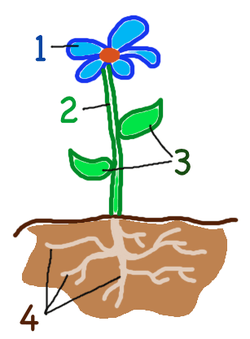
Look at the drawing of a plant. Which part provides support for this plant?
leaves
roots
flowers
stem
What is one function of a plant’s roots?
They keep the plant in the ground.
They make food for the plant.
They give off water and minerals.
They make seeds for new plants.
Which part of a plant brings water to all the other parts of the plant?
roots
stem
leaves
flowers
Which part of a plant absorb water from the soil?
leaves
roots
flowers
stem
How do plants get water to their leaves?
The roots absorb water from the soil and transport water to the leaves.
The stem transports water to the flowers, then the flowers transport water to the leaves.
The roots transport water to the stem, then the stem transports water to the leaves.
The stem absorbs water from the soil and transports water to the leaves.

The different parts of a plant are labelled R, S, T and U as shown below. Which part is the letter R?
root
stem
leaf
flower

What is the part labelled 'C' called?
Stem
Roots
Leaves
Fruit

Plants change carbon dioxide and water into food by using the energy of the
food
soil
sun
leaves
Leaves have tiny holes that take in carbon dioxide.
True
False
Plants get energy from the (a) to make food.
Leaves are important because ___ is made in the leaves.
fruit
water
food
nothing
A tree has a hard, woody stem called
a(n) ___.
truck
trunk
taproot
tube

When you breathe, you take in ___ that plants release.
carbon dioxide
sunlight
food
oxygen
Stems have ___ that carry food and
water through a plant.
bags
cars
tubes
chlorophyll
Roots take in ___ that help plants grow
and stay healthy.
sugar
carbon dioxide
oxygen
nutrients
Roots, stems, and leaves help a plant get what it
needs in order to ___.
survive
fly
sleep
study
To distinguish between living and nonliving things, all living things
respond to their environment, grow, need nutrients and air, reproduce, and need space
are known by their movement and need for nutrients
can sit still for a long period of time
have a smell
I can test an object to see if it is nonliving by asking
does it move when thrown, is it heavy, is it slippery?
did it grow, can it reproduce, does it need nutrients, and is it made up of cells?
is it pretty, is it hard, is it dry?
is it made up of elements, does it eat?



