
 Worksheets
Unit 3 Test
Total questions: 18
Worksheet time: 9mins
Which article of the U.S. Constitution addresses the issue of enforcing and executing the laws of the United States?
Article I
Article II
Article II|
Article IV
Which segment of government, not branch, is responsible for proposing federal government spending budgets?
the House of Representatives
The Executive Branch
The Judicial Branch
The Senate
Which of these is a power that the President of the United States can exercise?
overturn an unconstitutional state law
vote for a bill that is being discussed in Congress
veto a bill passed by Congress
declare a federal law unconstitutional

How does this section of the Constitution limit the power of the federal government?
It allows the Supreme Court to rule whether laws are legal or illegal according to the Constitution.
It allows the President to overturn Supreme Court decisions.
It allows Congress to pass laws limiting the power of the Supreme Court.
It allows states to appoint and remove members of the Supreme Court.
Because of the separation of powers in the United States government, the Legislative branch may enact laws, the Executive branch may veto laws, and the Judicial branch may
declare war by law.
enact laws to appoint judges.
begin impeachment proceedings against the Executive branch.
decide that a law is unconstitutional.
Which of these is an advantage of the system of checks and balances?
It makes it easy for one branch of government to seize power.
It allows the executive branch to supervise the actions of the other branches.
It prevents the Judicial branch from ruling laws as unconstitutional.
It requires each branch to work together for the good of the country.

Which is the BEST title for this chart?
Legislative Branch Checks on the Executive Branch
Judicial Branch Checks on the Legislative Branch
Legislative Branch Checks on the Judicial Branch
Judicial Branch Checks on the Executive Branch

How do these two excerpts BEST illustrate the limitation of the federal government's power?
The President commands the military but cannot go to war without Congress's approval.
The President has the power to declare war, but Congress regulates prisoners of war.
The President has the power to declare war, but Congress regulates prisoners of war.
Congress can impeach a government official, but the President can grant pardons.
A government in which powers are divided between a national government and state governments with the national government being supreme is called
a confederate government.
a republican government.
a unitary government.
a federal government
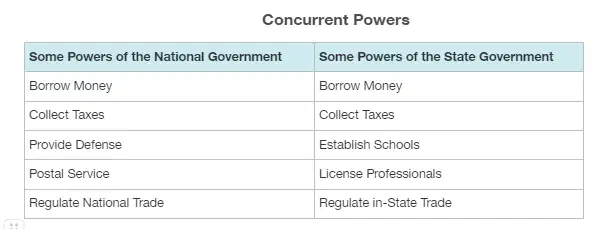
According to the chart, the power to tax and borrow money are concurrent powers, meaning
They belong to the state government alone.
They are government powers that are shared.
They are less important than the power to provide defense.
They are more important than regulating state trade.
An example of a STATE issue would be the requirements for
Provide defense
Postal Service
Regulate National Trade
Establish Schools

What word BEST completes this principle of the United States government?
Supreme
reserved
optional
denied
What part of the Federal government can prevent the President of the United States from controlling the Supreme Court by blocking nominations of judges?
Governors
the Senate
the President
state legislatures
How do federal courts play in checking the power of the legislative branch?
Congress creates courts and may impeach judges
federal judges and justices are appointed for life
they review laws of Congress for following the Constitution
the President may veto Congressional legislation with judicial approval
Identify three ways each branch can check a different branch with regard to legislation.
Congress can override a veto by the President.
The President can veto an act passed by Congress.
The President can issue signing statements when passing legislation.
The Supreme Court can determine a law to be unconstitutional.
Independent regulatory agencies can make administrative laws and judge corporations that break those laws.
The Supreme Law of the Land is the
Mr. Herrin's rules.
Bill of Rights
Constitution
Articles of Confederation
The main effect of the Supremacy Clause is to
hold laws in the U.S. Constitution above all other laws.
establish judicial review of all legislation.
protect the rights of individuals against governments.
ensure that the text of the Constitution never changes.
In McCulloch v. Maryland, the Supreme Court said states did not have the power to tax a federal bank. What clause in the Constitution did they use to decide the case?
Commerce Clause
Supremacy Clause
Establishment Clause
Funny Money Clause

