
 Worksheets
Ecological Succession
Total questions: 40
Worksheet time: 1hrs 6mins

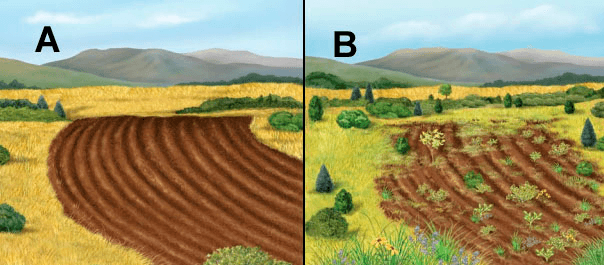
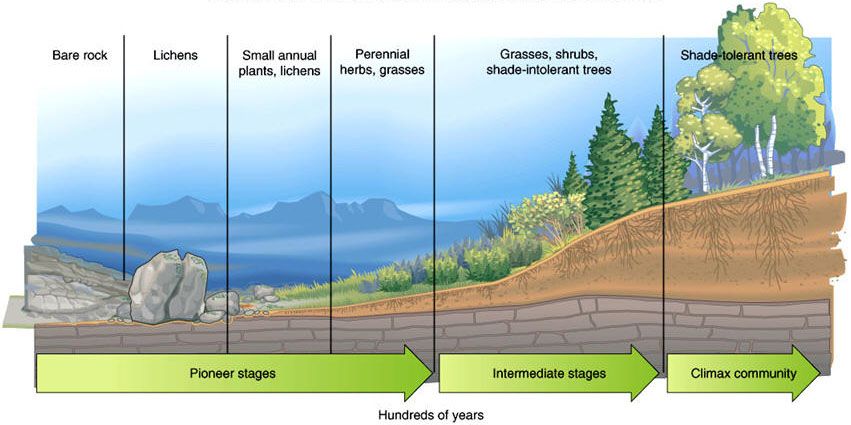
The picture shows what type of succession?
primary
secondary
tertiary
quaternary
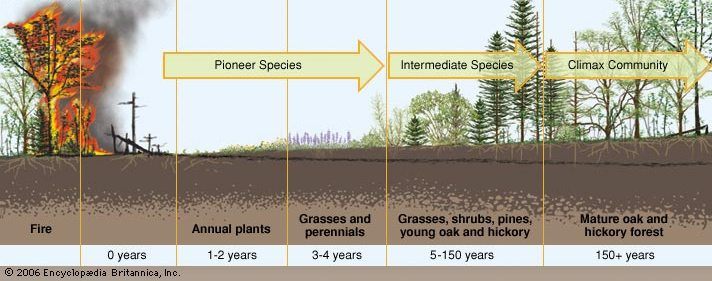
The picture shows what type of succession?
primary
secondary
tertiary
pond succession
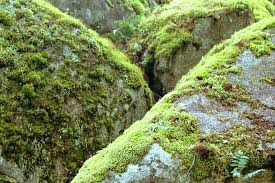
What are examples of pioneer species in a primary succession?
Bushes and Shrubs
Oak trees
Mosses and Lichens
A rose Bush

The process in which a new ecosystem is formed in an area that was lifeless.
resource
invasive (non-native) species
primary succession
competition
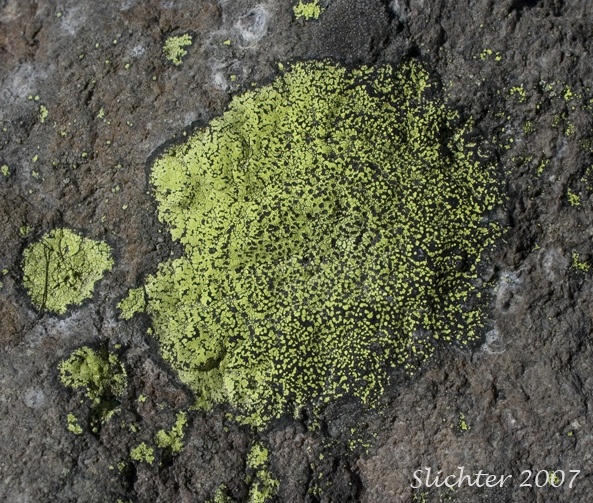
What is the first species you will see in the early stages of primary succession? (in picture)

Final illustration (#8) shows a

Which type of succession is being shown here?

Which type of succession is being shown here?

Volcanic eruptions lead to

Which of the following explains what pioneer species are?
The last organisms to colonize an area during primary succession.
The first organisms to colonize an area during succession.
Settlers that traveled across the United States in the early 1800's.
A species that can only live in extremely cold conditions.
This type of succession begins with bare rock.
If a glacier melts and exposes bare rock, which type of ecological succession will occur in this area?
primary succession
secondary succession
pond succession
icy succession
Which of the following explains what a shade tolerant tree is?
A tree that CAN grow without direct sunlight.
A tree that CANNOT grow without direct sunlight.
A tree that only grows in the darkness.
A tree that will be extremely small.


During a forest fire most vegetation (plants) burn. Which ecological succession will take place after a forest fire?
Primary
Secondary
The process in which a community changes through time
ecological succession
biodiversity
evolution
ecosystem resilience
Occurs in an area that has never before been colonized
primary succession
natural disturbance
ecological resilience
secondary succession
Occurs in a formerly inhabited area that was disturbed.
primary succession
natural disturbance
ecological resilience
secondary succession
Lichens are important in primary succession because they
help to break down rocks to create soil
provide a soft place for seeds to germinate
are fire-resistant
are gymnosperms, which are important for resilience
A non-living part of an ecosystem that affects its environment
biotic factor
abiotic factor
disturbance
resistance

The image is an example of
primary succession
secondary succession
biodiversity
pioneer species
What is an example of an area that is likely to undergo primary succession?
Glaciers melt and leave exposed rock
Plants die from drought and decompose
Land is bulldozed and soil remains
T or F: Succession increases biodiversity.
true
false
A bare rock community must first undergo...
the break down of soil in primary succession
the formation of grasses in secondary succesion
creating a climax community
the growth of trees on it
Which of the following best describes primary succession?
Volcano wipes out ecosystem that gradually grows back from ash covered soil
Volcano creates a new island of rock that must break down to form an ecosystem
Forest fire burns down forest that must bounce back over time
Tornado destroys a crop that must slowly grow back over time.
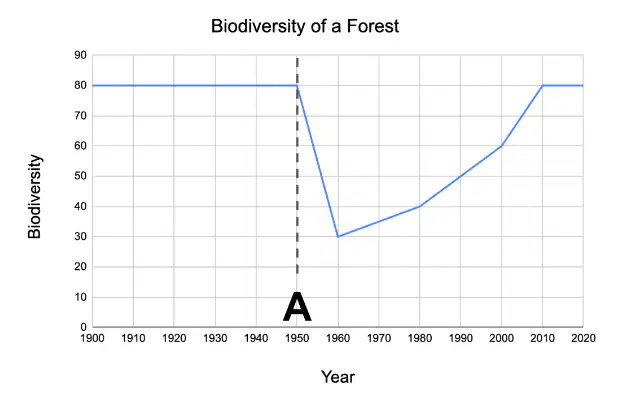
The graph shows the biodiversity of a forest over time.
A disturbance happened at point A. What could that disturbance have been and what type of succession is seen in the graph?
A volcanic eruption led to secondary succession
A forest fire led to primary succession
A flood led to secondary succession
A tornado led to primary succession

What type of succession is seen in the graph?
Primary succession because it starts with mosses
Secondary succession because it starts with mosses
Secondary succession because it has trees come back
Primary succession because it has trees come back

Which type of succession is seen in the graph?
Secondary succession because it starts with grasses
Primary succession because it has trees come back
Primary succession because it starts with grasses
Secondary succession because it has trees come back

Which type of succession is seen in the graph?
Primary succession because it ends with a climax forest
Primary succession because it starts with bare rock
Secondary succession because it ends with a climax forest
Secondary succession because it starts with bare rock

What type of succession is seen in the graph?
Primary succession because it starts with no life
Secondary succession because it starts with no life
Primary succession because it increases the number of individuals
Secondary succession because it increases the number of individuals

What type of succession is seen in the graph?
Primary succession because species decline drastically
Secondary succession because species decrease after a disturbance, then rebound
Primary succession because species increase over time after a disturbance
Secondary succession because there is no soil or species in this area

Which is represented by the blue line in the graph?
Primary succession
Secondary succession
Extinction
Climax Community
Which is represented by the red line in the graph?
Primary succession
Secondary succession
Extinction
Climax Community
If an avalanche occurs and removes all the soil and all the organisms, what would occur?
Climax community
Secondary succesion
Primary succession
Increase in Biodiversity

