
 Worksheets
Geologic Time Review
Total questions: 22
Worksheet time: 11mins
What is the term for the time it takes for half of a radioactive element's atoms to decay?
half-life
unconformity
radioactive dating
Carbon-14
All time before the Cambrian explosion of life is called
Pre Adolescent Time
Pre Apocalyptic Time
Pre Historic Time
Pre Cambrian Time
The Paleozoic era was known as the age of _________ . The Mesozoic era was known as the age of _________. The Cenozoic era was known as the age of _________ .
reptiles, fish, humans
fish, retiles, humans
fish, humans, reptiles
What geologic period had huge swamps and produced the fossil fuels we burn today?
Silurian
Carboniferous
Permian
Devonian
What do geologists mostly study to develop the geologic time scale?
Earth's rotation
tectonic plate motion
volcanoes and earthquakes
rock layers and index fossils
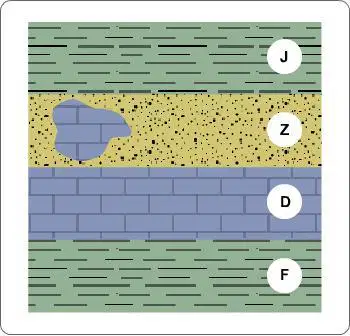
Which layer is the youngest layer?
J
Z
D
F
What is a fossil that was widely distributed but existed for a geologically short period of time?
sedimentary rock
index fossils
layers
decay fossils
Human history makes up
approximately half of Earth's history
about 1/3 of Earth's history
a very tiny fraction of Earth's history
a large amount of Earth's history
What is the purpose of the geologic time scale?
to organize and sequence events by eras and periods in the different divisions of time and to serve as a timeline
to show the evolution of life forms and to model how those life forms behaved and what they ate
to organize and sequence events in the history of Earth and to serve as a model for a vast amount of time covered
to determine the relative ages of rocks and when and how they formed to create a timeline of their development
A fault cutting through 2 lower layers of rock would be __________ than the layers around it.
older
younger
the same
harder
What is the name of the supercontinent that used to be?
Mordor
Pangaea
Rodinia
Spongaea
The most accurate way to get the age of a rock is to use
relative age
law of superposition
radioactive dating
radioactive decay
What formed in the atmosphere that allowed life to evolve on land?
nitrogen
the ionosphere
ozone layer
clouds
When looking at the layers of sedimentary rock what can you conclude about their ages?
their relative ages to each other
nothing
their absolute ages
estimated ages
Which is the smallest unit of geologic time?
eon
era
period
epoch
The Earth is approximately how old?
2023 years old
4.6 billion years old
4.3 billion years old
4 billion years old
Which term describes a gap in the geologic record?
extrusion
fault
intrusion
unconformity
Invertebrates were Earth's earliest multicellular organism.
True
False
What most likely caused the mass extinction of the dinosaurs?
the break up of Pangaea
a large meteor
the ice ages
snowball Earth
What is the largest division of time on the geologic time scale?
period
epoch
eon
era
Why is it important for geologists to use both relative and absolute ages to determine the age of rocks?
Scientists want to learn about the age of rocks.
Scientists need only one way to determine the age of rocks.
Scientists may not be able to determine the absolute age of some rocks.
Scientists can tell the age of rocks using the law of superposition.
The existence of which group of organisms spans the shortest geologic time?
birds
humans
dinosaurs
fish

