
 Worksheets
pre test ALS -2
Total questions: 20
Worksheet time: 15mins
The drug of choice for most forms of narrow-QRS tachycardia is:
Amiodarone
Atropine
Adenosine
Epinephrine
Which Of the following could be administered endotracheally if necessary?
Amiodarone, dopamine, procainamide, naloxone, and adenosine
Naloxone, atropine, vasopressin, epinephrine, and lidocaine
Lidocaine, amiodarone, procainamide, vasopressin, and naloxone
Procainamide, epinephrine, lidocaine, adenosine, and dopamine
The most common side effects of giving amiodarone are:
Nausea and asystole
Bradycardia and hypotension
AV block and hypertension
Blurred vision and abdominal pain
Which Of the following approaches is recommended during an initial patient evaluation?
Oxygen, IV, monitor
Level Of responsiveness, airway, breathing, circulation, defibrillation if necessary
Temperature, pulse, respiration, blood pressure
Oxygen, IV fluid challenge, vital signs, level Of responsiveness
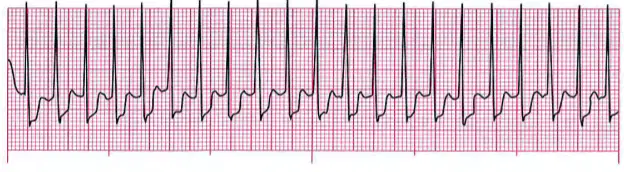
A 37-year-old woman is complaining Of shortness Of breath and palpitations. You have placed the patient on oxygen and an IV has been established. Her mental status is rapidly decreasing and she is very pale. Her initial blood pressure was 148/70. It is now 62/38. Breathing is shallow at 8 to 12 breaths/minute. The cardiac monitor shows the following rhythm:
Perform synchronized cardioversion starting with 50 joules
Give sublingual nitroglycerin
Perform CPR for 2 minutes, then defibrillate with 200 joules
Perform CPR and give epinephrine 1 mg IV push
At doses recommended for use in cardiac arrest, epinephrine and vasopressin:Slow conduction through the atrioventricular node
Cause significant peripheral vasoconstriction
Neutralize acid accumulated during cardiac arrest
Slow conduction through the atrioventricular node
Cause profound peripheral vasodilation
The first antiarrhythmic administered in the management Of the patient in pulseless ventricular tachycardia or ventricular fibrillation is:
Epinephrine or vasopressin
Amiodarone or lidocaine
Vasopressin or amiodarone
Epinephrine or lidocaine
During cardiac arrest:
Chest compressions should be interrupted for 2 to 3 minutes to start an IV and insert an advanced airway
Chest compressions should never be interrupted
Interruptions in chest compressions to analyze the ECG, Charge the defibrillator, place an advanced airway, check a
Chest compressions and ventilations should be interrupted every 3 to 5 minutes to permit the members Of the resuscitation team to change positions
A 56-year-old woman is complaining Of palpitations. When questioned, she denies Chest discomfort or Shortness of breath. Her blood pressure is 134/82, pulse 180, respirations 18. The cardiac monitor shows a narrow-CRS tachycardia without visible P waves. Recommended treatment for this patient includes:
Airway, breathing, circulation (ABCs); 02; IV; sedation; and synchronized cardioversion with 200 joules
ABCs, 02, IV, vagal maneuvers, and lidocaine 1- to 1.5-mg/kg IV bolus
ABCs, 02, IV, and atropine -mg IV every 3 to 5 minutes to a maximum Of 3 mg
ABCs, 02, IV, vagal maneuvers, and adenosine 6-mg rapid IV bolus
From across the room, your first impression Of the patient is that she is not moving, you can see no rise and fall of her chest Or abdomen. and her skin color is pale. When you arrive at the patient’s side, you confirm that she is unresponsive. As you shout for help, your next action in this situation should be to:
Apply the automated external
Open her airway and check
Begin chest compressions
Prepare the to insert an advanced airway
The primary survey reveals that the patient is unresponsive and not breathing. A weak pulse is present at a rate of about 70. Your course Of action Will be to:
Begin mouth-to-mouth breathing
Begin ventilating with a bag-valve-mask
Begin chest compressions
Insert an endotracheal tube, Cornbitube. or laryngeal mask airway
Vasopressin may be used in the management of:
Symptomatic first-degree atrioventricular block
ventricular fibrillation
Narrow-QRS tachycardia
Atrial fibrillation with a rapid ventricular response
Which of the following reflects the operation Of a transcutaneous pacemaker for a patient experiencing asymptomatic bradycardia?
The rate should be set between 20 and 60; the current (milliamps) should be increased slowly to maximum Output.
The rate should be Set between 40 and 100; the current should increased rapidly to a maximum Of 160 milliamps.
The rate should be set between 60 and 80; the current should be increased slowly until capture achieved.
The rate should be set between 80 and 100; the current should be increased rapidly to maximum
An oral airway:
May help in the delivery Of adequate ventilation With a device by preventing the tongue from blocking the airway
Is Of proper size if it extends from the tip Ot the nose to the tip Of the ear
Is usually well-tolerated in responsive or semi-responsive patients
Can only be used in spontaneously patients
. An oral airway is in place. In this situation, the groper rate for bag-valve-mask
8 to 10 ventilations minute; each ventilation delivered 1 second
10 to 12 ventilations per minute; each ventilation delivered over 1 second
12 to 20 ventilations per minute; each ventilation delivered over 1.5 to 2 seconds
20 to 24 ventilations per minute; each ventilation delivered over 1.5 to 2seconds
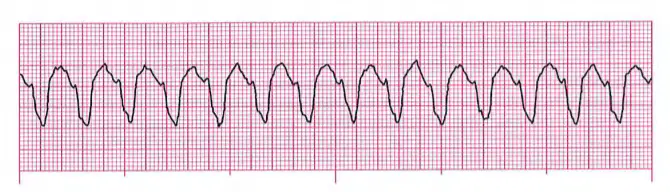
Which of the following statements is true about this rhythm?
his rhythm is ventricular fibrillation, a “shockable” rhythm
This rhythm is a narrow-QRS tachycardia, a “non-shockable” rhythm
This rhythm is monomorphic ventricular tachycardia, a “shockable” rhythm
This rhythm is a wide-QRS tachycardia, a “non-shockable” rhythm
When a shockable rhythm is present during cardiac arrest and a biphasic manual defibrillator is available, the initial energy level selected should be:
120 joules
200 joules
360 joules
The dose recommended by the manufacturer for terminating the rhythm
Drugs given during cardiac arrest should be given:
By the endotracheal route whenever possible
By continuous IV infusion
By IV bolus and followed with a 20-mL flush of IV fluid
By IV bolus over 2 to 3 minutes and then followed with a 10-mL flush of IV fluid
The approximate percentage of oxygen delivered by a simple face mask at 8 to 10 L/min is:
20%
40%
60%
100%
Amiodarone:
Is given as an initial IV dose Of 300 mg and one repeat dose of 150 mg in cardiac arrest due to pulseless ventricular tachycardia or ventricular fibrillation
Should be given IV or endotracheally in cardiac arrest due to pulseless electrical activity
Is given as a loading dose of 150-mg IV bolus over 10 minutes in cardiac arrest
Should be given only if there is a return of spontaneous circulation after cardiac arrest

