
 Worksheets
Muscular System Review
Total questions: 44
Worksheet time: 20mins
Found in the walls of hollow organs; also called visceral
smooth
cardiac
skeletal
all


Name the following in order from largest to smallest:
muscle, muscle fascicle, muscle cell, myofibril, filaments
muscle, muscle fascicle, muscle cell, filaments, myofibril
muscle, muscle cell, muscle fascicle, myofibril, filaments
muscle, muscle cell, muscle fascicle, filaments, myofibril
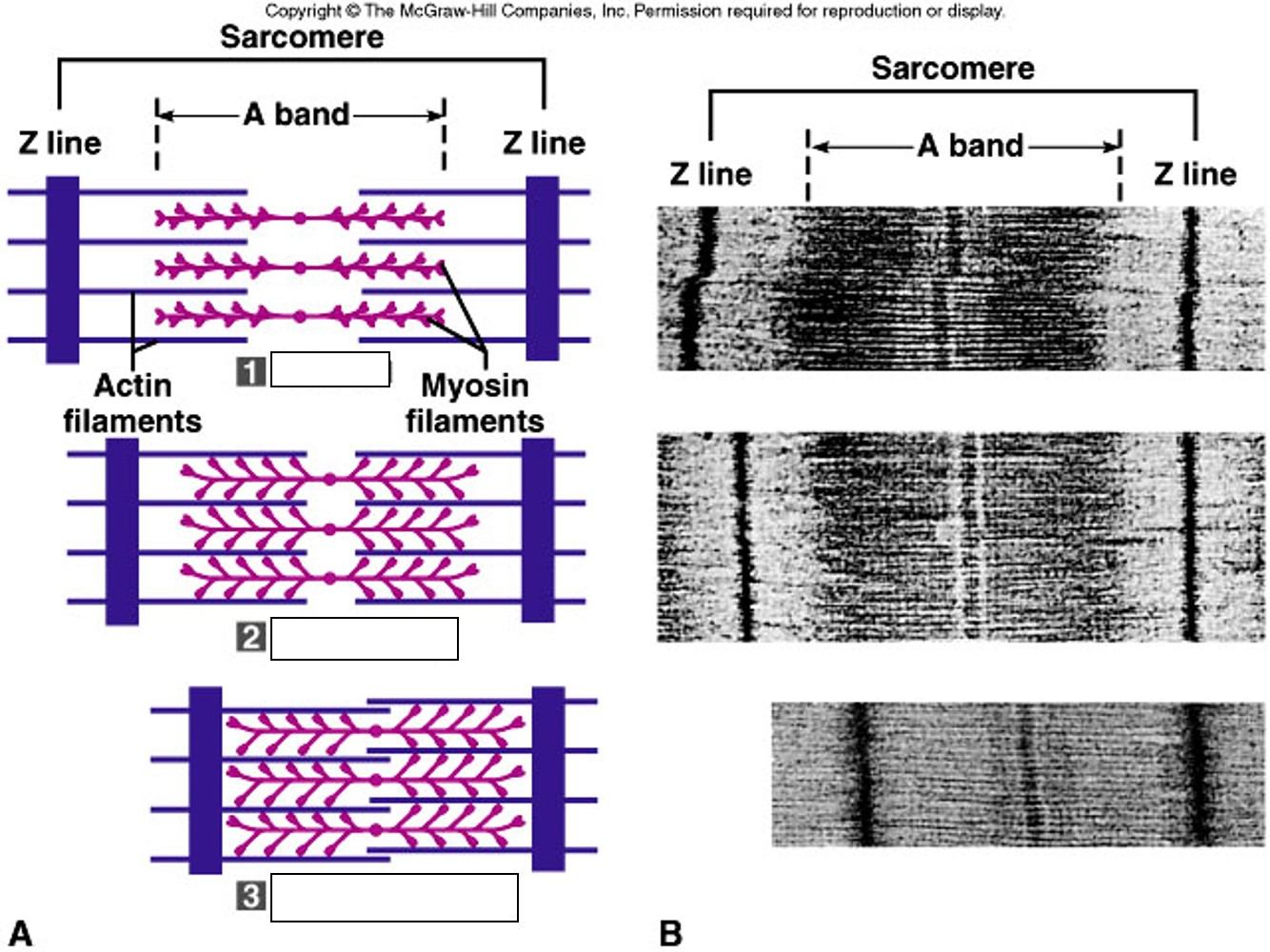
What is the length between Z-lines of an actin molecule called?
fascicle
sarcomere
myosin binding site
sarcoplasmic length
____________ attaches to actin to form the cross bridge.
Troponin
Tropomyosin
Myosin
Calcium
Adjacent sarcomeres are separated by ____.
Z discs
M lines
Thick filaments
The contractile unit of a muscle is the ____.
Fascicle
Muscle fiber
Sarcomere
Thick filaments are made of a protein called ____.
Actin
Sarcolemma
Myosin

Label D refers to ____.
Z discs
Thick filaments
Sarcomeres
Thin filaments
During contraction, ____ bind to and pull on thin filaments.
Tropomyosin
Thick filaments
Troponin
Z discs

What is the area labeled D?
Z line
H zone
I band
A band

What is the area labeled 10?
A band
H zone
I band
Zone of overlap
What happens to the H zone during a contraction?
It grows larger
It disappears
It stays the same length
Which part of the sarcomere contains only thick filaments?
I band
A band
H zone
Z zone

Name the muscle
pectoralis major
pectoralis minor
Deltoid
Trapezius

Name the muscle
transverse abdominis
internal oblique
rectus abdominis
eternal oblique

name the muscle
trapezius
latissiumus dorsi
recuts abdominis
transverse abdominis

Name the muscle
latissimus dorsi
levator scapula
trapezius
pectoralis major

Name the muscle
pectoralis major
subscapularis
deltoid
triceps

Name the muscle
biceps brachii
triceps brachii
rectus femoris
deltoid

name the muscle in green
masseter
frontalis
temporalis
orbicularis occuli

Name the muscle highlighted in green
gracilis
recuts femoris
sartorius
vastus medialis



The lateral motion TOWARDS the midline is called ______.
adduction
abduction
circumduction
opposition


Straightening parts at a joint so the angle between them increases is
flexion
dorsiflexion
extension
rotation

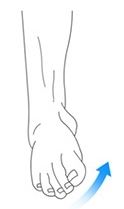
Identify the joint action being performed.
Circumduction
Lateral Rotation
Medial Rotation
Eversion
Which muscle extends, adducts, and applies medial rotation of the arm
biceps brachii
deltoid
latissimus dorsi
brachialis
Which muscle elevates, retracts, and rotates the scapula? We use it to shrug our shoulders.
Subscapularis
Latissimus Dorsi
Deltois
Trapezius
The ORIGIN is the muscle attachment to the _______ bone.
Stationary
Movable
The muscle attachment to the movable bone is the:
Muscle belly
Muscle body
Insertion
Fascicle


Muscles that are not used, may shrink/"decay" or undergo a process of __________
Hypertrophy
Atrophy
Fatigue
muscles that you consciously make contract and move
fast twitch
slow twitch
voluntary
involuntary

