
Font size
 Worksheets
American Revolution Part I Exam
Total questions: 66
Worksheet time: 41mins
- What is considered the first battle of the American Revolution?
Lexington and Concord
Trenton
Bunker Hill
Yorktown
Common Sense was written by
Thomas Jefferson
John Locke
George Washington
Thomas Paine
What were American's called who supported independence?
Patriots
Loyalists
Colonists who chose to side with the British were known as
Patriots
Loyalists

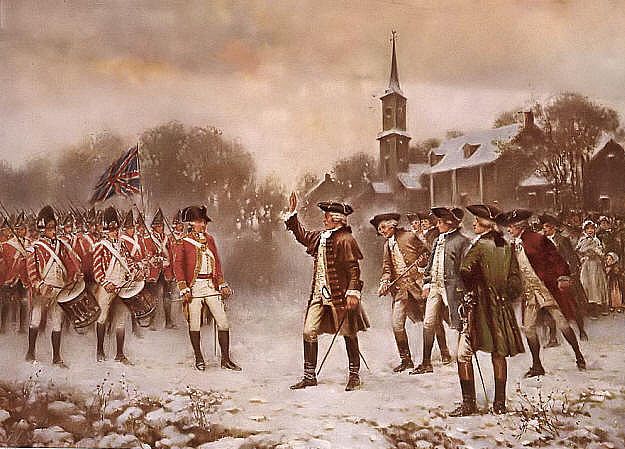
What event is depicted in this image?
Battle of Bunker Hill
Boston Massacre
Boston Tea Party
Lexington and Concord

Samuel Adams and Paul Revere led members of the Sons of Liberty in this protest against taxes.
First Continental Congress
Boston Massacre
Boston Tea Party
Stamp Act Congress
Which was a slogan during the time of the American Revolution?
No taxation without representation!
The French the French
What are unalienable rights?
rights given by the president
rights the government can't take away from you
rights given by congress
What are the big 3 unalienable rights?
life, property, and liberty
time, money, and power
life, liberty, and pursuit of happiness
The author of the famous pamphlet that argued for an end to monarchy and supported independence?
Thomas Paine
Tomas Pain
Thomas Jefferson
Mercantilism placed heavy restrictions on (a) which only allowed the colonies to import/export with England.
After the Proclamation of 1763 colonists could not expand...
North
South
East
West

What impact does Thomas Paine have on the American Revolution?
he persuades the colonists to rebel
he persuades the colonists to remian loyal
he persuades the colonists to immigrate to England

What was the first battle of the American Revolution?
Guilford Courthouse
Trenton
Yorktown
Lexington & Concord

Which Founder Father made the first call for "national" (or colonial) unity?
Samuel Adams
George Washington
Benjamin Franklin
John Hancock
Who was the monarch of Britain in the time leading up to and during the American Revolution?
King James III
King George III
Queen Elizabeth II
King Louis IV
Which of the following was the main reason that American colonists opposed the Stamp Act of 1765?
The act was taxation without representation.
The act was passed by the king, not Parliament.
The tax was a large amount of money.
The tax was not imposed on the wealthy.
What is the Boston Massacre?
What was the Boston Tea Party?
(a)

What does this political poster represent?
The Colonies needed to be united
Colonies need to be independent
Serpents can grow back together
Ben Franklin didn't know why he made this
Why were the Colonist forbidden to go west of the Appalachian mountains
Border Lands
Manifest Destiny
Proclamation line of 1763

Who did the King feel should pay for the war?
British
colonists
Spain
the practice of persuading someone to do something by using force or threats
coercion
combat
commercial
consent
a type of tax that is placed on an import in an effort to regulate trade
Coercion
Duty (tax)
Mercantilism
Direct Tax
an organization of men who resisted laws and taxes placed on the English colonies by the King of England and Parliament
Sons of Liberty
Patriots
Daughters of Liberty
Loyalists
An economic concept where it was believed that colonies existed to contribute to the wealth and power of the mother country
Coercion
Socialism
Capitalism
Mercantilism
Refusal to buy a product or services as a form of protest
Propaganda
Boycott
Coercion
Direct Tax
An act of Parliament in 1765 which levied a direct tax on almost all paper items in the colonies including legal documents, pamphlets and playing cards
Stamp Act
Sugar Act
Quartering Act
Tea Act
The Stamp Act taxed all ________ goods.
paper
plastic
pollution
What is another name for the French and Indian War?
The Nine Years’ War
The Seven Years’ War
The France and Britain
Who were the countries involved in the conflict?
Germany and Spain
Britain and France
America and Britain
What famous military leader started the French and Indian War?
George Washington
Benjamin Franklin
William Pitt
What caused conflict between Britain and France in the early 1750s?
Britain expanded into the Ohio River Valley
France expanded into the Ohio River Valley
Which country won more battles at the beginning of the war?
Britain
France
Who won the French and Indian War in 1763
The Indians
France
Great Britain
What treaty was signed at the end of the war?
Peace and Friendship Treaty
Treaty of Paris
Treaty of French and Indian War
What did Britain receive at the end of the war?
More territory in North America
Canada from France
Florida from Spain
All of them
What did the Stamp Act place a tax on?
All paper items
Tea
Stamps
Why were the American colonists upset about the new taxes?
They weren’t upset, they wanted to pay lots of taxes
They believed there should be no taxation without representation
They thought only the rich should pay taxes
What was the effect of Britain’s taxing American colonists?
They just paid the taxes
They were happy about the taxes
The Revolutionary War
What cartoon did Benjamin Franklin draw during the French and Indian War?
Freedom is Never Free
Join, or Die
Live or Let Live
The results or effects of the French and Indian War were?
Taxes, Debt, and the Proclamation of 1763
Taxes, Independence, and the Proclamation of 1763
Trade, Debt, and the loss of Fort Necessity
Trade, Slavery, and the Proclamation of 1763
The Great Awakening was a religious movement that took place...
In the Middle Ages
In the 1730's
Under the Vikings
In the 1760's
Georgia and Delaware are the two missing colonies on the Join or Die flag.
True
False
The symbolism of the Join or Die flag is seen in the shape and pieces of the snake.
True
False
The Albany Plan of Union was important because...
It represented all the colonies
The flag was shaped like the coast line
It started the French and Indian War
It was the first time that the colonists tried to unite
Who wrote the Albany Plan of Union?
George Washington
Benjamin Franklin
William Pitt
King George III
Why did the Proclamation of 1763 increase the tension between the American colonies and Great Britain?
Britain started collecting taxes on the colonists
Britain encouraged Natives to attack the colonies
Britain reduced its military power in the colonies
Britain prohibited settlement west of the Appalachian Mts
What were the two key issues fought over by the French and the British? These led to the war.
land and pride
trading posts and farmland
land and fur
fur and gold



