
 Worksheets
SY24 Geometry Q2 Benchmarks in Depth
Total questions: 16
Worksheet time: 20mins
How many years have you taught HS Geometry?
This is my first year
1 - 2 years
3 - 5 years
6 - 10 years
over 10 years
Please Rate the following statement:
I use Big Ideas to assign classwork and homework problems.
Never
Seldom
Sometimes
Usually
Always
The verb used in each ALD is very important. Complete the statement about verbs and item type:
When asked to identify something, this is (a) , represent is (b) , graph or plot, requires a (c) , and interpret is (d) .
Which of the following are true for ALL L2 -L4 benchmarks on TRANSFORMATIONS?
SELECT ALL THAT APPLY.
Items can be in mathematical or real-world context
Rotations can be clockwise OR counter-clockwise
Centers of rotations and dilations can be a point on the figure OR the origin
Items involving a reflection across a line can include the x-axis, y-axis, or a horizontal or vertical line
Rotations are limited to 90, 180, or 270.
For GR.2.1, what is the difference between an L2 and L3?
For GR.2.3, what is the difference between an L2 and L3?
SELECT ALL THAT APPLY.
L2 has a sequence of up to 2 transformations; L3 is up to 3
L3 includes rotations, not just translations and reflections
L3 students must describe the sequence in words or coordinates vs. just words in L2
L3 must have a real-world context
For GR.2.3, what is the difference between an L3 and L4?
A sample question for GR.2.5 gives the directions shown below. What two transformations are given in one algebraic mapping?
Draw the resulting figure after quadrilateral 𝐴𝐵𝐶𝐷 is transformed using (𝑥, 𝑦) → (−𝑥, 𝑦 − 3).
reflection and rotation
translation and rotation
reflection and translation
translation and dilation
Students also struggled with benchmarks GR.2.2 (Identify transformations that do or do not preserve distance) and
GR.2.6 (Apply rigid transformations to map one figure onto another to justify that the two figures are congruent)
DISCUSS WITH YOUR NEIGHBORS: Why do you think students had difficulty with these?
In Chapter 5, which 3 benchmarks did our students struggle most with?
Using coordinate geometry to classify or justify definitions, properties and theorems involving circles, triangles, & quadrilaterals
Prove relationships and solve problems involving postulates and theorems of triangles.
Solve mathematical and real-world problems involving congruence or similarity in two-dimensional figures
Apply rigid transformations to map one figure onto another to justify that the two figures are congruent
Prove triangle congruence using SSS, SAS, ASA, AAS, and HL
GR.3.2 (use coordinate geometry to classify or justify definitions, properties and theorems involving circles, triangles, & quadrilateralsis)
is covered throughout many different lessons. In what chapter was an extra Lesson added to the guide to help students with this benchmark?
The Sample Assessment Item for GR.1.2 is considered an ALD level 4 because...
it is a paragraph proof
it includes missing statements AND reasons
there are more than two missing statements and/or reasons
the image does not show any markings
How are proofs under BEST different than they were with MAFS?
SELECT ALL THAT APPLY.
Under MAFS students only had to fill in missing reasons; with BEST they may have to fill in missing statements as well
BEST places more of an emphasis on proof types other than two-column
Under BEST, students have to memorize formal names of theorems and postulates for missing reasons
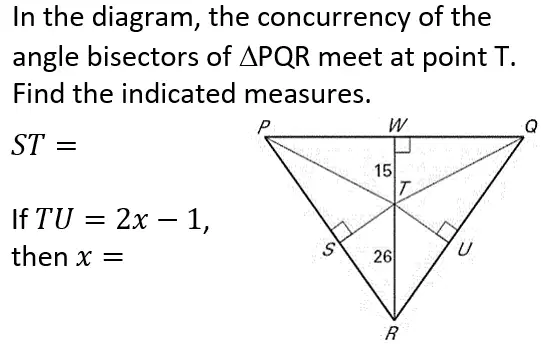
GR.1.3 is used throughout most of Chapter 6.
At what ALD is this question written?
(follow-up...what theorem does this assess?)
L2
L3
L4
L5
The Sample Assessment Item shown with GR.3.3 was supposed to be listed with benchmark (a) , and would represent a question at an ALD level (b)
Students did not do well on GR.3.3. However, this does not mean they couldn't answer questions on centroid or midsegments. This benchmark also includes which of the following topics? SELECT ALL THAT APPLY
Writing the equation of a line, including lines that are parallel or perpendicular
Finding the midpoint of a segment
Partitioning a segment given endpoints and a ratio
Finding the distance between two points
Determine the weighted average of two or more points on a line

