
 Worksheets
standing waves
Total questions: 68
Worksheet time: 2hrs 56mins

This fig.represents the standing waves formed in a stretched string..Which is the mode in which it is vibrating
first harmonic
third harmonic
second harmonic
nth harmonic
Wave interference
is always destructive
is the same thing as pass interference
is always constructive
happens when two waves meet in a medium
Constructive wave interference ...
shifts phase
decreases amplitude
increases amplitude
locks phase
∎ Progressive waves are travelling along the string in both directions.
∎ The standing wave is an example of superposition.
∎ The wavelength of the standing wave is d.


The pipe length of A is 0.18 m. Sound travels at 343 ms-1 Calculate the frequency of the sound produced.
686 Hz
1905.56 Hz
343 Hz
1429.17 Hz
The pipe length of B is 0.25 m. What is the wavelength of the sound produced?
0.25 m
0.5 m
0.75 m
1 m
The pipe length of D is 0.65 m. The frequency of the sound produced is 1200 Hz. Calculate the wave velocity.
120 m/s
600 m/s
343 m/s
780 m/s

The figure represents a string of length L, fixed at both ends, vibrating in several harmonics. Which string shows the 4th harmonic?
A
B
C
D
E

The figure shows several modes of vibration of a string fixed at both ends. The mode of vibration that represents the fifth harmonic is
1
2
3
4
None of these is correct.
A 1.00 m string fixed at both ends vibrates in its fundamental mode at 440 Hz. What is the speed of the waves on this string?
220 m/s
440 m/s
660 m/s
880 m/s
1.10 km/s

The string is 3.5m long. The wavelength is ...
1.75 m
3.50 m
7.00 m
14.0 m

The diagram shows a stationary wave on a string at two instants of maximum vertical displacement.
The frequency of the wave is 12 Hz. What is the speed of the wave?
3.6 m s–1
7.2 m s–1
360 m s–1
720 m s–1

Even numbered harmonics (multiples of fundamental frequency) do not form in a closed pipe because
the pipe “fits” only an odd number of quarter wavelengths
the pipe “fits” only an even number of quarter wavelengths
the pipe cannot put an anti-node at the open end
the pipe cannot get enough air to vibrate in the pipe at these lengths
The figure represents a string of length L, fixed at both ends, vibrating in several harmonics. Which string shows the 4th harmonic?
A
B
C
D
E

The figure represents a string of length L, fixed at both ends, vibrating in several harmonics. Which string shows the 3rd harmonic?
A
B
C
D
E

A stretched string is fixed at points 1 and 5. When it is vibrating at the second harmonic frequency, the nodes of the standing wave are at points
1 and 5.
1, 3, and 5.
1 and 3.
2 and 4.
1, 2, 3, 4, and 5.

A stretched string is fixed at points 1 and 5. When it is vibrating in its first harmonic frequency, the nodes are at points
1 and 5 only.
1, 3, and 5.
2 and 4.
2, 3, and 4.
1, 2, 3, 4, and 5.

The figure shows a standing wave in a pipe that is closed at one end. The frequency associated with this wave pattern is called the
first harmonic.
second harmonic.
third harmonic.
fourth harmonic.
fifth harmonic.

Of the sound sources shown, that which is vibrating with its first harmonic is
the whistle.
the organ pipe.
the vibrating string.
the vibrating rod.
None of these.

Of the sound sources shown, that which is vibrating with its first harmonic is the
whistle.
organ pipe.
vibrating string.
vibrating rod.
vibrating spring.
When an organ pipe, which is closed at one end only, vibrates with a frequency that is three times its fundamental (first harmonic) frequency,
the sound produced travels at three times its former speed.
the sound produced is its fifth harmonic.
beats are produced.
the sound produced has one-third its former wavelength.
the closed end is a displacement antinode.

The air in a closed organ pipe vibrates as shown. The length of the pipe is 3.0 m. The frequency of vibration is 80 Hz. The speed of sound in the pipe is approximately
80 m/s
0.16 km/s
0.24 km/s
0.32 km/s
0.96 km/s
A string fixed at both ends is vibrating in a standing wave. There are three nodes between the ends of the string, not including those on the ends. The string is vibrating at a frequency that is its
fundamental.
second harmonic.
third harmonic.
fourth harmonic.
fifth harmonic.
On a standing-wave pattern, the distance between two consecutive nodes is d. The wavelength is
d/2
d
3/2d
2d
4d
In a pipe that is open at one end and closed at the other and that has a fundamental frequency of 256 Hz, which of the following frequencies cannot be produced?
768 Hz
1.28 kHz
5.12 kHz
19.7 kHz
All of these can be produced.
The fundamental frequency of a pipe that has one end closed is 256 Hz. When both ends of the same pipe are opened, the fundamental frequency is
64.0 Hz
128 Hz
256 Hz
512 Hz
1.02 kHz
A 1.00 m string fixed at both ends vibrates in its fundamental mode at 440 Hz. What is the speed of the waves on this string?
220 m/s
440 m/s
660 m/s
880 m/s
1.10 km/s

The sound wave in an organ tube shown has a wavelength that is equal to the distance between
A and B.
A and C.
the nodes farthest apart.
the antinodes farthest apart.
None of these are correct.

A uniform wire, fixed at both ends, is plucked in the middle so that it vibrates at the first harmonic as shown.
What is the phase difference between the oscillations of the particles at P and Q?
zero
π/4 rad
π/2 rad
3π/4 rad
The velocity of waves in a string fixed at both ends is 2 m/s. The string forms standing waves with nodes 5.0 cm apart. The frequency of vibration of the string in Hz is:
40 Hz
30 Hz
20 Hz
10 Hz

Stretched strings:
If the length of the string is L = 2 m, what is its wavelength?
1.33 m
0.667 m
4 m
not enough information

The diagram shows a stationary wave on a string at two instants of maximum vertical displacement.
The frequency of the wave is 12 Hz. What is the speed of the wave?
3.6 m s–1
7.2 m s–1
360 m s–1
720 m s–1

The diagram shows a sketch of a wave pattern, over a short period of time.
Which description of this wave is correct?
The wave is longitudinal, has a wavelength of 20 cm and is stationary.
The wave is transverse, has a wavelength of 20 cm and is stationary.
The wave is transverse, has a wavelength of 40 cm and is progressive.
The wave is transverse, has a wavelength of 40 cm and is stationary.
A string, fixed at both ends, supports a standing wave with a total of 4 nodes. If the length of the string is 6 m, what is the wavelength of the wave?
0.67 m
1.2 m
3 m
4 m
A string, fixed at both ends, has a length of 6 m and supports a standing wave with a total of 4 nodes. If a transverse wave can travel at 40 m/s down the rope, what is the frequency of the standing wave?
6.7 Hz
10 Hz
20 Hz
26.7 Hz
What is the frequency of the third harmonic for an air air column whose first harmonic frequency is 272Hz.
1016 Hz
816 Hz
90.7 Hz
272 Hz

Determine the wavelength of the wave in this 63-cm long air column.
63 cm
21 cm
42 cm
none of them.

Determine the wavelength of the wave in this 85-cm long air column.
42.5 cm
85 cm
42 cm
none of them.

Standing waves are created by
Two identical waves reflecting off each other
Two identical waves being diffracted together
Two identical waves move through each other in opposite directions
Two identical waves are diffracted from two identical sources
Standing waves are created by
Two identical waves reflecting off each other
Two identical waves being diffracted together
Two identical waves move through each other in opposite directions
Two identical waves are diffracted from two identical sources

Which one of these statements is true?
In the diagram which letters represent the nodes
A B C
A C E
B D
B D E
A C D


How many antinodes does this standing wave have?
5
6
7
8


Look at the diagram. At which positions will the overlapping waves have the most constructive interference?
Positions #1 & #3
Positions #2 & #4
Positions #4 & #7
Positions #1 & #8
If waves overlap and are in phase, how will that affect the resultant wave?
Decrease the amplitude
Increase the amplitude
Decrease the frequency
Increase the frequency
Standing waves are produced by the superposition of two waves with ...
The same amplitude, frequency, and direction of propagation.
The same amplitude and frequency, and opposite propagation directions.
The same amplitude and direction of propagation, but different frequencies.
The same amplitude, different frequencies, and opposite directions of propagation
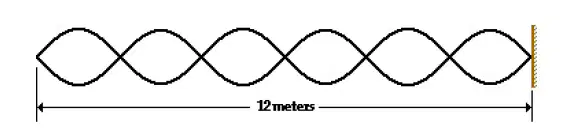
Consider the standing wave pattern shown below. A wave generated at the left end of the medium undergoes reflection at the fixed end on the right side of the medium. What is the number of antinodes in the diagram?
3
5
6
7
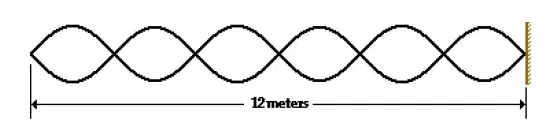
The standing wave pattern in the diagram is representative of the ... overtones
Third
Fifth
Sixth
Seventh
The distance between nearest nodes to antinode in any standing wave pattern is equivalent to ____ wavelengths.
half
quarter
twice
triple
A node is a point along a medium where there is always ...
A crest meeting a crest
A trough meeting a trough
Constructive interference
Destructive interference
A stretched string vibrates with a fundamental frequency of 100. Hz. The frequency of the first overtone is ...
25 Hz
50 Hz
100 Hz
200 Hz
..... wave is a result of interference in which portions of the wave are at the rest position and other portions have a large amplitude.
Reflected
Refracted
Standing
Transverse
A string is plucked producing four loops (antinodes). The length of the string is 12.00 m. The wavelength of the wave must be ...
48.0 m
24.0 m
6.0 m
3.0 m
Standing waves are produced in a wire by vibrating one end at a frequency of 100. Hz. The distance between the 2nd and the 5th nodes is 60.0 cm. The wavelength of the original traveling wave is ____ cm.
50
40
30
20

