
Font size
 Worksheets
Unit 1: Biochemistry
Total questions: 24
Worksheet time: 6hrs 0mins
A student conducted an experiment to determine if the amount of water added to a plant affected its growth. Amount of water added was measured in mL per day and plant growth was measured in cm. What is the independent variable?
Water added
Amount of sun
Type of plant
Plant growth in cm
A student conducted an experiment to determine if the amount of water added to a plant affected its growth. Amount of water added was measured in mL per day and plant growth was measured in cm. What is the dependent variable?
Water added
Amount of sun
Type of plant
Plant growth in cm
Which of the following characteristics of living things best explains why birds fly south for the winter?
Living things respond to their environment
Living things are made up of cells
Livings things have DNA
Living things maintain homeostasis
Living and non-living things can display characteristics of life. Both a fast-moving stream and a dog have some characteristics of life, but what characteristic of life is why a dog is considered alive and a stream isn’t?
The ability to grow and develop
Being able to change over time
The ability to move
Being made of cells
The mouth, stomach, and intestines work together to do a specific job. This is an example of?
Organ
Organ System
Cell
Tissue
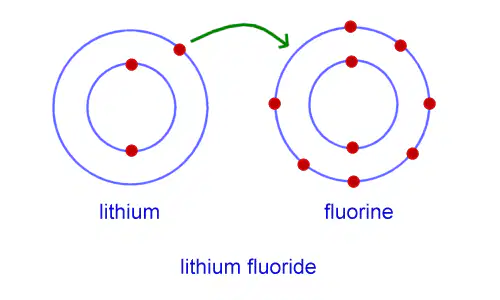
A covalent bond gets its name from the fact that two atoms share (co-) outer electron rings (valent). Based on this image, why is the bond NOT a covalent bond?
The two atoms are attracted electrically, making it a hydrogen bond
The lithium and fluorine are not sharing the electron - it is an ionic bond
Lithium is an alkali metal, thus it would be a metallic bond
Fluorine atoms cannot form covalent bonds
Using the pH scale, what is the best explanation as to why a substance has a pH of 9.5?
This substance is an acid
This substance has excess hydroxide (OH-) ions
This substance is considered as pure water
This substance has excess hydrogen (H+) ions
Which of the following chemical compounds represents an organic molecule?
LiFl
CuSO4H2O
CH4
H2O
Examine the list below and identify the correct pairing of a macromolecule and its function?
Nucleic Acid - stores genetic information
Lipid - enzymes
Protein - primary source of energy for the body
Carbohydrate - used for building muscle
Josh is a sprint runner. Before the race, Josh eats Gatorade chews and a candy bar that contains carbs, proteins, and lipids. He also makes sure to drink plenty of water. Which of the following would most likely be Josh’s source of stored energy so Josh can finish the whole race?
Lipid
Water
Carbohydrate
Protein
What is special about how carbon bonds that makes it essential to life?
Carbon atoms form ring structures each time they bond.
Carbon has the ability to bond with no more than one other carbon atom
Carbon has the ability to form up to four bonds.
Carbon containing compounds must contain double bonds.
The element sulfur can be found in simple, non-living substances, such as air and in complex molecules in living organisms, such as DNA. Which statement explains why nitrogen can exist in many compounds?
Nitrogen atoms can bond to different atoms
Sulfur atoms have different amounts of energy
Sulfur atoms are different sizes
Sulfur atoms are different ages
Which mechanism is not an example of a positive feedback mechanism in the human body?
Release of chemicals during labor
Contracting muscles
Blood clotting when you get hurt
Regulating blood pressure
Why is sweating an effective way to cool the body?
Evaporating water absorbs excess heat from the skin
Condensing water absorbs excess heat from the skin
Condensing water releases excess heat to the skin
Evaporating water releases excess heat to the skin
How does an enzyme influence a biological reaction to help maintain homeostasis?
It decreases the activation energy necessary to initiate the chemical change
It decreases the kinetic energy of reactants
It increases the net energy difference between reactants and products
It increases the kinetic energy of reactant
The enzyme lactase breaks down the sugar lactose. Which choice would best illustrate a negative feedback loop as it relates to this process?
Enzyme activity slows down as substrate concentration runs low
Lactase will only bond at the active site on the enzyme
Enzyme activity speeds up as substrate concentration runs low
Enzyme activity slows down as substrate concentration increases
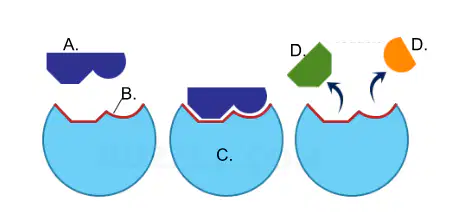
In the diagram below, which of the following is the enzyme?
A
B
C
D
In the diagram below, which of the following is the substrate?
A
B
C
D
The temperature optimum for an enzyme is 37°C. What will most likely happen if you idecrease the temperature from 37°C to 0°C?
The enzyme activity will increase
The enzyme activity will decrease
The enzyme activity will stay the same
Select all of the statements below that would be examples of feedback mechanisms within human bodies designed to maintain homeostasis?
A human bleeds after falling down
Pancreas releases insulin when blood sugar rises above healthy levels
Humans shiver when their body temperature begins to drop below healthy levels
A human growing from a baby to a toddler
You jump at the sound of a train horn
What two properties of water allow water to travel from the roots of a plant to the top of the plant?
Cohesion
Density
High specific heat
Adhesion
Photosynthesis
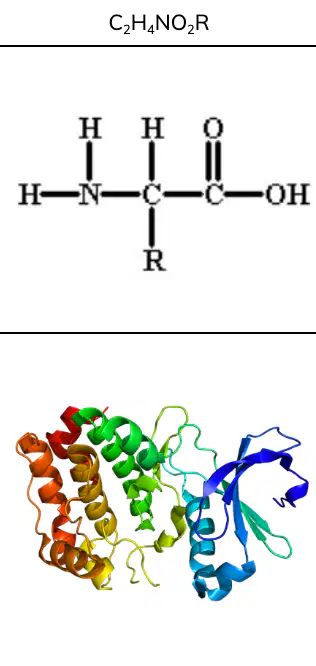
What macromolecule is shown here?
Carbohydrate
Lipid
Protein
Nucleic Acid
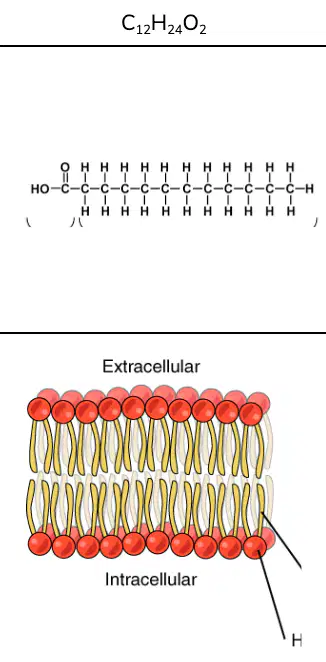
What macromolecule is shown here?
Carbohydrate
Lipid
Protein
Nucleic Acid
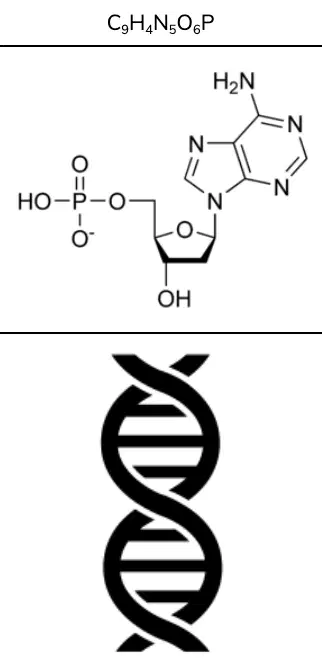
What macromolecule is shown here?
Carbohydrate
Lipid
Protein
Nucleic Acid

